Hermès Evelyne vs Picotin: Which Has Better Market Liquidity?
A platform-by-platform secondary market analysis — resale recovery rates, size dynamics, SA signal quality, and which non-quota bag better serves the spend ratio strategy in 2026.
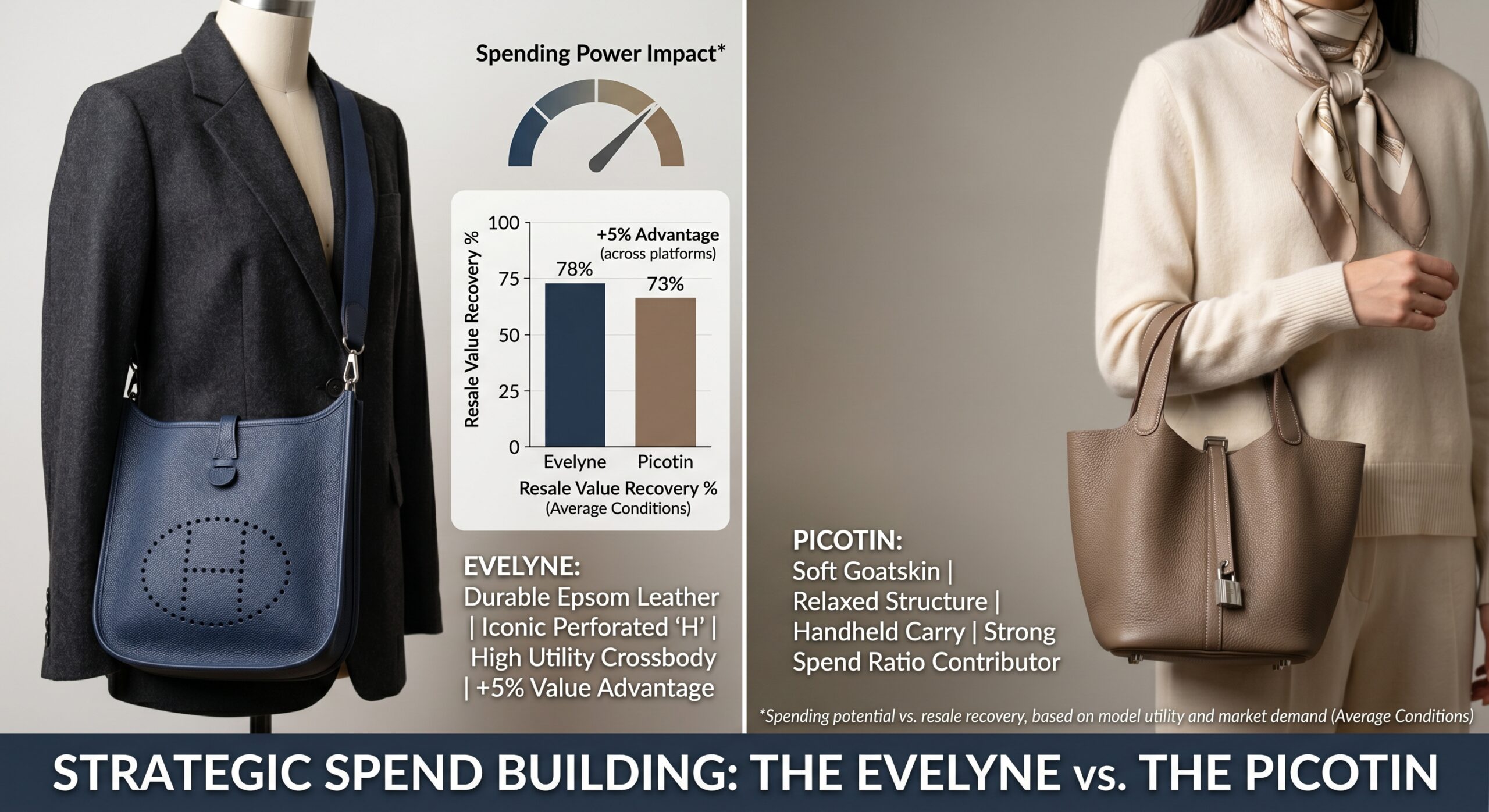
On Fashionphile in 2026, an Evelyne PM in Noir Epsom in excellent condition recovers approximately 88–93% of its retail purchase price. The equivalent Picotin 18 in Noir Clemence in equivalent condition recovers approximately 83–89%. The price delta between these two is approximately 5 percentage points — meaningful in a tier where the correct investment metric is resale recovery rate rather than above-retail premium, and where the difference between 88% and 83% recovery translates directly to how much the spend ratio purchase costs in real capital terms over a 12–24 month holding period.
The Evelyne and Picotin are the two strongest non-quota Hermès bag styles for buyers using the sub-$3,000 tier strategically — whether for spend ratio building toward a first Birkin or Kelly allocation, or for buyers who want a genuine Hermès bag at a more accessible price point with above-average resale recovery among non-quota styles. Neither trades above retail; neither produces the investment return of a quota bag. But between the two, the Evelyne consistently delivers better liquidity, stronger resale recovery, and a more versatile spend ratio signal — and understanding why allows buyers to make the marginal purchase decisions that add up to meaningful differences in total cost of non-quota ownership.
The Non-Quota Liquidity Framework
The liquidity analysis for non-quota Hermès bags operates on a fundamentally different investment framework than the quota bag analysis. Where Birkin and Kelly investors measure price-to-resale ratio (pieces that trade above retail), Evelyne and Picotin holders measure resale recovery rate (pieces that trade near but below retail). The correct question for non-quota bags is not "how much above retail can this achieve?" but "how close to retail can this recover, and how quickly?" — because these are the two metrics that determine the real capital cost of using non-quota purchases as spend ratio tools.
The full spend ratio strategy framework — including how non-quota purchases contribute to SA relationship building and quota bag allocation — is covered in our Hermès Iconic Collections hub and our dedicated entry-level bags guide. Within that framework, the Evelyne and Picotin compete directly for the role of primary non-quota bag purchase — and the liquidity comparison between them is the most practically relevant analysis for any buyer making this decision.
A buyer who purchases an Evelyne PM for $2,100 and recovers $1,890 (90%) at resale after 18 months has effectively paid $210 for 18 months of spend ratio contribution, SA relationship maintenance, and daily use of a genuine Hermès bag. A buyer who purchases a Picotin 18 for $1,800 and recovers $1,500 (83%) has paid $300 for equivalent benefits. The Evelyne costs more to buy but less to hold — because its recovery rate offsets more of the purchase price at exit.
Multiplied across several non-quota purchases over a 24-month relationship building period, the recovery rate differential compounds into a meaningful difference in total spend ratio cost. The Evelyne's liquidity advantage is not cosmetic — it directly affects how much the quota bag relationship costs in real capital terms before the first Birkin or Kelly offer is made.
The SA signal dimension adds a further differentiating factor. Both the Evelyne and the Picotin contribute equivalent absolute spend amounts to the spend ratio — a $2,100 Evelyne and a $2,100 Picotin produce the same dollar contribution to purchase history. But the SA's perception of which piece was purchased carries a subtle qualitative dimension: the Evelyne's perforated H design — an iconic, specifically Hermès-branded visual element — signals engagement with the brand's design vocabulary in a way that the Picotin's more generic bucket tote format does not quite replicate. The size demand dynamics that explain this pattern are consistent with the broader analysis in our guide to which Hermès bag sizes have the highest resale demand in 2026.
Evelyne vs Picotin: Head-to-Head Metrics
The head-to-head comparison across six primary metrics produces a consistent picture: the Evelyne leads on resale recovery, liquidity, condition durability, and SA signal quality. The Picotin leads on price point (lower entry cost) and lifestyle utility for buyers who specifically need an open tote format for daily carry. Neither win is trivial — the Picotin's lower price point is a genuine advantage for buyers with more modest initial budgets, and its open tote utility is genuinely different from the Evelyne's crossbody.
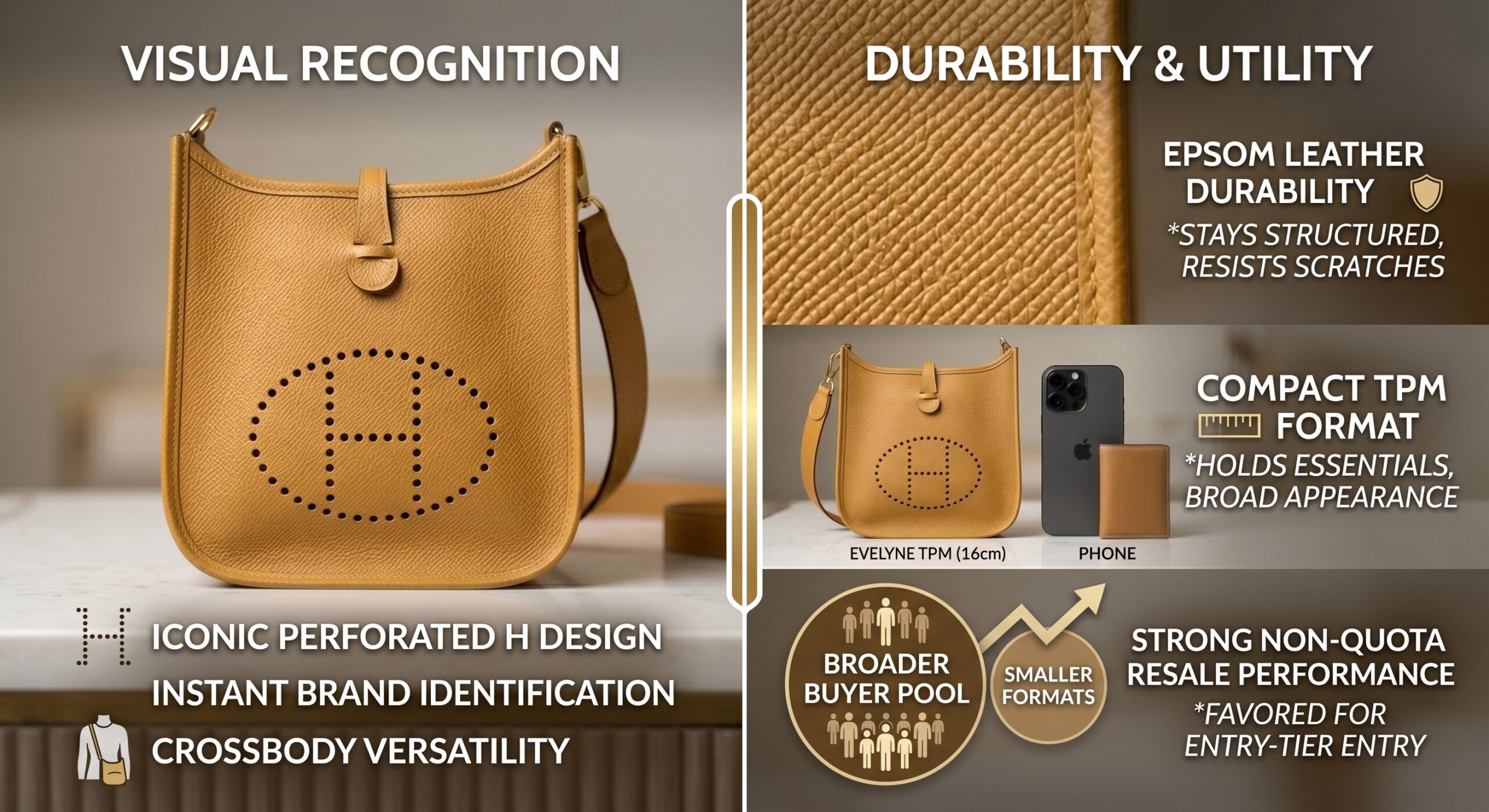
The condition durability dimension is worth examining specifically. The Evelyne is predominantly produced in Epsom leather — Hermès's most durable, most scratch-resistant, and most condition-stable standard leather. An Evelyne that has been carried daily for 18 months in Epsom will typically present in Excellent condition at resale with minimal conditioning needed. The Picotin is predominantly available in Clemence — a softer, more open-grain leather that is significantly more susceptible to base deformation, surface scuffing, and the handle darkening that affects non-quota bags in daily use. The condition at resale is therefore partially a function of leather type independent of care practices, and Epsom's durability advantage consistently produces better condition grade assessments for Evelyne pieces than Clemence-typical Picotin pieces under equivalent carry conditions.
"The Evelyne's Epsom leather produces better resale condition grades under equivalent daily carry than the Picotin's Clemence — a durability advantage that compounds into a real recovery rate difference at exit without requiring any additional care effort."
- For buyers whose primary objective is resale recovery and spend ratio efficiency: the Evelyne TPM or PM in Noir or Etain Epsom is the optimal non-quota purchase choice across all evaluation criteria.
- For buyers who specifically need an open top tote for functional daily carry: the Picotin 18 in a neutral Clemence colour is the correct choice — the format difference is genuinely functional, not merely aesthetic, and utility must be part of any spend ratio purchase decision.
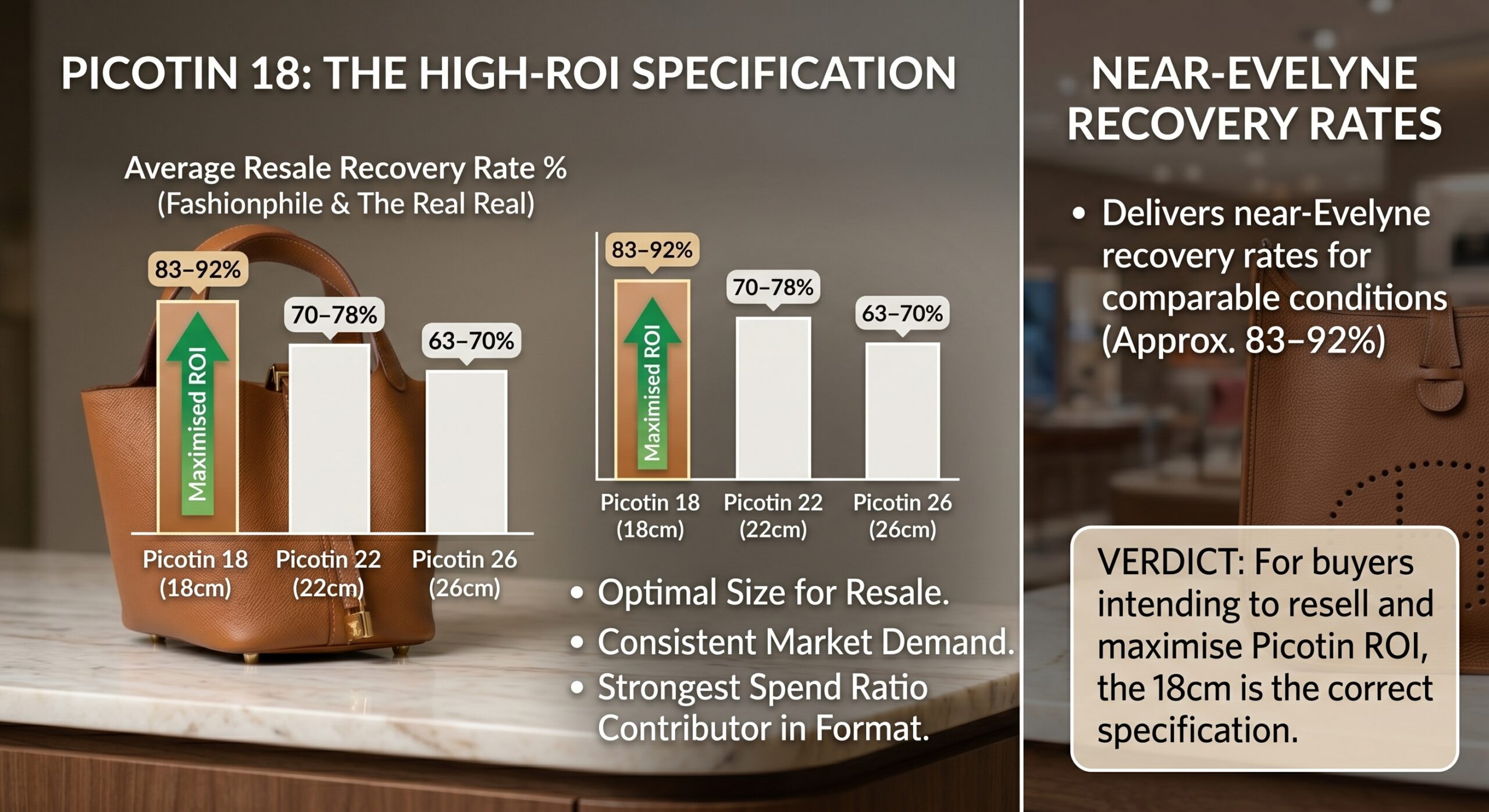
- For buyers considering the Picotin 22: the larger size underperforms the 18 by approximately 8–10 percentage points at resale recovery and should be avoided if resale recovery is a priority. The 18 is the only Picotin size that delivers near-Evelyne-level recovery.
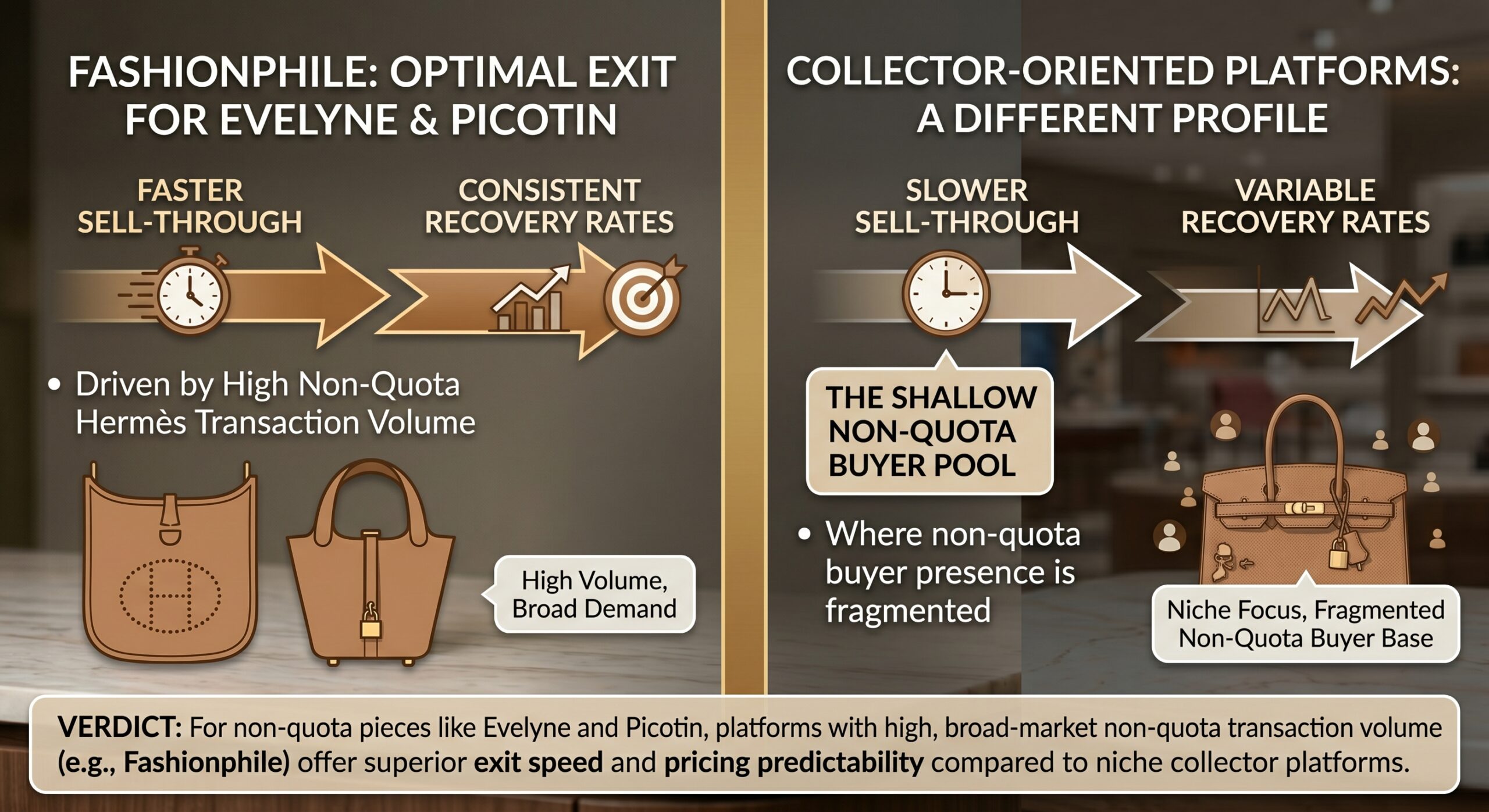
- Platform selection at exit is more uniform for the Evelyne than for the Picotin — Fashionphile handles both sizes well; Vestiaire Collective and The Real Real perform similarly. For the Picotin 22, Fashionphile produces slightly better recovery than The Real Real due to its buyer pool composition.
Size Dynamics: Which Variants Recover Best
The size demand dynamics that favour smaller Birkins and Kellys apply with equal consistency to the non-quota tier — the Evelyne TPM outperforms the PM, and the PM outperforms the GM at resale recovery rates. The Picotin 18 outperforms the 22 by an even more significant margin. Understanding the size hierarchy within each style allows buyers to specify the correct size for resale optimisation at the point of boutique purchase.
The Evelyne TPM's outperformance of the PM at resale is consistent with the broader small-format demand dynamic — but it is worth noting that the TPM's lower retail price means the absolute dollar recovery is also lower, even at a higher percentage rate. A buyer choosing between the TPM ($1,500 retail, 92% = $1,380 recovered) and the PM ($2,100 retail, 90% = $1,890 recovered) is giving up $510 in absolute dollar recovery by choosing the TPM, despite the higher percentage. The choice between sizes should balance percentage recovery against absolute dollar recovery — and the PM's combination of the highest absolute dollar recovery and very strong percentage recovery makes it the optimal single Evelyne size for most spend ratio buyers.
For the Picotin, the 18cm is unambiguously the better resale choice — it outperforms the 22 by approximately 8 percentage points in recovery rate and by significantly more in absolute dollar terms. There is no scenario where the 22 outperforms the 18 at resale, and the size difference in daily utility (the 22 holds somewhat more but is meaningfully larger) rarely justifies the resale sacrifice. Always specify the Picotin 18 over the 22 for any buyer who intends to resell.
Strategic Application: Spend Ratio and Exit Planning
The Evelyne and Picotin serve different strategic functions within the spend ratio framework depending on where a buyer is in their boutique relationship and how they intend to use the piece during the holding period. Understanding these functional differences allows buyers to sequence their non-quota purchases in a way that maximises both spend ratio contribution and resale recovery simultaneously.
The Evelyne's crossbody format makes it genuinely wearable across a wider range of daily carry contexts than the Picotin — from structured office environments to casual weekend use. This carry breadth increases the frequency with which the bag is actually used, which serves the spend ratio strategy: a piece that is carried regularly to boutique visits, SA interactions, and daily contexts generates more natural conversation opportunities about the brand than one that sits unused. The lifestyle and aesthetic dimension of each format — which contexts each works best in, how they read in different settings — is explored in depth by the design team at Hermès Guidance Lounge's Evelyne vs Picotin style guide.
- For first non-quota purchase: the Evelyne PM in a neutral Epsom colour — Noir, Etain, or Gold — is the optimal single choice. It maximises resale recovery, SA signal quality, and carry versatility simultaneously.
- For second non-quota purchase after an Evelyne: consider the Picotin 18 in a complementary colour or the silk carré, depending on budget. The Picotin adds format diversity to the purchase history and demonstrates engagement with a different product line.
- Exit timing for non-quota pieces: hold for a minimum of 12 months before listing — this allows Hermès price increases (typically 7–12% annually) to partially close the recovery gap, as the retail price floor rises while secondary market prices adjust. An Evelyne purchased at $2,100 in early 2025 and listed in early 2026 after a price increase may find the retail price has risen to $2,300 — making its $1,890 recovery 82% of current retail rather than 90% of original purchase, but still a reasonable outcome.
- Platform for exit: Fashionphile is the most reliable exit platform for both the Evelyne and the Picotin — its high transaction volume for non-quota Hermès pieces produces faster sell-through than Vestiaire or 1stDibs, where collector buyer pools are less engaged with non-quota styles.
- Condition at exit: the condition grade delta between excellent and good at this tier is approximately 10–12% of recovery — equivalent to the difference between the Evelyne's advantage over the Picotin. Maintaining excellent condition through the holding period is as valuable as choosing the right bag to begin with.
The complete strategy for sequencing non-quota purchases toward a first quota bag offer is covered in our Hermès wish list strategy guide and our broader guide to which Hermès bag styles hold their resale value best in 2026. The All Topics archive at the Hermès Advisory Forum provides the complete market intelligence context for every stage of the Hermès acquisition and holding strategy.
| Metric / Size Variant | Evelyne TPM | Evelyne PM | Picotin 18 | Picotin 22 |
|---|---|---|---|---|
| Retail Price (approx.) | $1,500–$1,900 | $2,000–$2,500 | $1,400–$1,900 | $1,700–$2,200 |
| Resale Recovery (Fashionphile) | 90–95% | 88–93% | 83–92% | 75–85% |
| Liquidity (sell-through speed) | Fastest | Fast | Moderate | Slower |
| Primary Leather | Epsom (most durable) | Epsom (most durable) | Clemence / Togo | Clemence / Togo |
| Condition Grade Risk | Low — Epsom resilient | Low — Epsom resilient | Moderate — Clemence softer | Moderate — plus base sag risk |
| SA Relationship Signal | High — iconic H design | High — iconic H design | Good — bucket format | Good — bucket format |
| Best Exit Platform | Fashionphile | Fashionphile | Fashionphile · TRR | Fashionphile |
| Overall Verdict | Best % recovery | Best absolute recovery | Strong — only 18cm | Avoid — resale penalty |
Resale recovery figures are approximate and reflect observed patterns for excellent condition pieces in neutral colours on Fashionphile. Actual outcomes depend on specific colour, condition, and market timing. All retail price figures reflect approximate 2026 US market ranges.
Evelyne for Maximum Recovery — Picotin 18 When the Format Is Genuinely Needed
The secondary market data produces a clear liquidity verdict: the Evelyne outperforms the Picotin on every metric that matters for buyers using non-quota purchases as spend ratio tools — resale recovery rate, sell-through speed, leather durability, and SA relationship signal quality. The Evelyne PM in neutral Epsom is the optimal single non-quota purchase for buyers building toward a first Birkin or Kelly allocation, and the Evelyne TPM delivers the strongest percentage recovery of any non-quota Hermès bag in the entry tier.
The Picotin 18 is not a poor choice — it is the correct choice for buyers who genuinely need the open tote format for daily functional carry that the Evelyne's crossbody does not replicate, or for buyers whose budget is better suited to the Picotin's lower price point. Within the Picotin range, the 18cm is the only variant worth specifying for buyers who prioritise resale recovery — the 22cm underperforms by approximately 8–10 percentage points and should be avoided when recovery is a consideration.
The most impactful decision within this comparison is not Evelyne versus Picotin but small versus large within each style. The Evelyne TPM outperforms the GM by approximately 12 percentage points; the Picotin 18 outperforms the 22 by a similar margin. The size dynamics that favour compact formats across the full Hermès range operate with equal force in the non-quota tier — and the buyer who specifies the smallest functional size in either style will always achieve meaningfully better resale outcomes than the buyer who defaults to the larger format.
Bottom Line: Buy the Evelyne PM in neutral Epsom for maximum recovery and SA signal quality — or the Picotin 18 if the open tote format is genuinely needed — and always specify the smallest size that meets your functional requirements to maximise resale recovery at exit.
Popular Searches
Explore our most searched Hermès entry-level liquidity and spend ratio questions
Frequently Asked Questions
The Hermès Evelyne delivers better resale recovery than the Picotin across all size variants and all four major resale platforms in 2026. The Evelyne TPM and PM consistently recover approximately 88–95% of purchase price in excellent condition on Fashionphile, compared to the Picotin 18's 83–92%. Both are non-quota styles that do not trade above retail, but the Evelyne's crossbody format, iconic perforated H design, and Epsom leather durability produce a slightly broader and more engaged buyer pool. See our full entry-level strategy guide for the complete context.
The Evelyne TPM (16cm) consistently achieves the strongest resale recovery of any Evelyne size — approximately 90–95% of purchase price in excellent condition on Fashionphile — driven by the same small-format demand dynamics that favour the Birkin 25. The Evelyne PM (29cm) is the highest-volume Evelyne and delivers approximately 88–93% recovery with stronger absolute dollar returns. The Evelyne III GM (40cm) recovers approximately 78–88% — meaningful underperformance that mirrors the large Birkin vs small Birkin premium gap. Always specify the smallest size that meets your functional needs when prioritising resale recovery.
The Picotin resells at near-retail levels in excellent condition — approximately 83–92% of purchase price for the 18cm size on Fashionphile and The Real Real. This is a solid resale recovery for a non-quota Hermès style, but slightly below the Evelyne's equivalent performance. The Picotin 22cm underperforms the 18cm significantly — approximately 75–85% recovery. For buyers whose primary purpose is spend ratio building alongside daily utility, the Picotin 18 in a neutral Clemence colour is a sound choice with predictable near-retail exit.
Both are excellent first Hermès purchases for buyers building toward a quota bag allocation, but the Evelyne has a marginal edge as the strongest single first-purchase choice. The Evelyne TPM or PM in Epsom delivers better resale recovery, a stronger SA relationship signal, and more versatile carry across a wider range of contexts. The Picotin 18 is appropriate for buyers who genuinely need a relaxed open tote for daily use — its lower price point allows a more modest initial investment with comparable spend ratio contribution. See our Hermès wish list strategy guide for how first purchase choices signal collector intent to your SA.