Preventing Color Transfer on Light Hermès Leather: Proven Methods
The complete prevention guide for Craie, Nata, Gold, and Biscuit Birkins and Kellys — covering every colour transfer risk source, the behaviours that cause permanent staining, and the methods that actually prevent it.
A Hermès Craie Birkin 30 submitted to Fashionphile with visible denim dye transfer on the front panel will not receive a Pristine or Grade A assessment. The staining — typically a pale blue-grey tint visible under natural light on the white-toned leather — is permanent, irreversible, and noted explicitly in the grading report. No Hermès Spa treatment, no professional leather cleaning service, and no home remedy removes indigo dye that has bonded with light vegetable-tanned leather at the molecular level. The grade penalty for visible colour transfer on pale Hermès leather is approximately 20–35% of achievable resale price versus a clean equivalent — on a Craie Birkin 30 in current market conditions, that is a $3,000–$6,000 difference from a single afternoon carrying the bag while wearing dark jeans.
This is the defining characteristic of light Hermès leather ownership: the condition risks are asymmetric. Surface scratches on Togo or Epsom are unsightly but tolerable — they affect grade modestly and may buff partially with conditioning. Colour transfer on Craie, Nata, Gold, or Biscuit leather is catastrophic and permanent. The entire care strategy for light leather holders must be organised around this asymmetry — not as an afterthought, but as the primary decision framework that governs every carry context, outfit pairing, and storage choice.
This article covers the complete prevention system: every significant colour transfer source ranked by risk level, the leather vulnerability hierarchy among the most popular light Hermès colours, and the specific behavioural protocols that eliminate the avoidable colour transfer events that account for the vast majority of permanent staining incidents reported at resale platforms.
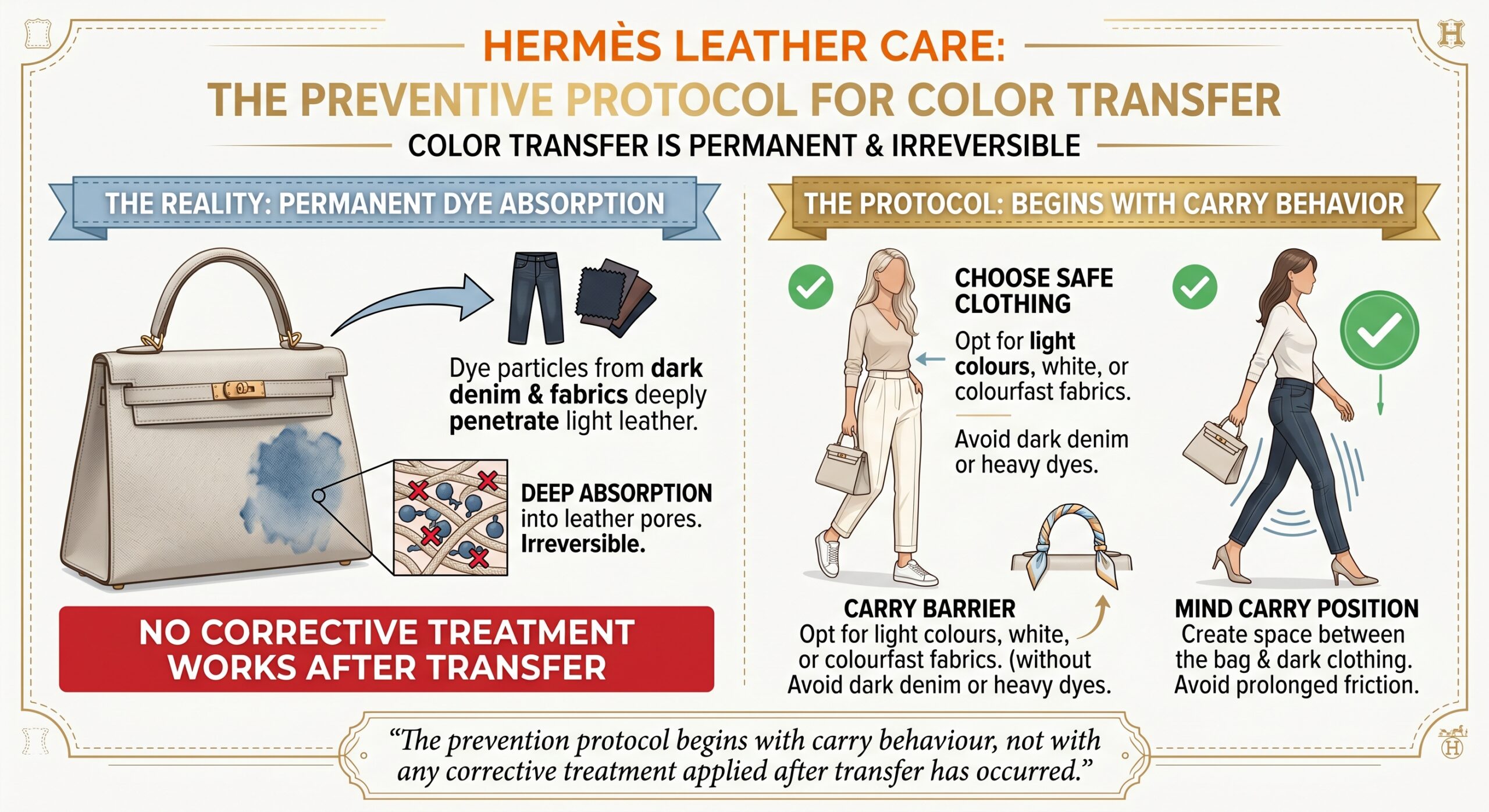
Why Colour Transfer Is Permanent — and the Resale Stakes
The permanence of colour transfer on light Hermès leather is a function of leather chemistry rather than cleaning methodology. When indigo dye or other fabric dye contacts leather, the dye molecules do not merely sit on the surface — they penetrate the leather's outer fibres and bond with the tanning agents that give the leather its structure. On darker leathers, this bonding is invisible because the transferred dye is of lower or similar value to the background colour. On light leathers — particularly the near-white tones of Craie, Nata, and similar pale colours — the dye contrast is immediately visible and the bonding occurs at a depth that surface-level cleaning cannot reach.
The full care framework for light leather is covered in the Hermès Care & Storage Guide, but the colour transfer dimension requires understanding the specific chemistry of why no corrective intervention works. The leather surface after tanning contains a complex structure of tanning agents, dyes, and surface finishes that are each chemically distinct. When an external dye penetrates this structure, it integrates into the tanning agent matrix in ways that neither water-based cleaning nor solvent-based cleaning can reverse without simultaneously degrading the leather itself. The precise chemistry behind how different dye types interact with vegetable-tanned and chrome-tanned leather surfaces is covered by the materials science team at Hermès Insights Hub's leather colour transfer chemistry guide.
All four major resale platforms photograph light-coloured Hermès pieces under multiple lighting conditions specifically to detect colour transfer that may be invisible under standard indoor lighting. Fashionphile's grading team uses a combination of overhead, angled, and raking light to identify any surface tinting or discolouration on pale leathers — including subtle transfer that the seller may not have noticed. The Real Real applies the same multi-light photographic process and explicitly notes "colour transfer" or "dye staining" as a condition descriptor in grading reports when detected.
On Vestiaire Collective, where sellers set their own condition grade, colour transfer that is not disclosed by the seller is typically detected by the authentication team after the sale and results in a condition correction — which can trigger buyer disputes and returns. Undisclosed colour transfer on Vestiaire represents one of the most common grounds for post-sale condition disputes on light leather pieces.
The resale stakes convert the prevention requirement into a straightforward financial calculation. A Craie Birkin 30 in Grade A or Pristine condition achieves approximately $18,000–$22,000 on Vestiaire Collective in 2026. The same piece with visible colour transfer is graded Excellent at best — more commonly Good — and achieves approximately $13,000–$16,000. The $5,000–$6,000 grade penalty from a single colour transfer incident dwarfs the entire care investment required to prevent it. Light leather ownership is not compatible with casual carry behaviour — the financial asymmetry is too severe to manage with anything other than consistent prevention discipline.
Colour Transfer Sources: Risk Ranked and Explained
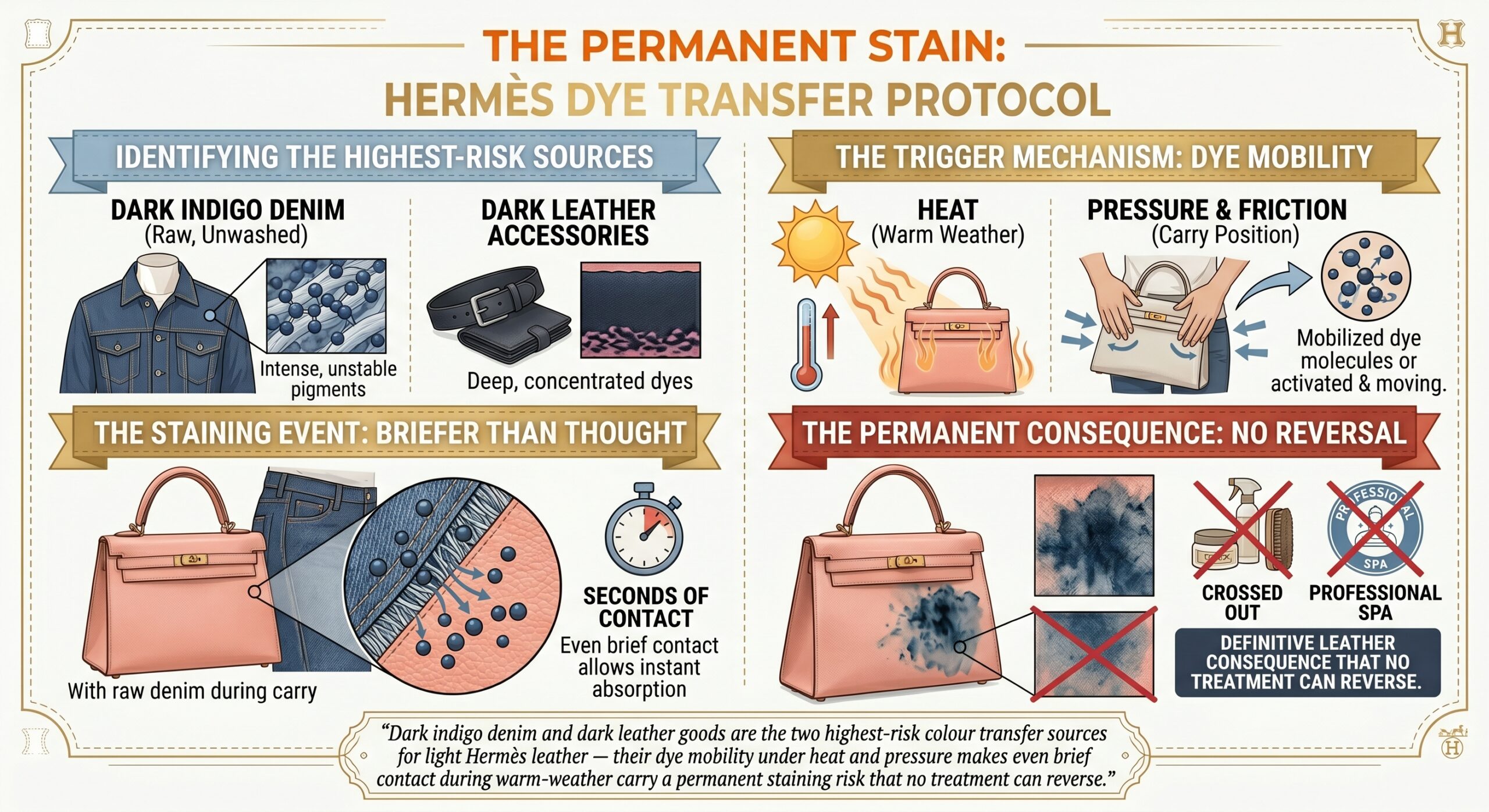
Colour transfer risk sources are not equally hazardous — they vary significantly by dye mobility, contact conditions, and leather exposure pattern. Understanding the risk hierarchy allows holders to concentrate prevention effort on the most dangerous sources rather than treating all risks equivalently.
"The denim rule for light Hermès leather is absolute — never place a pale Birkin or Kelly on a denim-covered surface, lap, or seat. The risk-to-consequence ratio is too severe for any contextual exception."
Leather Vulnerability: Which Light Colours Are Most at Risk
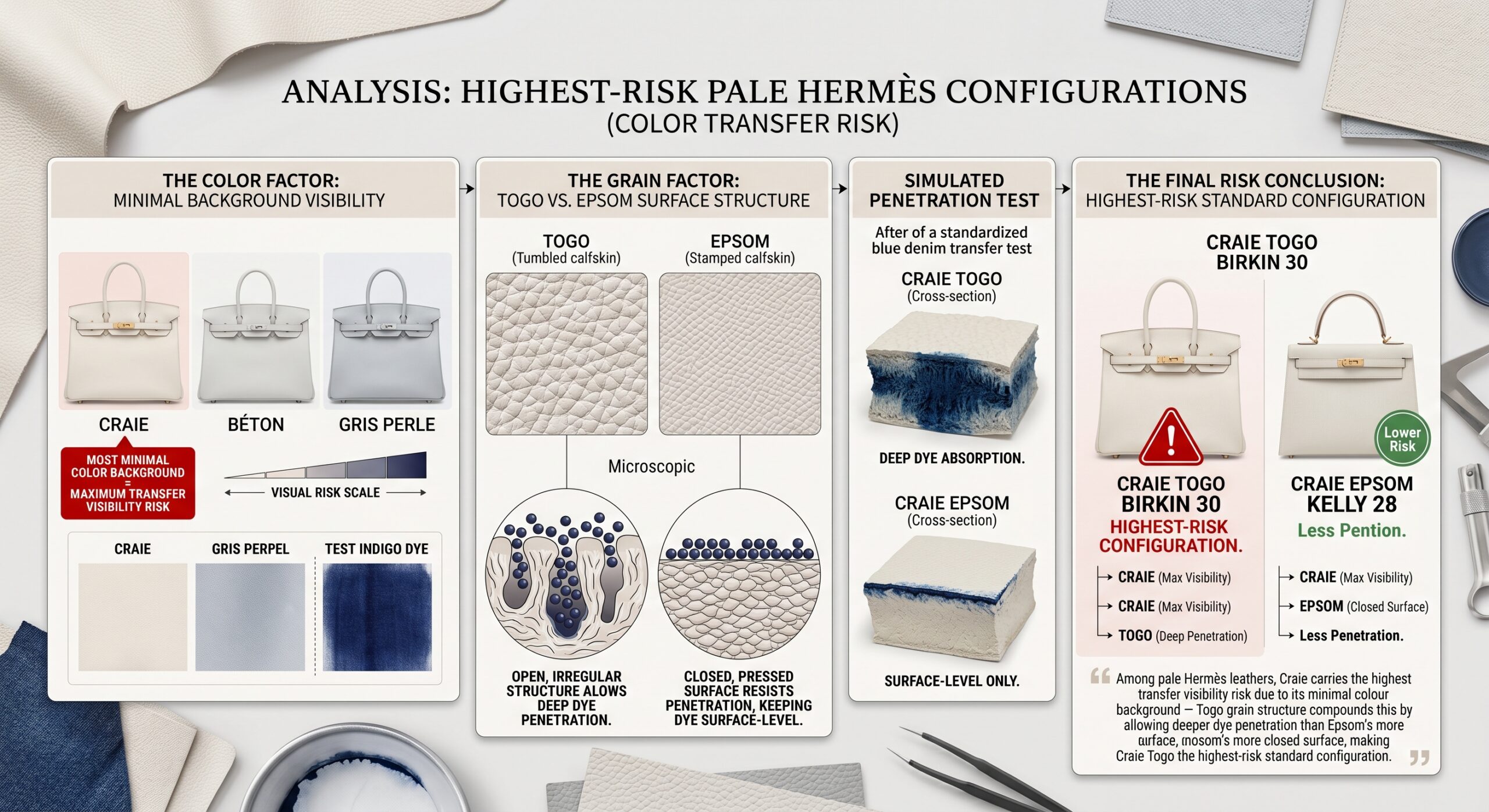
Not all light Hermès leather colours are equally vulnerable to visible colour transfer — the starting lightness of the leather determines how visibly any transferred dye reads against the background. But within the pale leather category, the surface treatment and grain structure of the specific leather also affects how deeply a transferred dye penetrates and how quickly it sets permanently.
The leather type interacts with the colour vulnerability to create a two-dimensional risk matrix. Within the critical-risk Craie colour, Togo leather is more at risk than Epsom leather — Togo's more open grain structure allows dye to penetrate more quickly and more deeply than Epsom's semi-treated, more closed surface. A Craie Togo Birkin and a Craie Epsom Birkin both carry critical colour transfer risk, but the Togo configuration sustains deeper bonding from a briefer contact than the Epsom under equivalent conditions. The durability comparison between these leathers in the context of daily use and care risk is covered in our guide to which Hermès leathers are most durable for daily use.
- Craie and Nata holders: apply the strictest possible prevention protocol to every carry session — these colours have essentially zero tolerance for transfer contact before visible staining results.
- Gold and Biscuit holders: the prevention protocol is equally important for blue-toned and black dye transfer; the warm background provides slight forgiveness for warm-toned transfers but not for cool or dark ones.
- The interior lining of any Hermès bag — regardless of exterior colour — is also subject to colour transfer from bag inserts and dark leather goods carried inside. Light-lined interiors need the same insert material standards as light exterior leathers.
- Vintage light-leather pieces are more vulnerable than current production equivalents — the leather surface treatment may have degraded over time, reducing whatever barrier the original finish provided against dye penetration.
The Complete Prevention Protocol
The prevention protocol for light Hermès leather is organised into three phases: carry behaviour (preventing transfer during active use), storage protocol (preventing transfer during storage), and emergency response (the immediate action after any suspected transfer contact that minimises but does not reverse damage).
The carry behaviour phase is where the majority of colour transfer events occur and where prevention effort is most consequential. The specific behaviours that eliminate the most significant transfer risks are straightforward once identified — the challenge is maintaining them consistently rather than understanding them intellectually.
- Never place a light leather bag on a denim-covered surface, lap, or seat — this is an absolute rule with no contextual exceptions. Even a brief lap placement during warm weather with dark jeans creates transfer risk. Use the bag base on a clean, light surface or hold it by the handle.
- Never place a light leather bag on dark upholstered seating — car seats, restaurant banquettes, and upholstered chairs in dark leather or fabric are transfer risks, particularly when warm. Always place the bag on a light surface, your own lap with light-coloured clothing, or on a bag-safe surface in a pochette or pouch.
- Carry with a light-coloured clothing barrier — when wearing dark jeans or dark clothing, ensure that light clothing (a cream or white top, a scarf draped over the lap) provides a barrier between your clothing and the bag's contact surface. Never allow the bag exterior to rest directly against dark-dyed clothing for extended periods during carry.
- Avoid dark leather goods in the same bag interior — black wallets, dark leather card holders, and dark leather accessories should be kept in a separate light-coloured pouch rather than loose inside the light leather bag where they can rub against the lining.
- For Twilly on light leather handles: always perform the colour fastness test before using any Twilly on pale-handled Kellys — as covered in our Twilly Kelly handle tying guide. A dye-unstable Twilly in a deep colour is itself a transfer source if the silk becomes damp.
- Bag base protectors: for daily carry of light leather Birkins, a felt or Alcantara base protector — not a dark plastic or rubber one — placed between the bag base and any seating surface eliminates the lap and seating transfer risk entirely. Combined with the bag insert covered in our Birkin 30 bag insert guide, this provides full base protection from both structural and colour transfer risks simultaneously.
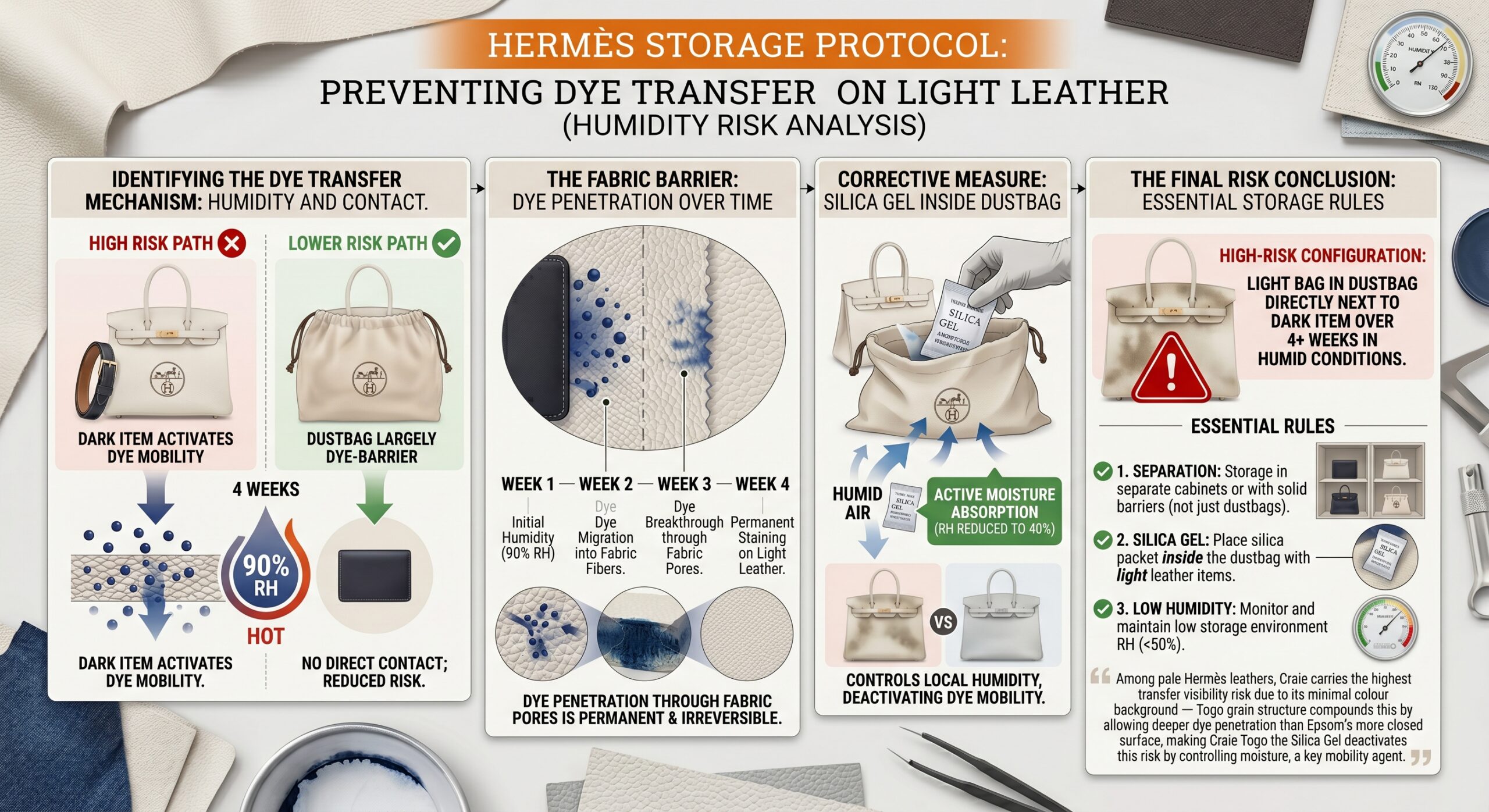
The storage protocol is simpler but equally important. Store light leather bags away from dark leather goods — do not share a wardrobe shelf where dark leather accessories can rest against the light leather dustbag. The dustbag provides some protection but is not impermeable; sustained pressure of a dark leather item against the dustbag over weeks can eventually transfer dye through the fabric. Maintain silica gel inside the dustbag for light leather bags in humid climates — humidity increases dye mobility and accelerates transfer for any contact that does occur. The full humidity storage approach is covered in our guide to storing Hermès bags in high humidity.
The emergency response for suspected transfer contact is brief air exposure and gentle surface inspection — never aggressive rubbing, which drives the dye further into the leather surface. If contact has occurred, the leather should be gently blotted (not rubbed) with a clean dry white cloth, then allowed to air in a cool, dry environment. Contact the Hermès Spa immediately for professional assessment — while Spa treatment cannot reverse dye bonding, early intervention occasionally reduces the visible severity of fresh transfer before full bonding has occurred. The full Spa service context is available in our guide to Hermès Spa treatment cost, wait time, and when it's worth it.
| Transfer Source | Risk Level | Reversibility | Prevention Method | Grade Impact if Occurs |
|---|---|---|---|---|
| Dark indigo denim (new/light wash) | Critical | Permanent — irreversible | Never place bag on denim surface | −20–35% vs clean equivalent |
| Black unlined leather goods (interior) | Critical | Permanent — irreversible | Pouch separation from lining | −15–30% (lining stain) |
| Dark upholstered seating (warm) | High | Usually permanent | Base protector or avoid contact | −15–25% |
| Saturated dark clothing (navy, black) | High | Usually permanent | Light clothing barrier during carry | −15–30% |
| Dyed bag insert (colour-unstable) | High (interior) | Permanent (lining) | Felt or Alcantara inserts only | −10–20% (lining grade) |
| Twilly with dye instability | Moderate–High | Usually permanent (handle) | Colour fastness test before use | −10–20% (handle grade) |
| Newspaper ink / printed materials | Moderate | Partial (surface level) | Pouch for paper items inside bag | −5–15% |
| Correctly selected neutral inserts | None | N/A — no transfer | Undyed felt or Alcantara only | No grade impact |
Grade impact percentages are approximate and reflect the additional condition grade penalty from colour transfer staining above any other wear present. Actual impacts depend on the visibility of the transfer, the specific platform grader, and the overall condition of the piece. All figures relate to light leather configurations (Craie, Nata, Gold) where transfer contrast is highest.
Prevention Is the Entire Strategy — There Is No Corrective Option
The most important characteristic of colour transfer on light Hermès leather is that it requires no corrective strategy — because no corrective strategy exists. The moment indigo dye bonds with Craie leather, the condition grade outcome is determined. Prevention is the only lever available to light leather holders, and it must be applied consistently — not selectively, not when convenient, not only when the risk is obvious. The denim contact that takes 30 seconds on a warm afternoon destroys the condition grade that a two-year holding period and careful daily care have built.
The prevention protocol is not onerous once the carry behaviour adjustments become habitual. The absolute rules — never place on denim, never rest against dark clothing, never share interior with dark unlined leather — each take seconds to observe once they are automatic. The storage protocol — separation from dark accessories, silica gel in the dustbag — adds no time to the daily routine once correctly configured. Together these interventions eliminate the avoidable colour transfer events that account for the vast majority of the permanent staining that arrives at resale platforms on light leather pieces.
Light leather Hermès bags command collector premiums on Vestiaire Collective and 1stDibs precisely because they are rare in Grade A condition — the demand exists for clean pale pieces because the supply of clean pale pieces is constrained by the number of holders who have maintained prevention discipline consistently across the holding period. That rarity premium rewards holders who protect correctly, making the prevention protocol not just a care obligation but a genuine return-generating investment decision.
Bottom Line: For light Hermès leather, prevention is the only strategy — apply the absolute rules for denim, dark fabric, and dark leather contact consistently, and the condition grade premium that pale leather commands at resale is preserved. Allow any exception, and the loss is permanent.
Popular Searches
Explore our most searched colour transfer and light Hermès leather care questions
Frequently Asked Questions
No — colour transfer from denim, dark fabrics, or dyed materials onto light Hermès leather is almost always permanent and irreversible. The dye molecules bond with the leather's tanning agents at a molecular level that surface cleaning cannot reverse. Hermès Spa treatment can address some surface contaminants (dirt, oil) but cannot extract dye that has bonded with the leather substrate. On light leathers such as Craie, Nata, and Gold, even a brief contact with wet denim can produce visible transfer that no professional intervention fully removes. Prevention is the only effective strategy. For the leather chemistry context, see the Hermès Insights Hub leather colour transfer chemistry guide.
Dark indigo denim is the highest single colour transfer risk for light Hermès leather — the indigo dye used in unwashed and lightly worn denim is highly mobile, particularly when damp with perspiration during warm weather carry. Black leather goods and dark-dyed fabrics in navy, deep burgundy, and saturated forest green are secondary risks. New dark clothing — before multiple washes remove excess surface dye — is significantly more hazardous than frequently washed equivalents. The risk increases substantially in warm, humid conditions that increase dye mobility and transfer speed.
Professionally applied leather protectors can reduce (but not eliminate) colour transfer risk on smooth and semi-treated leathers. On Epsom leather, a professional waterproofing treatment provides a surface barrier that slows dye penetration. On Togo and Clemence, the effect is less reliable due to the more open grain structure. Consumer spray products are not recommended for Hermès leathers — their formulations are not tested against Hermès tanning chemistry and can alter the leather surface permanently. Prevention through carry behaviour is more reliable than any protective treatment for light leather colour transfer. See our guide on which Hermès leathers are most durable for daily use for the full leather durability context.
Yes — significantly and permanently. Colour transfer staining on light Hermès leather is one of the condition grade penalties that most severely affects achievable resale price. A Craie Birkin with visible denim transfer will not receive a Grade A or Pristine assessment at any major platform — the staining is noted explicitly in grading reports and reduces the achievable price by approximately 20–35% versus a clean equivalent. The grade penalty from colour transfer is disproportionately large on pale leathers because the contrast makes staining immediately visible to buyers and platform graders under all lighting conditions. See our guide on which Hermès leathers are most durable for daily use for the full leather durability and condition grade context.