Hermès Chevre vs Epsom for Daily Use: Durability and Resale Impact
The complete durability and secondary market comparison — which leather holds condition grade better under daily carry, commands stronger resale premiums, and is the superior specification for investment-minded buyers in 2026.
A Birkin 30 in Chevre Mysore submitted to Fashionphile in Grade A condition achieves approximately 8–15% above the price of an equivalent Epsom Birkin 30 in the same colour and hardware configuration. This collector premium for Chevre over Epsom is not driven by superior durability alone — it is driven by relative scarcity, a distinctive visual signature, and the specific appreciation that collector-tier buyers on 1stDibs and Vestiaire Collective have developed for what many regard as the most refined of Hermès's standard calfskin alternatives. The durability advantage of Chevre is real and meaningful for daily carry; the resale premium it commands is an additional benefit that makes any Chevre offer from an SA worth accepting with particular enthusiasm.
Epsom, meanwhile, remains the most commercially ubiquitous and practically reliable daily-use leather in the Hermès range — its embossed, semi-treated surface is the closest thing to a maintenance-free option that the brand produces, and its consistent availability makes it the most common leather specification across standard boutique allocation. Epsom is not a lesser leather — it is a different engineering solution to the daily-use durability problem, one that prioritises surface treatment protection over the natural hide strength that Chevre offers.
This article covers the complete comparison: the structural basis for each leather's durability characteristics, the specific daily use conditions under which each performs better, and the measurable resale premium that Chevre commands over Epsom in 2026 across styles, sizes, and platforms.
Chevre and Epsom: What Makes Each Leather Distinctive
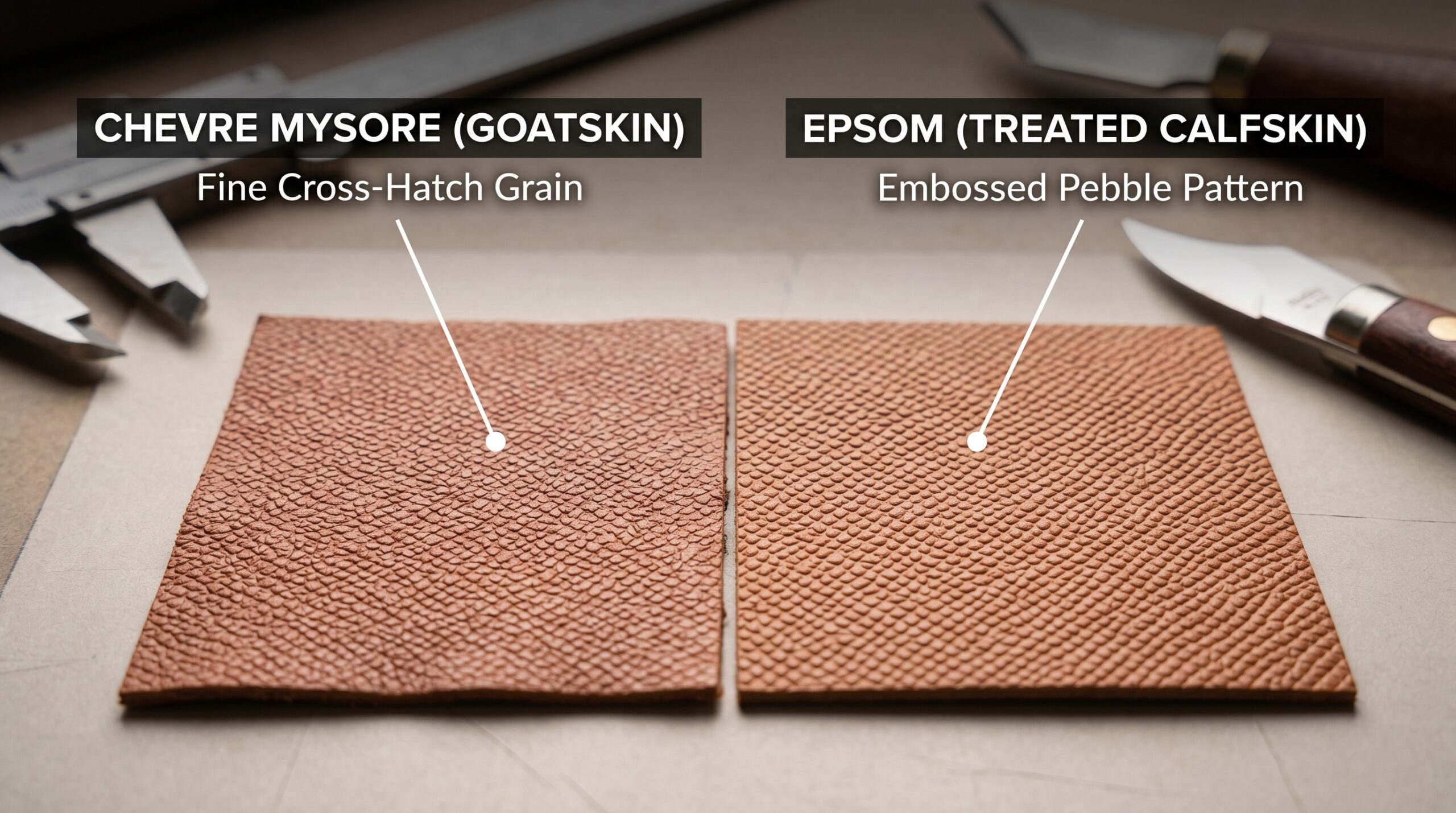
The fundamental difference between Chevre and Epsom is the animal source — and this difference cascades into meaningfully different structural properties, surface characteristics, and durability profiles. Chevre is goatskin; Epsom is embossed, treated calfskin. Understanding why these two source materials produce different leather behaviours is the foundation for the durability comparison and the resale premium analysis that follows.
The full leather types framework is covered in the Hermès Leather Types Guide, but the Chevre vs Epsom comparison requires specific attention to the grain structure difference. Goatskin has a naturally tighter, more uniform fibre bundle structure than calfskin — the result of the animal's more active lifestyle and the denser collagen network that this produces in the hide. This tight fibre structure is what makes Chevre naturally more resistant to surface abrasion than any calfskin equivalent, including embossed and treated variants like Epsom. The natural strength is intrinsic to the hide; it does not depend on any surface treatment to maintain. The precise leather science behind the grain structure differences between goatskin and embossed calfskin — including the specific fibre density measurements and abrasion resistance testing that quantifies the performance difference — is covered by the materials science team at Hermès Insights Hub's Chevre and Epsom leather science guide.
Epsom's embossed pebble pattern is applied mechanically to calfskin through a hot-press embossing process, then sealed with a surface treatment that gives it the light rigidity and moisture resistance that distinguish it from unembossed leathers like Togo or Clemence. The embossing and treatment together produce a surface that is highly uniform, very colour-stable, and resistant to both moisture and surface contamination. The trade-off is that the treatment is a surface intervention rather than a structural property — and a Chevre hide with no treatment at all may withstand comparable daily carry abrasion better than an Epsom with full treatment, because the goatskin's natural fibre structure is simply denser than the calfskin's.
Daily Use Durability: Head-to-Head Attribute Comparison
Daily use durability encompasses multiple independent attributes that do not all resolve in the same direction for either leather. The comparison below maps each attribute to the leather that performs better — and identifies the specific use conditions under which each advantage is most relevant.
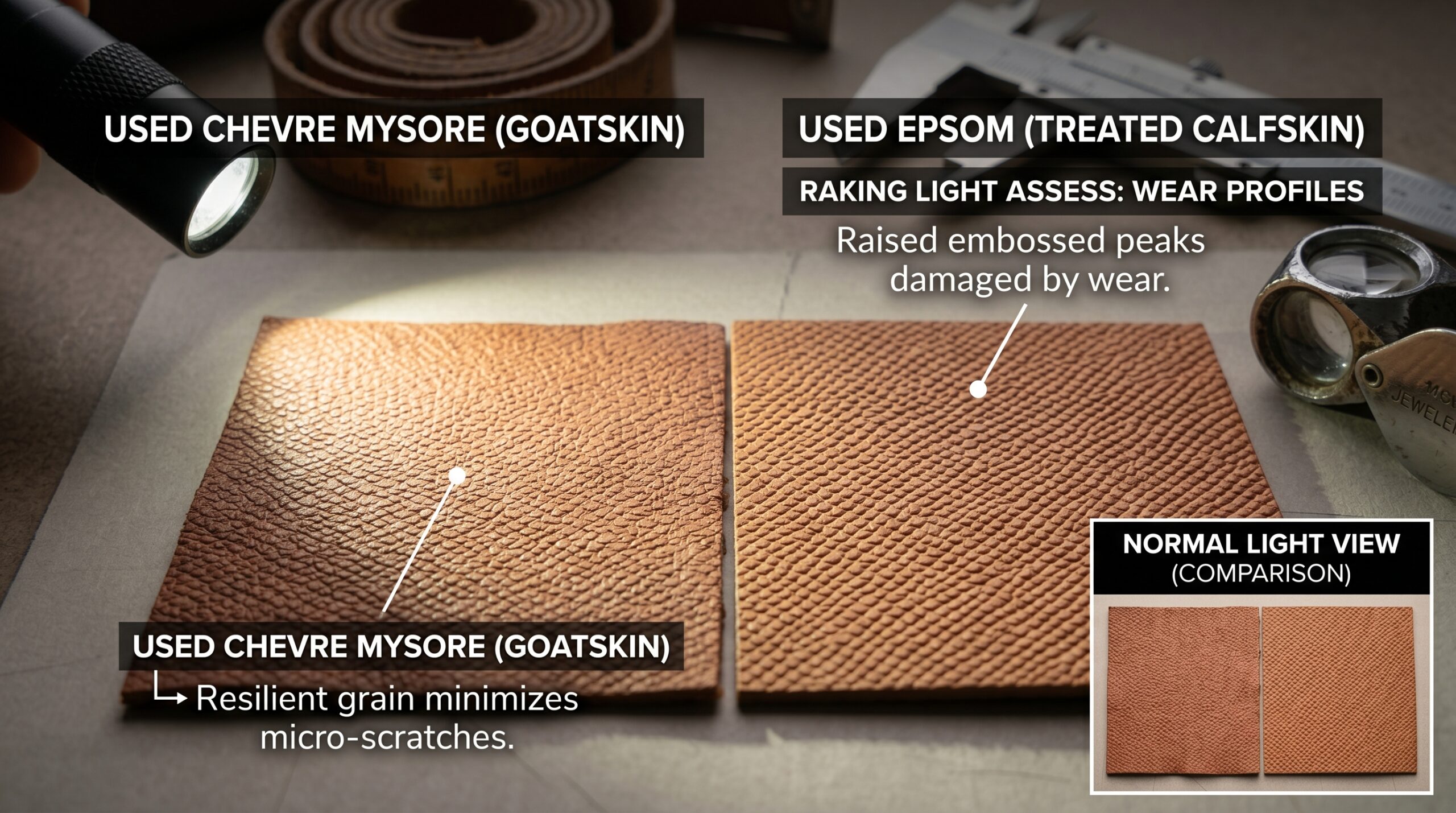
Fashionphile and The Real Real graders assess surface condition by running light across the leather at a low angle — raking light reveals micro-scratches, surface abrasion patterns, and any irregularities in the grain that indicate wear. Under this assessment, Chevre Mysore consistently shows fewer visible micro-scratches after equivalent carry periods than Epsom, because the natural grain structure resists micro-abrasion more effectively than the embossed surface treatment does under sustained contact.
Epsom's embossed pebble pattern can show wear at the raised peaks of the pebbles after heavy daily use — a characteristic that is visible under raking light and occasionally noted in grading reports as "light surface wear to raised grain." This wear pattern is specific to embossed leathers and does not occur on Chevre, whose natural flat grain structure does not have the raised peaks that wear preferentially under contact. The difference is not dramatic under most carry conditions, but it is visible and assessable by trained platform graders.
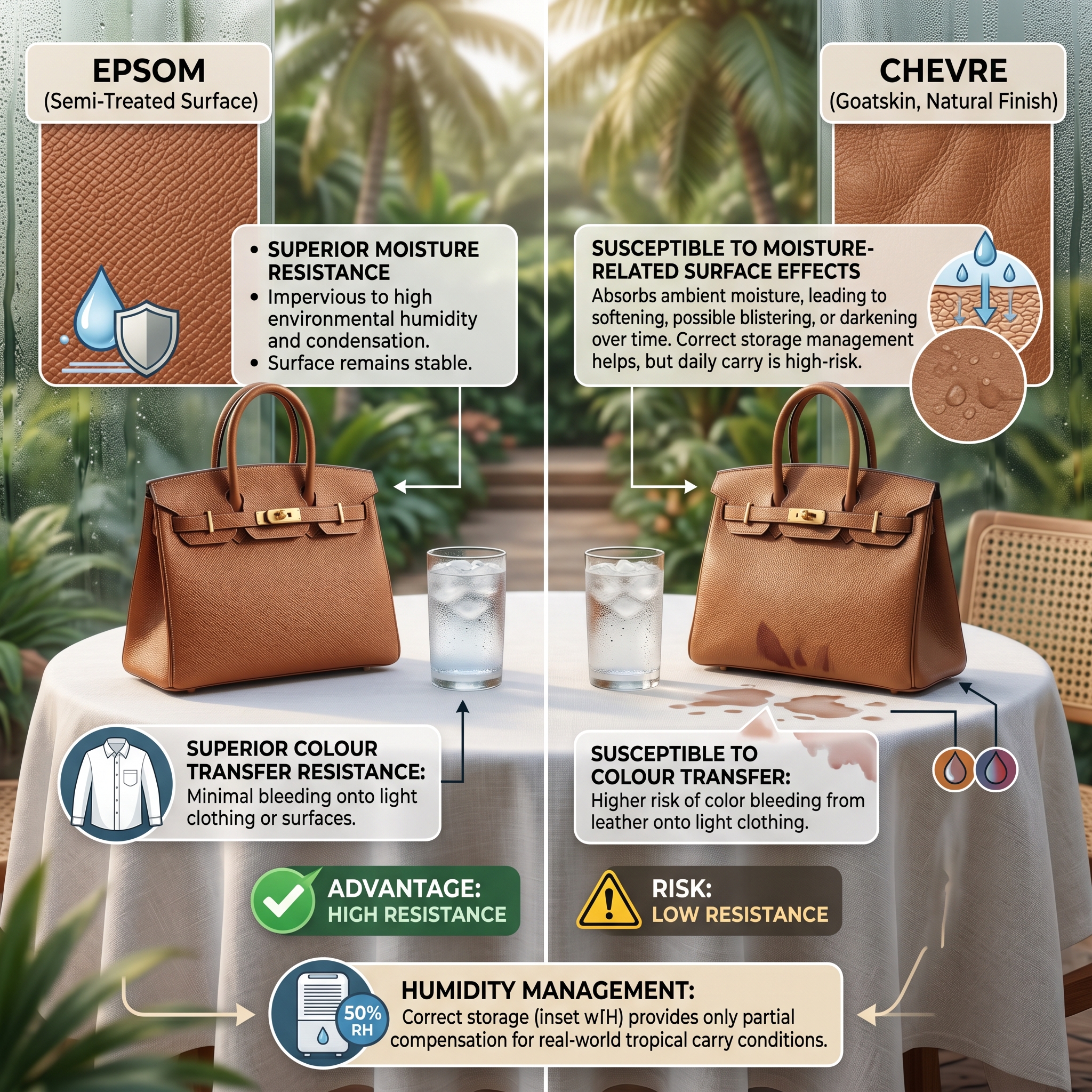
The climate dimension deserves specific attention for buyers in humid markets. In Southeast Asia, coastal regions, and tropical climates, Epsom's surface treatment advantage over Chevre is most consequential — the treatment significantly reduces moisture penetration and humidity absorption that affect Chevre's more natural surface in ways that the comprehensive guide to storing Hermès bags in high humidity addresses fully. Buyers in these climates should weight Epsom's moisture advantage more heavily than buyers in dry or temperate climates.
"Chevre's scratch resistance advantage is intrinsic — it comes from the hide itself and requires no maintenance. Epsom's moisture and transfer advantage requires no maintenance but can degrade if the surface treatment wears through under very heavy use."
Resale Impact: Which Leather Commands the Stronger Premium
The resale premium for Chevre over Epsom in equivalent configurations is one of the most consistent leather-level price deltas in the Hermès secondary market — more stable across the 2024–2025 correction than many size or hardware premiums, and more broadly recognised across collector and mainstream buyer pools than many other leather comparisons. Understanding why it exists and how to capture it optimally at exit provides the investment intelligence that turns a Chevre offer acceptance into a measurably better financial outcome.
The premium has three independent drivers. First, production scarcity: Chevre production is significantly more limited than Epsom, both in the volume produced per year and in the frequency with which Chevre appears in standard boutique allocation. Buyers who encounter a Chevre Birkin or Kelly offer are receiving a configuration that appears substantially less frequently than Epsom on the secondary market, creating the supply scarcity that drives collector premium pricing. Second, visual distinctiveness: Chevre Mysore's fine cross-hatch grain pattern is immediately recognisable and visually distinctive from both Epsom's mechanical pebble pattern and the organic textures of Togo and Clemence. Collector buyers who specifically seek Chevre know what they are looking for and pay for it. Third, the natural-versus-treated distinction: in an era where collector buyers increasingly value natural material properties over engineered surface treatments, Chevre's status as a leather whose durability comes from the hide itself rather than from embossing and treatment carries an intrinsic desirability that positions it closer to the collector end of the Hermès leather spectrum.
- The Chevre premium is strongest on 1stDibs and Vestiaire Collective — the collector platforms where buyers specifically seek distinctive leather configurations and are prepared to pay the scarcity premium. On Fashionphile and The Real Real, the premium is still present (approximately 5–10%) but narrower than on the collector platforms (8–15%).
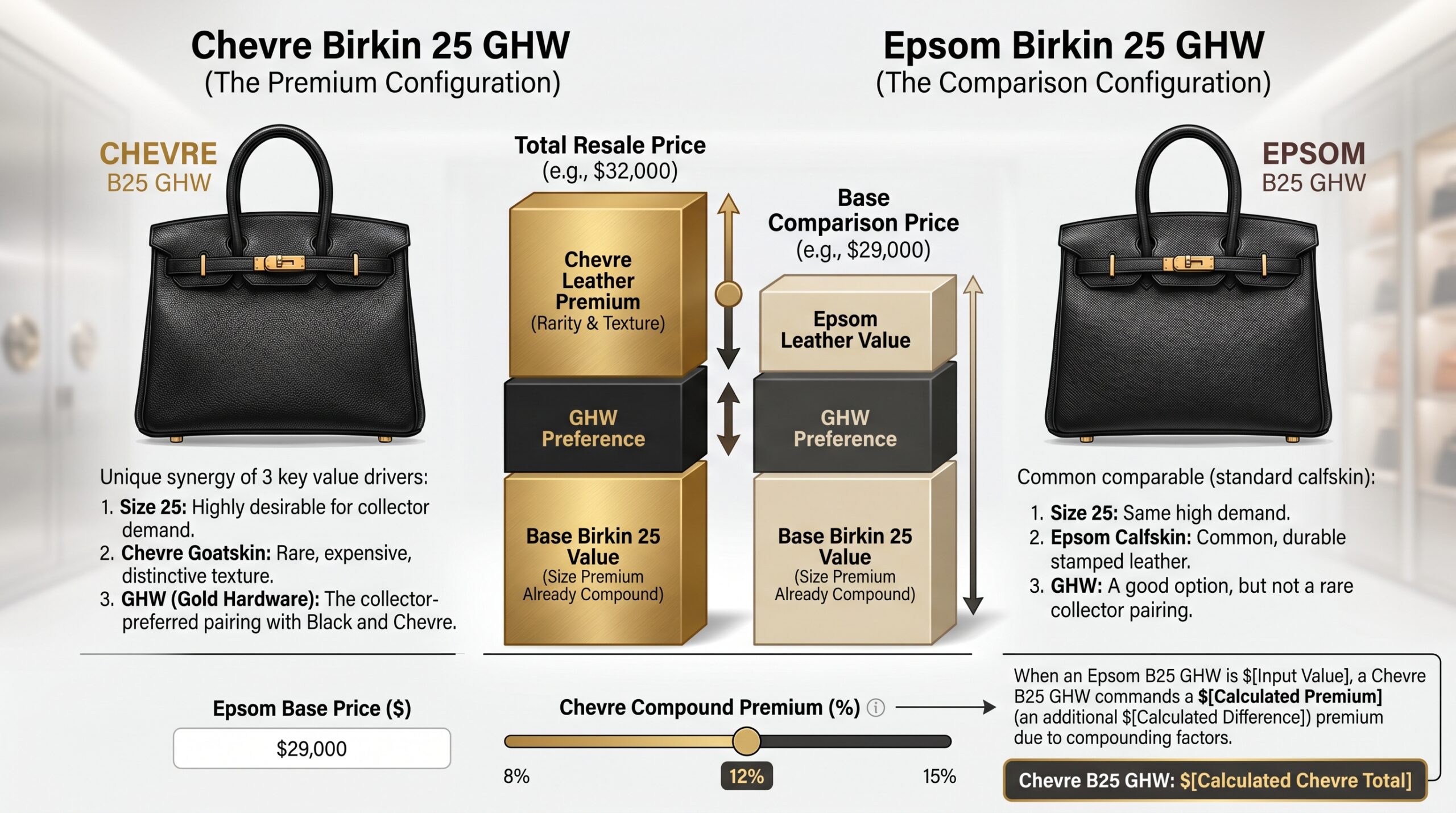
- The premium is most pronounced in the Birkin 25 and Kelly 25 Sellier — the collector-tier size-construction combinations where the leather premium compounds with the size premium and construction premium to produce the strongest total collector positioning of any standard configuration.
- Chevre in pale colours (Craie, Nata, Gold) commands less of the leather premium because pale colour maintenance risk partially offsets the collector positioning — as covered in our guide to preventing colour transfer on light Hermès leather, Chevre's more natural surface finish makes it slightly more vulnerable than Epsom to colour transfer from dark fabrics in pale colourways.
- For hardware: Chevre in GHW consistently outperforms Chevre in PHW on collector platforms, as the warm-natural pairing of goatskin and gold hardware resonates more strongly with 1stDibs and Vestiaire collector buyers than the cooler palladium combination. This is the opposite of the Epsom pattern where PHW holds a marginal liquidity advantage on mainstream platforms.
The hardware interaction covered in our companion analysis of how Hermès hardware type affects resale price is particularly relevant for Chevre holders — the leather-hardware pairing decision at the point of SA offer has a compounding effect that is more pronounced for Chevre than for any other standard leather, because collector buyers who specifically seek Chevre also tend to prefer GHW more consistently than mainstream buyers do. The full Sellier vs Retourne construction analysis covered in our guide to Sellier vs Retourne construction and shape similarly interacts with the Chevre premium in the Kelly range.
The Acquisition and Holding Decision
The Chevre vs Epsom acquisition decision is simpler than the durability comparison might suggest: accept Chevre enthusiastically whenever offered, because its collector premium and natural durability advantages both favour the holder. The more nuanced decision is the specification preference when an SA is open to colour and hardware choice with either leather — where optimising those secondary variables compounds with the leather premium to produce the strongest possible secondary market position.
For daily-use holders who intend to carry the bag actively before eventual resale: the durability comparison produces a practical guidance that accounts for climate and carry habits. In dry or temperate climates with typical office-to-social daily carry, Chevre's scratch resistance advantage and superior surface condition over time make it the better durability specification for Grade A condition maintenance. In humid tropical climates, Epsom's surface treatment advantage for moisture and colour transfer resistance becomes more significant — and the humidity storage guide's protocols for both leathers should be applied regardless of which is held.
- When offered a Chevre Birkin or Kelly: accept immediately — it is a relatively scarce configuration that commands a collector premium at resale, and the durability profile under daily carry is at least as good as Epsom's for most carry conditions.
- If offered Chevre: specify dark or neutral colours (Noir, Etain, Navy) and GHW where the hardware choice is available — this combination maximises both the Chevre collector premium and minimises the colour transfer vulnerability that Chevre's more natural surface carries in pale colourways.
- If offered Epsom in a humid climate: follow the full humidity storage protocol covered in our high-humidity storage guide — Epsom's moisture resistance advantage during carry does not extend to unmanaged storage humidity, and both leathers require active humidity management in sustained tropical conditions.
- At resale, list Chevre pieces on Vestiaire Collective and 1stDibs first — these platforms produce the strongest Chevre premium because their collector buyer pools include the buyers who specifically seek the leather. Fashionphile and The Real Real will achieve the premium as well but with slightly less price sensitivity to the leather distinction.
- The condition grade maintenance imperative applies equally to both leathers — Chevre's scratch resistance advantage produces better surface condition under equivalent use, but it does not eliminate the need for bag insert support (covered in our Birkin 30 insert guide) or correct storage practices to maintain the overall Grade A condition that the collector premium demands.
The full leather types investment framework — including how Chevre and Epsom compare to Togo, Clemence, and exotic leathers across the full holding period — is available in the Hermès Leather Types Guide hub. The complete market intelligence context for both durability and resale decisions across all leather types is available through the All Topics archive.
| Attribute | Chevre Mysore | Epsom | Winner / Context |
|---|---|---|---|
| Animal source | Goatskin — natural tight grain | Calfskin — embossed + treated | Different — both quality |
| Scratch resistance | Superior — natural hide | Very Good — treated surface | Chevre — natural advantage |
| Moisture resistance | Moderate — natural finish | Superior — semi-treated | Epsom — treatment advantage |
| Colour transfer risk | Moderate (higher in pale colours) | Lower — surface coating | Epsom — treatment advantage |
| Surface condition over time | Excellent — fewer micro-scratches | Very Good — pebble peak wear | Chevre — natural resilience |
| Structural shape retention | Excellent — both rigid | Excellent — emboss adds rigidity | Tie — both excellent |
| Production availability | Limited — scarce allocation | Most available — standard | Epsom — consistent access |
| Resale premium | +8–15% over Epsom (collector) | Benchmark — no premium | Chevre — scarcity premium |
| Best resale platform | 1stDibs · Vestiaire Collective | All 4 platforms equally | Epsom — platform flexibility |
| Best hardware pairing | GHW (collector preferred) | PHW (mainstream) or GHW | Context-specific |
All figures approximate and reflect observed secondary market patterns for Grade A condition pieces in standard configurations. Chevre premium ranges reflect 1stDibs and Vestiaire Collective collector platform pricing versus Fashionphile benchmark. Actual outcomes depend on specific colour, size, construction, and market conditions at time of sale.
Chevre for Collector Premium and Scratch Resistance — Epsom for Moisture and Colour Transfer Protection
The Chevre vs Epsom comparison produces a verdict that honours both leathers' genuine strengths rather than declaring a universal winner. Chevre is the superior specification for buyers who prioritise scratch resistance in daily carry and who are targeting the collector-platform tier for resale exit — its natural goatskin durability, distinctive visual signature, and 8–15% collector premium over Epsom in equivalent configurations make it the stronger investment specification whenever it is available.
Epsom is the superior specification for buyers in humid tropical climates, buyers who frequently carry against dark fabrics or in moisture-risk environments, and buyers who prioritise the broadest platform flexibility at exit. Its surface treatment provides genuine protection advantages over Chevre's more natural finish in these specific conditions — and its consistent availability in standard boutique allocation makes it the most reliable specification choice for buyers who cannot afford to wait for Chevre availability.
The acquisition rule is clear: always accept Chevre when offered — it is scarce enough that passing a Chevre offer while waiting for the same configuration in Epsom would be a financially irrational decision, given the leather's premium positioning at resale. Within the Chevre holding strategy, specify dark neutral colours and GHW to maximise the collector platform premium, and apply Vestiaire Collective and 1stDibs as the primary exit channels where the Chevre-specific buyer pool is most concentrated.
Bottom Line: Accept any Chevre offer enthusiastically — its natural scratch resistance and 8–15% collector premium over Epsom make it a superior specification at both the carry and resale stages of the holding period. In humid climates or pale colour preferences, Epsom's surface treatment advantages are real and should be weighted accordingly in the specification preference.
Popular Searches
Explore our most searched Hermès leather comparison and durability questions
Frequently Asked Questions
Both Chevre and Epsom are among the most durable standard Hermès leathers for daily use, but they achieve their durability through different mechanisms. Chevre (goatskin) is naturally more scratch-resistant than any calfskin leather — its tight grain structure produces a surface that resists abrasion significantly better than Epsom under equivalent daily carry. Epsom's advantage is its semi-treated surface that resists moisture and colour transfer better than Chevre's more natural finish. For buyers in dry climates prioritising scratch resistance: Chevre. For buyers in humid climates or who frequently carry against darker fabrics: Epsom's surface treatment provides additional protection. See our guide on which Hermès leathers are most durable for daily use for the full comparison.
Chevre commands a meaningful collector premium on 1stDibs and Vestiaire Collective relative to Epsom — typically 8–15% above Epsom pricing for the same Birkin or Kelly size, colour, and hardware. This premium reflects the leather's relative scarcity, its distinctive fine-grain surface appearance, and the specific collector demand for a more refined and less commercially ubiquitous leather than Epsom. The premium is most pronounced in Birkin 25 and Kelly 25 Sellier configurations in GHW, where collector buyers dominate demand. See our analysis of which Hermès bag styles hold their resale value best in 2026 for the broader resale context.
Chevre is produced from goatskin — a naturally stronger and more scratch-resistant hide than calfskin, with a distinctive fine cross-hatch grain pattern immediately visually distinctive from Epsom's pebbled pattern. Epsom is calfskin that has been embossed with a fine pebble pattern and treated with a surface coating that gives it rigidity, moisture resistance, and colour stability. Chevre's durability comes from the natural properties of the hide; Epsom's durability comes primarily from its surface treatment. The technical details of the goatskin tanning and finishing process are covered at Hermès Insights Hub's Chevre and Epsom leather science guide.
Chevre leather availability in the Birkin and Kelly range varies by year and market. Hermès has reduced its Chevre allocation in recent years relative to peak production, making Chevre pieces less common than Epsom or Togo configurations in standard boutique allocation. Buyers who encounter a Chevre Birkin or Kelly offer from their SA should treat it as a relatively scarce configuration — Chevre commands a secondary market premium partly because of this production scarcity. HSS special order remains one route through which dedicated collectors can commission Chevre pieces, subject to normal HSS eligibility requirements.