Hermès Market & Investment Glossary: Every Term You Need
The definitive secondary market and investment vocabulary — every term from quota bag to condition grade, HSS to price delta, explained with market context and resale implications.
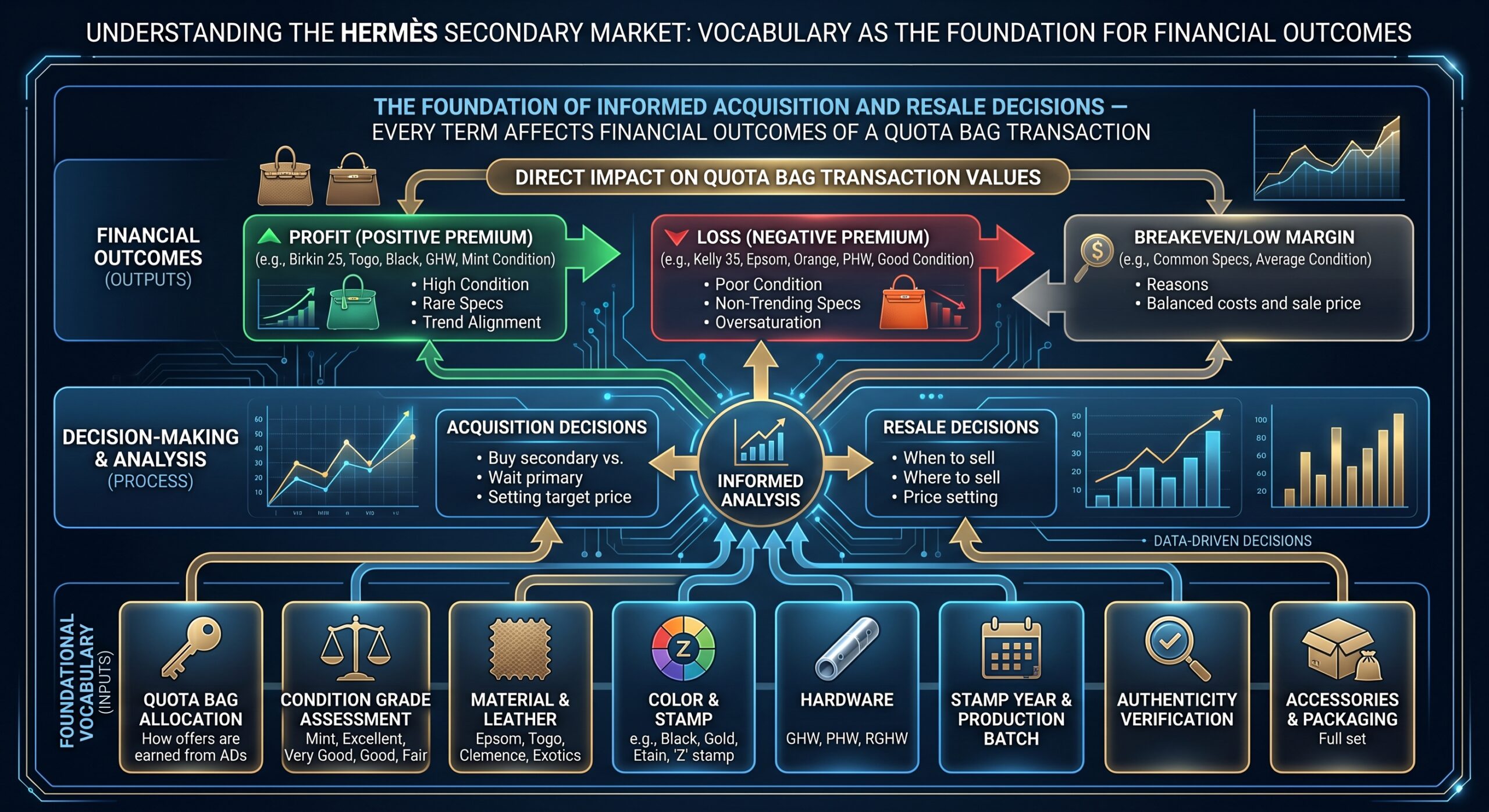
The Hermès secondary market operates on a vocabulary that distinguishes serious collectors and informed buyers from those entering the space for the first time. Terms like spend ratio, quota bag, price delta, condition grade, and provenance appear throughout platform listings, SA conversations, and investment analysis — and understanding their precise meaning is the foundation of any rational acquisition or resale decision.
This glossary covers every term used throughout the Hermès Terminology Glossary hub and across all Hermès Advisory Forum market intelligence articles, with investment context and resale implications provided for each entry. It is designed as a reference resource — bookmark it and return when an unfamiliar term appears in your research, SA conversations, or platform listings.
The leather science and materials terminology that underpins the physical side of these investment decisions — tanning methods, leather composition markers, surface treatment chemistry — is covered in depth by the materials team at Hermès Insights Hub's leather terminology guide. This glossary focuses on the market, investment, and acquisition vocabulary that operates at the secondary market level.

| Term | Category | Investment Relevance | Key Article |
|---|---|---|---|
| Quota Bag | Style Category | Defines which styles deliver above-retail secondary market premiums | Styles Resale Value 2026 |
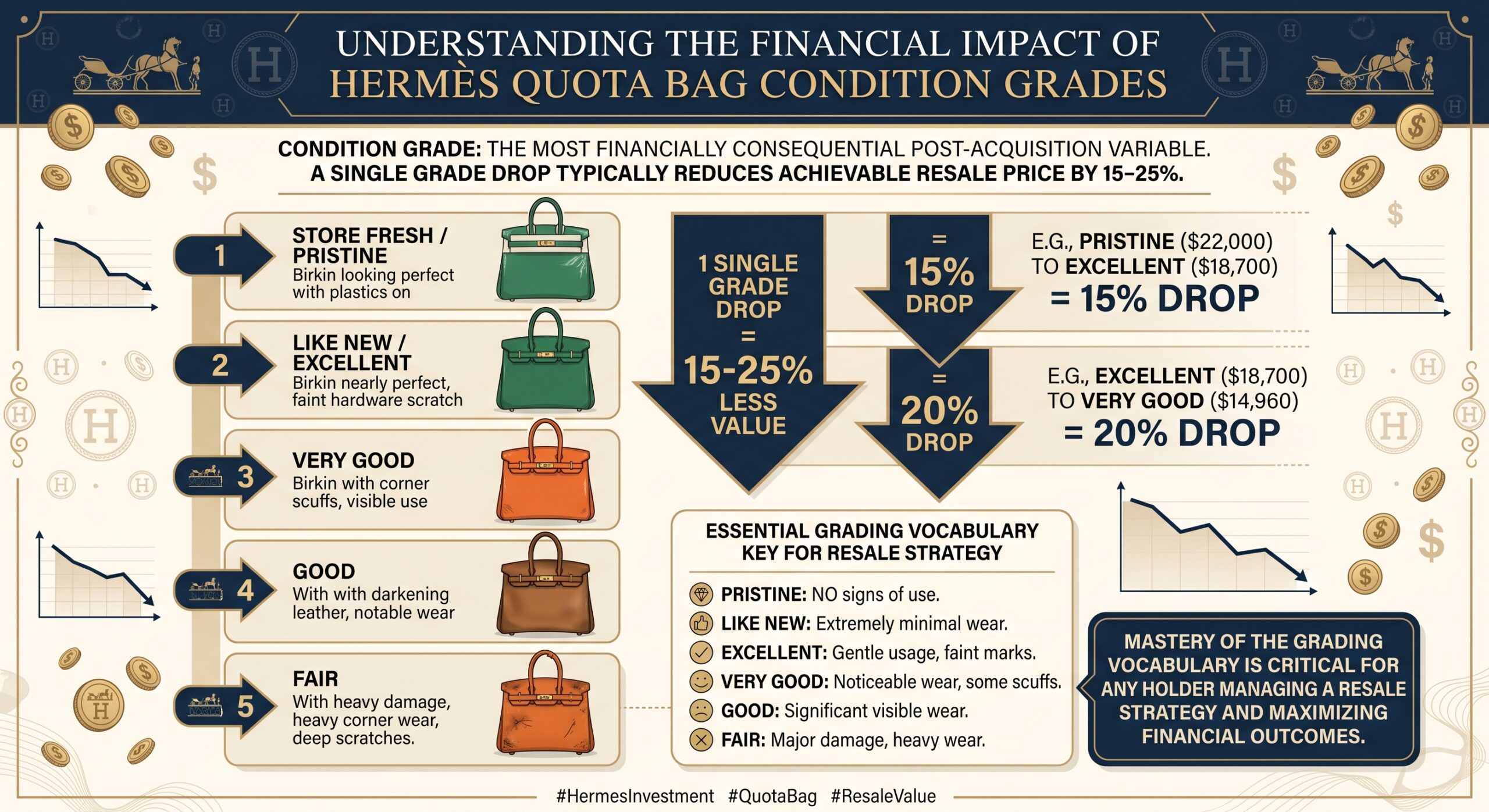
| Condition Grade | Resale Metric | ±15–25% price impact per grade — most controllable value variable | Leather Durability Guide |
| Price-to-Resale Ratio | Investment Metric | Core return metric — Birkins at 1.20–1.45, non-quota at 0.85–1.05 | Styles Resale Value 2026 |
| Price Delta | Tactical Metric | Variable comparison tool — hardware, colour, size, platform differences | Hardware Resale Analysis |
| Spend Ratio | Acquisition Strategy | 0.5–1.5× target bag retail accumulated over 12–24 months | Spend Ratio Strategy 2026 |
| Provenance | Documentation | +5–12% standard configs; +15–25% rare/HSS pieces with full docs | Selling Without Receipt |
| HSS | Commission Programme | +15–30% premium vs retail — requires full documentation to achieve | HSS Resale Value |
| Liquidity | Investment Metric | Sell-through speed — Birkin 30 fastest; rare colours and large sizes slowest | Styles Resale Value 2026 |
| SA | Relationship Term | The human allocation mechanism — relationship quality determines offer timing | Wish List Strategy |
| Sellier | Construction Term | +10–18% vs Retourne — Kelly-specific construction premium | Sellier vs Retourne |
All figures are approximate ranges reflecting observed secondary market patterns. Actual outcomes depend on specific configuration, condition, platform, and market timing. Links connect to the detailed articles that develop each term in full investment context.
Vocabulary Is Strategy — Every Term Here Has a Financial Implication
The Hermès secondary market vocabulary is not decorative — every term in this glossary describes a variable that affects the financial outcome of an acquisition or resale decision. Condition grade determines price by 15–25% per level. Spend ratio determines timeline to first allocation. Provenance determines achievable price premium by 5–25% depending on configuration. Platform selection determines sell-through speed and maximum achievable price for any given piece.
Buyers who enter SA conversations, platform listings, and investment research without this vocabulary are making decisions with incomplete information. The terms are not technical jargon — they are the precise language through which the secondary market communicates value, risk, and opportunity to buyers who are paying attention.
This glossary is a living reference — return to it as new terms appear in your research and as market conditions introduce new vocabulary. The full market intelligence framework across all Hermès investment dimensions is available through the All Topics archive, where every term defined here appears in its full analytical context.
Bottom Line: Knowing the vocabulary of the Hermès secondary market is not optional for any serious buyer or seller — it is the foundation on which every financially rational acquisition, holding, and exit decision is built.
Popular Searches
Explore our most searched Hermès market terminology and investment questions
Frequently Asked Questions
A quota bag refers to the Birkin and Kelly — the two Hermès bag styles that can only be purchased through an established boutique relationship and purchase history. The term reflects the fact that these styles are allocated in limited quantities by boutique SAs rather than being freely available for purchase. Non-quota bags (Evelyne, Picotin, Lindy) can be bought by any customer without prior purchase history. The quota status of the Birkin and Kelly is the primary structural driver of their secondary market premium — supply is constrained at retail in a way that no other standard Hermès style replicates. See our full spend ratio strategy guide for the acquisition context.
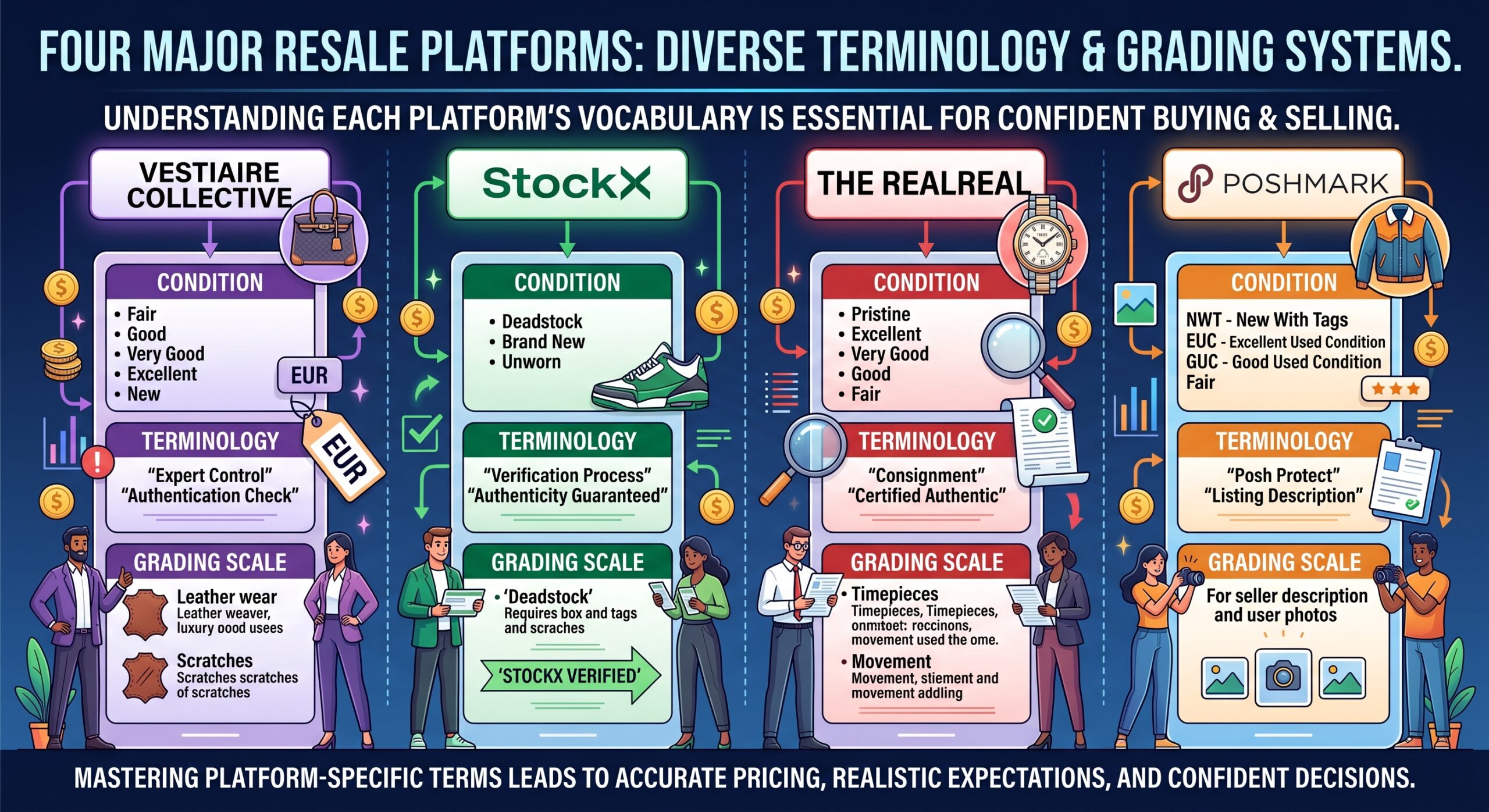
Condition grade is the rating assigned to a pre-owned Hermès piece by a resale platform's authentication and assessment team, reflecting the physical state of the leather, hardware, lining, and structure. Each platform uses its own grading system: Vestiaire Collective grades A (pristine), B+ (excellent), B (good), and C (fair); The Real Real uses Pristine, Excellent, Good, and Fair. A single condition grade drop — for example from Grade A to B+ — typically reduces the achievable resale price by approximately 15–25% on most platforms. See our guide on which Hermès leathers are most durable for daily use for leather durability and grade retention context.
Provenance refers to the documentation history of a Hermès piece — the chain of original retail purchase and ownership evidence that gives buyers confidence in the piece's authenticity and history. Key provenance documents include the original retail receipt, dustbag, box, clochette with lock and keys, and authenticity card. Full provenance typically adds 5–12% to achievable resale price for standard configurations on Vestiaire Collective and 1stDibs, and significantly more for HSS special orders or rare colour pieces. See our guide on selling Hermès without the original receipt for the platform-specific impact of missing provenance documents.
Price delta refers to the measurable price difference between two specific configurations, conditions, or platforms — always expressed as a percentage or range. Price-to-resale ratio is the broader investment metric that compares a bag's secondary market value to its retail price — a Birkin 30 trading at 125% of retail has a price-to-resale ratio of 1.25. The ratio is the core investment metric for comparing returns across styles, sizes, and configurations; the delta is the tactical metric for comparing specific variable choices within a configuration decision. Both metrics appear throughout our Market & Resale analysis articles.