Hermès Market & Investment Glossary: Every Term You Need

Hermès Market & Investment Glossary: Every Term You Need | Hermès Advisory Forum
Market Intelligence · Complete Reference

Hermès Market & Investment Glossary: Every Term You Need

The definitive secondary market and investment vocabulary — every term from quota bag to condition grade, HSS to price delta, explained with market context and resale implications.

April 2026 · 2,080 words · Reference Article

The Hermès secondary market operates on a vocabulary that distinguishes serious collectors and informed buyers from those entering the space for the first time. Terms like spend ratio, quota bag, price delta, condition grade, and provenance appear throughout platform listings, SA conversations, and investment analysis — and understanding their precise meaning is the foundation of any rational acquisition or resale decision.

This glossary covers every term used throughout the Hermès Terminology Glossary hub and across all Hermès Advisory Forum market intelligence articles, with investment context and resale implications provided for each entry. It is designed as a reference resource — bookmark it and return when an unfamiliar term appears in your research, SA conversations, or platform listings.

The leather science and materials terminology that underpins the physical side of these investment decisions — tanning methods, leather composition markers, surface treatment chemistry — is covered in depth by the materials team at Hermès Insights Hub's leather terminology guide. This glossary focuses on the market, investment, and acquisition vocabulary that operates at the secondary market level.
Hermès secondary market terminology reference showing quota bag provenance condition grade and resale platform concepts
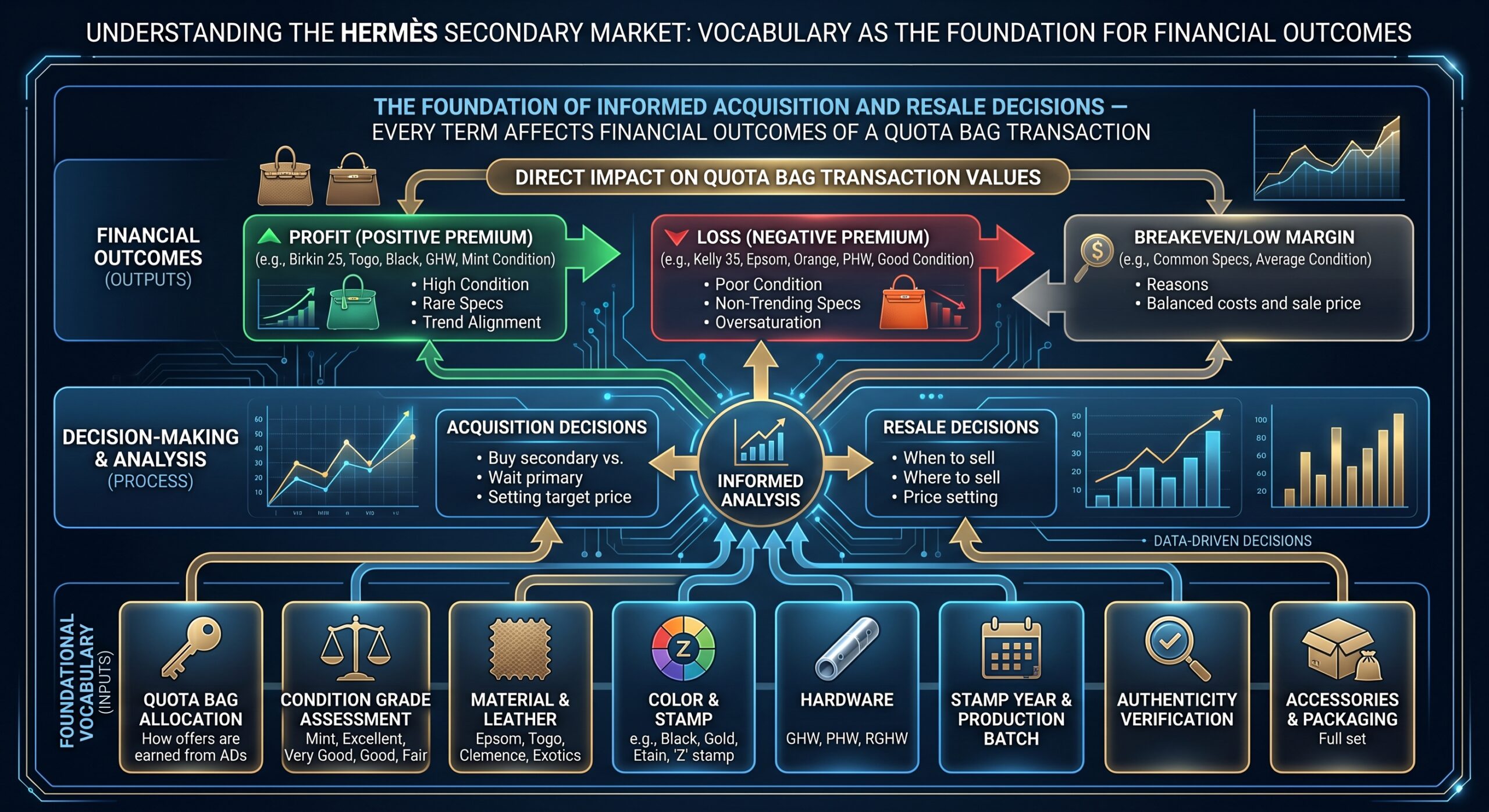
The Hermès secondary market vocabulary is the foundation of informed acquisition and resale decisions — every term from quota bag allocation to condition grade assessment directly affects the financial outcomes of any quota bag transaction.
35+
Terms Defined
Complete coverage of secondary market, investment, acquisition, and care vocabulary used across all Hermès market intelligence
4
Platform Grade Systems
Vestiaire Collective · The Real Real · Fashionphile · 1stDibs — each uses distinct condition grade terminology
Market
Investment Context Lens
Every definition includes resale implications — how the term affects price, liquidity, or acquisition strategy
A — B
Allocation Noun
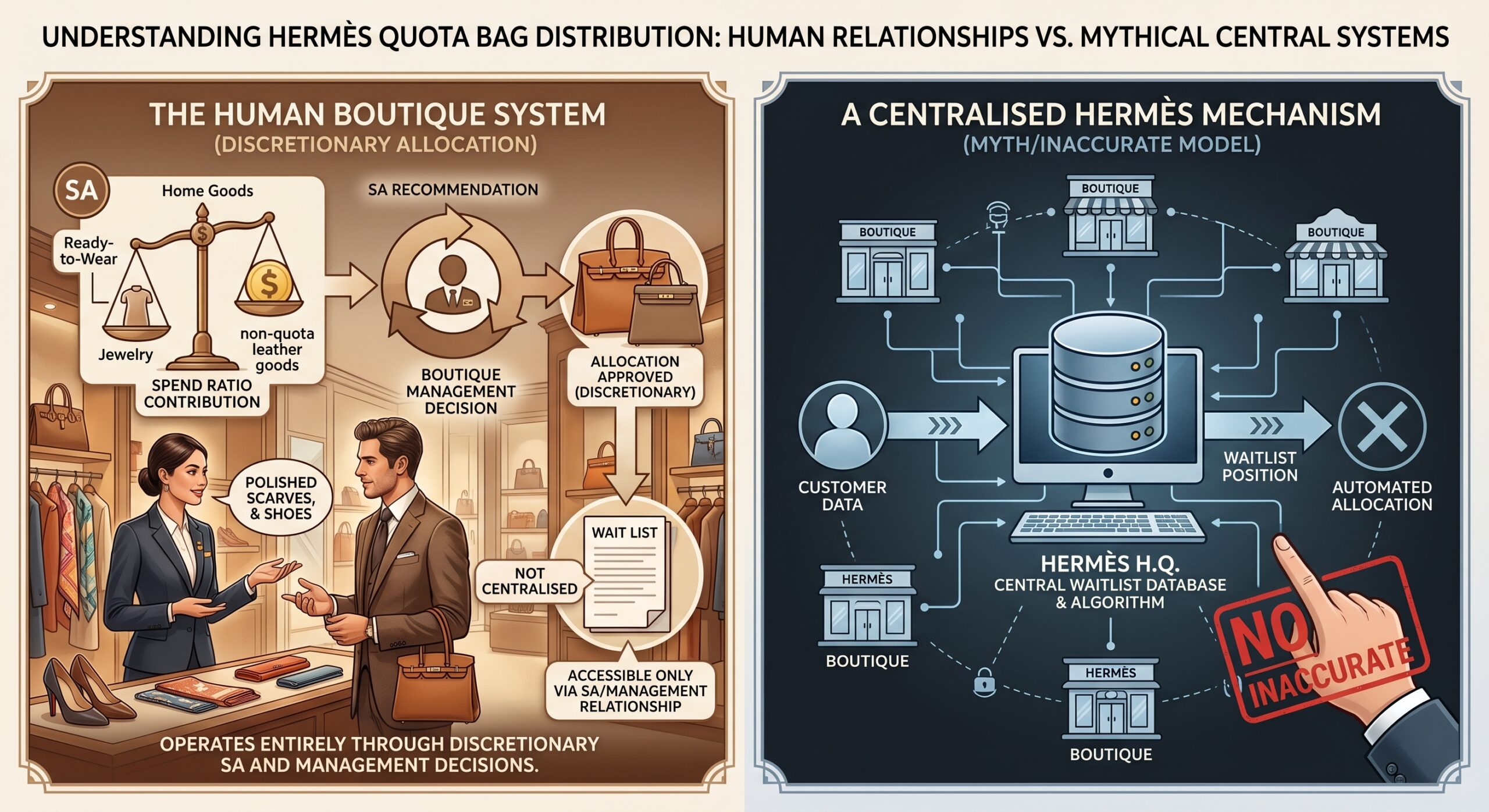
The process by which an SA assigns a quota bag offer to a specific client from available boutique inventory. Allocation decisions are made at boutique level, are not subject to a centralised Hermès system, and are at the sole discretion of the SA and boutique management. A client's allocation priority is determined by their purchase history, boutique relationship quality, expressed preferences, and responsiveness history.
See also: Quota Bag, SA, Spend Ratio. Full context in Spend Ratio Strategy.
Authentication Noun
The process of verifying that a Hermès piece is genuinely produced by Hermès, performed by resale platform specialists through physical inspection of leather composition, hardware stamps, saddle stitch count, date stamp placement, and construction details. Authentication does not require an original receipt — it is performed on the physical piece. Distinguished from provenance, which establishes ownership and purchase history rather than physical authenticity.
See also: Provenance, Condition Grade. Full context in Selling Without Receipt.
Birkin Style Name · Quota Bag
The Hermès tote-format quota bag, available in sizes 25, 30, 35, and 40cm. The most recognised Hermès investment vehicle, trading at 20–45% above retail in the 25 and 30 sizes in Grade A condition in 2026. The Birkin 30 is the highest-volume secondary market configuration; the Birkin 25 commands the highest premium percentage. Requires an established SA relationship and purchase history for retail acquisition in all markets.
See also: Quota Bag, Kelly, Price-to-Resale Ratio. Birkin vs Kelly five-year comparison.
Boutique Relationship Noun
The SA-client relationship built through consistent boutique visits, purchase history across multiple categories, and genuine brand engagement over time. The boutique relationship is the primary mechanism through which quota bag allocation is accessed — it determines which clients receive offers and in what configuration. Distinct from a client's global Hermès spend history, which is visible systemically; the boutique relationship is the human dimension that converts spend history into an actual offer.
See also: SA, Spend Ratio, Wait List, Allocation. Wish list strategy guide.
Hermès condition grade assessment showing Vestiaire Collective and Fashionphile grading criteria for quota bag resale
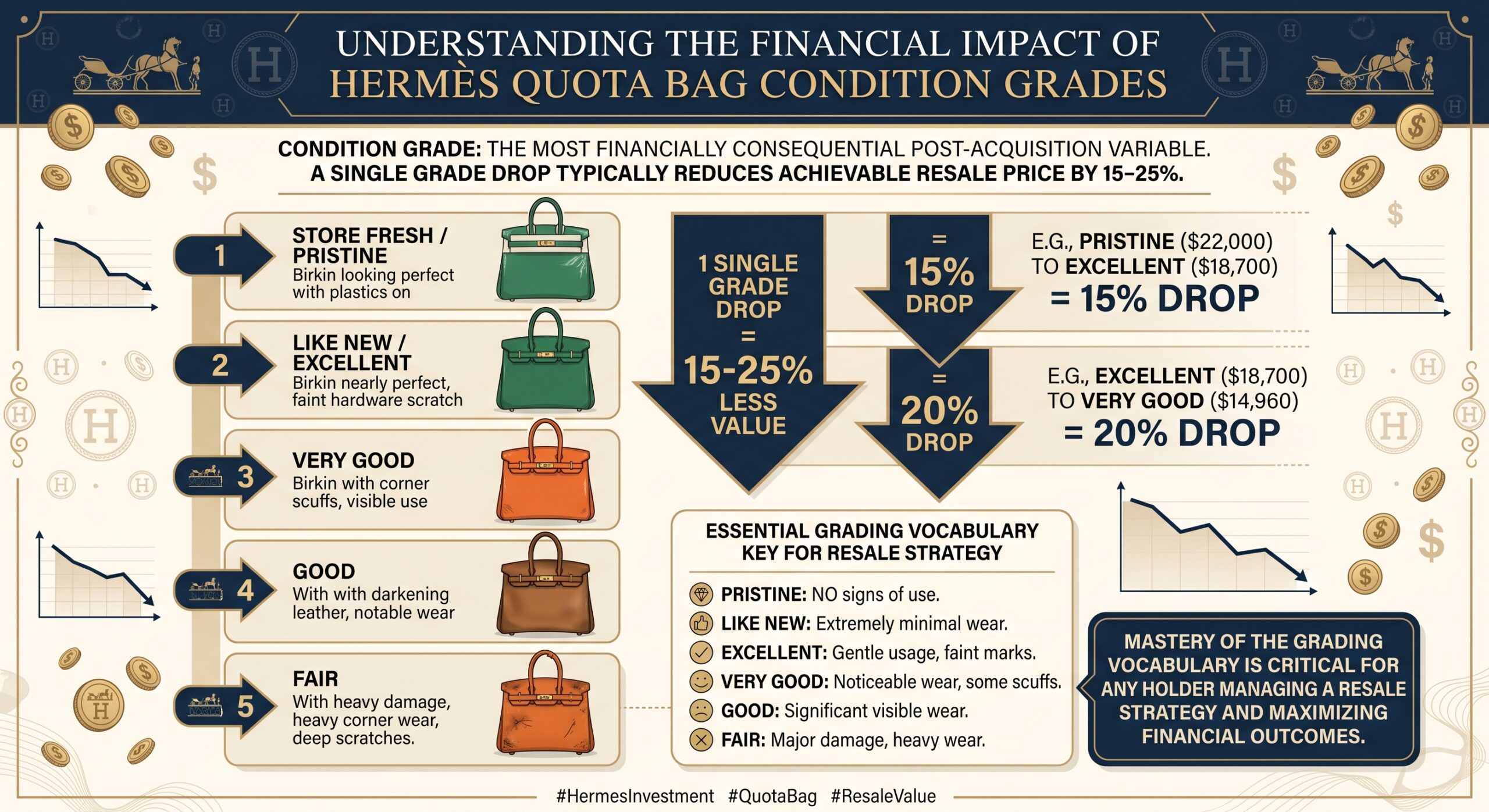
Condition grade is the most financially consequential post-acquisition variable for quota bag holders — a single grade drop typically reduces achievable resale price by 15–25%, making the grading vocabulary essential for any holder managing a resale strategy.
C — D
Condition Grade Noun
The rating assigned by a resale platform's assessment team to a pre-owned Hermès piece, reflecting the physical state of all assessable elements: leather surface, structure, hardware, and lining. A single grade drop typically reduces achievable resale price by approximately 15–25% across major platforms. The most financially significant variable a quota bag holder can actively manage across the holding period through correct carry, storage, and care practices.
Platform-specific grade systems are detailed in the Grade Reference section below. Leather durability and grade retention.
Correction Market Term
A period of secondary market premium compression in which previously elevated price-to-resale ratios decline toward historical norms. The Hermès secondary market experienced a significant correction between 2024 and 2025 in which standard leather Birkin premiums compressed by approximately 8–18% from 2022–2023 peak levels. Corrections affect larger formats and standard configurations more than compact and collector-tier configurations, which typically demonstrate greater premium resilience.
See also: Price-to-Resale Ratio, Liquidity. Full correction analysis 2024–2026.
Dustbag Noun · Provenance Element
The original cotton storage bag provided by Hermès with every new bag purchase, branded with the Hermès name. The dustbag is the most universally expected provenance element in any Hermès secondary market sale — its absence signals an incomplete retail set to buyers across all platforms and typically reduces achievable price by 3–8% versus an equivalent piece with full accessories. The dustbag is also a functional storage tool that provides dust protection while allowing leather to breathe during storage.
See also: Provenance, Clochette. Impact of missing provenance documents.
H — L
HSS (Hermès Special Service) Acronym · Programme Name
The Hermès special order programme that allows established clients who have already received standard quota bag allocations to commission a Birkin, Kelly, or Constance in bespoke leather, colour, and hardware combinations not available through standard retail. HSS pieces with full commission documentation can command 15–30% above comparable retail configurations on 1stDibs and Vestiaire Collective. Without provenance documentation, the HSS premium shrinks to 5–10% or disappears entirely. HSS access typically requires a minimum of one prior quota bag allocation and a deeper boutique relationship than first-allocation clients possess.
See also: Provenance, Quota Bag, Boutique Relationship. Full HSS resale value analysis.
Hardware Noun
The metal components of a Hermès bag — including the lock, turn-key closure, clochette ring, handle attachment plates, and zipper pulls where applicable. Available in palladium (PHW), gold (GHW), brushed gold (BGHW), and ruthenium finishes. Hardware type affects resale price by approximately 3–8% between PHW and GHW on standard configurations (PHW leads on mainstream platforms; GHW leads on exotic leather and collector-platform configurations). Hardware condition is assessed independently from leather condition at all major resale platforms.
See also: PHW, GHW, Condition Grade. Full hardware resale analysis.
Liquidity Noun · Investment Term
How quickly and at what price a Hermès piece can be sold on the secondary market — the ease of converting the asset into cash without significant price concession. The Birkin 30 in standard leather with PHW is the most liquid quota bag configuration — it sells fastest across all four major platforms at consistent premiums. Rare colors, exotic leathers, and unusual configurations command higher premiums but have lower liquidity due to their narrower buyer pools. Non-quota bags (Evelyne, Picotin) have low liquidity — they sell near or below retail and do not attract competitive buyer interest.
See also: Price-to-Resale Ratio, Resale Platform. Style liquidity rankings.
P — Q
PHW / GHW / BGHW Abbreviations · Hardware Finishes
PHW: Palladium Hardware — the cool-toned silvery finish that is the most common hardware specification on Hermès quota bags and delivers marginally stronger liquidity on US-focused platforms (Fashionphile, The Real Real). GHW: Gold Hardware — the warm-toned traditional Hermès finish that commands collector premiums on exotic leathers and rare colors, strongest on Vestiaire Collective and 1stDibs. BGHW: Brushed Gold Hardware — the matte gold finish that commands a modest 5–10% premium over polished GHW on Kelly bags specifically, with a narrower buyer pool and slower average sell-through.
See also: Hardware, Price Delta. Hardware price delta analysis.
Price Delta Noun · Investment Term
The measurable price difference between two configurations, conditions, or platforms — always expressed as a percentage or range. Examples: the price delta between Birkin PHW and GHW is approximately 3–8% in favour of PHW on standard leathers; the price delta between Grade A and Grade B+ condition is approximately 15–25%; the price delta between a Rose Shocking and an Etain Birkin in equivalent configuration is approximately 20–35% in favour of the rare colour. Price delta is the tactical metric for evaluating specific configuration variable choices within an acquisition or resale decision.
See also: Price-to-Resale Ratio, Condition Grade. Applied throughout market analysis articles.
Price-to-Resale Ratio Noun · Core Investment Metric
The ratio of a bag's secondary market value to its current retail price — the core investment metric for any Hermès acquisition. A Birkin 30 trading at $16,000 when its retail price is $13,000 has a price-to-resale ratio of approximately 1.23 (123% of retail). Ratios above 1.0 indicate above-retail secondary market positioning; below 1.0 indicates below-retail positioning. Quota bags (Birkin, Kelly) consistently maintain above-1.0 ratios; non-quota bags typically maintain below-1.0 ratios. The Constance 18cm GHW occupies a middle position at approximately 1.10–1.25 in strong configurations.
See also: Liquidity, Quota Bag, Condition Grade. Central metric across all investment guide articles.
Provenance Noun
Documentation history of a Hermès piece — the original retail receipt, dustbag, box, clochette with lock and keys, and authenticity card that establish the retail purchase history and ownership chain. Full provenance adds a measurable buyer confidence premium of approximately 5–12% on standard configurations and significantly more on HSS, rare colour, and vintage pieces where the documentation verifies specific claims about the piece's origin. Provenance is distinct from authentication — authentication verifies the piece is genuine; provenance verifies its purchase and ownership history.
See also: Authentication, HSS, Dustbag. Platform-by-platform provenance impact.
Quota Bag Noun · Category Term
The Birkin and Kelly — the only two Hermès bag styles that require an established boutique relationship and purchase history to acquire at retail in all markets. The quota designation reflects the controlled allocation mechanism that limits supply independently of production capacity, creating the secondary market scarcity premium that distinguishes these styles from all other Hermès products. Non-quota bags (Evelyne, Picotin, Lindy, Garden Party) can be freely purchased without relationship history and consequently do not deliver above-retail secondary market positioning.
See also: Birkin, Kelly, Boutique Relationship, Allocation. Quota vs non-quota market positioning.
Platform Grade Reference
Vestiaire Collective
Grade APristine / As new — no visible wear
Grade B+Excellent — very light wear, minimal use
Grade BGood — visible light wear, used
Grade CFair — significant wear, clearly used
The Real Real
PristineUnworn or like new — no detectable wear
ExcellentVery light wear, well maintained
GoodNormal light use wear present
FairVisible wear — priced accordingly
Fashionphile
Never WornWith tags / as new from retail
PristineNo signs of wear — essentially new
ExcellentMinimal wear, well cared for
Good / FairVisible wear — priced to reflect
1stDibs
NewUnworn with tags or never used
ExcellentLike new, minimal to no wear
Very GoodLight wear consistent with careful use
GoodNormal wear visible — antique standard
Hermès SA boutique relationship terminology showing spend ratio allocation and wait list concepts in practice
The boutique relationship vocabulary — SA, spend ratio, allocation, wait list — describes the human system through which quota bags are distributed at retail, a system that operates entirely through discretionary SA and management decisions rather than any centralised Hermès mechanism.
R — S
Resale Platform Noun · Category Term
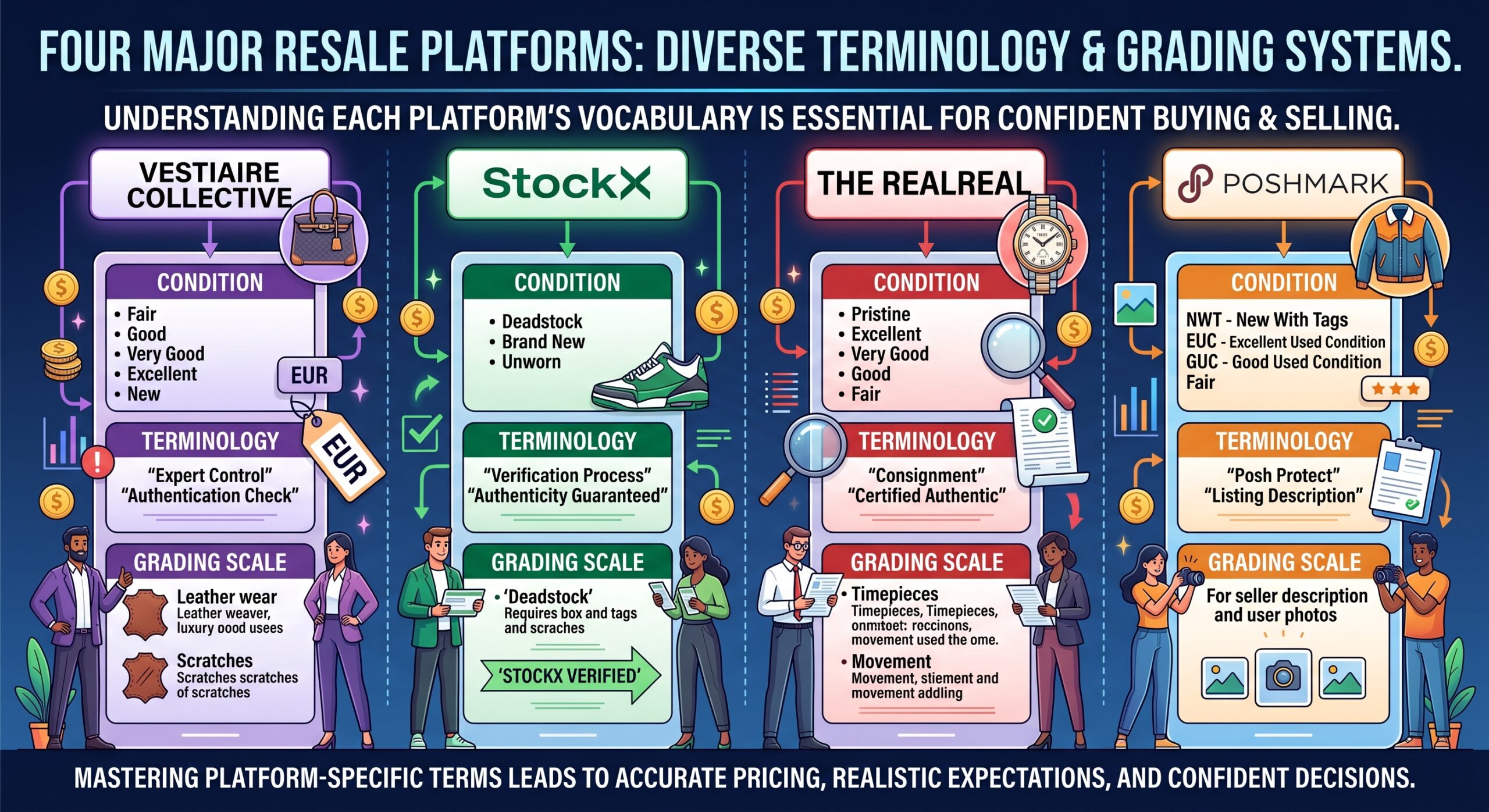
The four major secondary market channels for Hermès luxury goods: Vestiaire Collective (international collector-oriented, seller-set pricing, strongest for rare colours and Kellys), The Real Real (US-focused, platform-set pricing, highest volume for accessible configurations), Fashionphile (US-focused, consignment model, fastest sell-through for standard configurations), and 1stDibs (dealer-listed, highest price ceiling for exotic and vintage pieces, strongest collector buyer pool). Platform selection is the most actionable lever for maximising achieved price on any specific configuration.
See also: Liquidity, Condition Grade. Platform comparison throughout Market & Resale articles.
SA (Sales Associate) Abbreviation · Relationship Term
The Hermès boutique Sales Associate — the specific staff member who manages a client relationship and controls quota bag allocation offers. The SA is the central human figure in the quota bag acquisition process: they assess client purchase history, relationship quality, and expressed preferences when making allocation decisions, and advocate internally for their clients when quota bag inventory becomes available. A client's relationship with a specific SA — not just their global spend history — is the critical allocation variable.
See also: Boutique Relationship, Allocation, Spend Ratio. SA interaction strategy.
Sellier Noun · Construction Term
The Kelly bag construction in which seams are placed on the exterior of the bag — creating a rigid, geometric trapezoidal silhouette with sharp edges and flat faces. The Sellier commands a consistent 10–18% premium over the equivalent Retourne construction on Vestiaire Collective and 1stDibs, driven by its production scarcity (fewer Sellier units per leather run than Retourne) and collector demand for its formal, structured appearance. The Kelly 25 Sellier is the strongest Kelly investment configuration in 2026.
See also: Retourne, Kelly, Price Delta. Full Sellier vs Retourne analysis.
Spend Ratio Noun · Acquisition Strategy Term
The ratio of non-quota purchases to quota bag offers — the boutique relationship building concept describing the purchase history required before an SA will typically extend a quota bag offer. Observed spend ratios for first quota bag offers range from approximately 0.5× to 1.5× the retail value of the desired bag, accumulated over 12–24 months. The spend ratio is a financial measure of relationship investment; it is necessary but not sufficient without the relational dimension of an established SA interaction. Category selection within the spend ratio matters: jewellery, ready-to-wear, and small leather goods signal stronger engagement than fragrance or accessories.
See also: SA, Boutique Relationship, Allocation. Complete spend ratio strategy.
V — W
Vestiaire Collective Proper Noun · Resale Platform
The largest international Hermès resale platform by collector buyer pool depth, operating a seller-set pricing model with post-sale authentication. Vestiaire Collective is the strongest platform for rare colour configurations, Kelly pieces (particularly Sellier construction), and HSS special orders — its international buyer pool surfaces collector demand that US-focused platforms cannot match. Sellers set their own ask prices, which are verified by the authentication team after sale; price is the primary negotiation mechanism between buyer and seller. Fastest repricing of any platform following Hermès retail price increases.
See also: Resale Platform, 1stDibs, Fashionphile, The Real Real. Platform comparisons in rare colour resale analysis.
Wait List Noun · Colloquial Term
The informal term buyers use to describe their position in an SA's mental queue of clients awaiting quota bag offers. No official Hermès wait list exists — there is no registration system, no number assignment, and no centralised mechanism for tracking quota bag interest. What buyers experience as a wait list is the SA's memory of which clients have expressed clear preferences and the boutique management's awareness of the client roster. The term is widely used in buyer community discussions but misrepresents the actual allocation mechanism, which is entirely discretionary and relationship-dependent.
See also: SA, Boutique Relationship, Allocation. What the wait list actually is.
Hermès resale platform reference showing Vestiaire Collective 1stDibs Fashionphile and The Real Real comparison for secondary market terminology
Each of the four major resale platforms uses its own terminology and grading system — understanding the specific vocabulary of the platform you are selling or buying on is essential for accurate pricing, realistic expectations, and confident transaction decisions.
Key Hermès Market Terms: Quick Reference
TermCategoryInvestment RelevanceKey Article
Quota BagStyle CategoryDefines which styles deliver above-retail secondary market premiumsStyles Resale Value 2026
Condition GradeResale Metric±15–25% price impact per grade — most controllable value variableLeather Durability Guide
Price-to-Resale RatioInvestment MetricCore return metric — Birkins at 1.20–1.45, non-quota at 0.85–1.05Styles Resale Value 2026
Price DeltaTactical MetricVariable comparison tool — hardware, colour, size, platform differencesHardware Resale Analysis
Spend RatioAcquisition Strategy0.5–1.5× target bag retail accumulated over 12–24 monthsSpend Ratio Strategy 2026
ProvenanceDocumentation+5–12% standard configs; +15–25% rare/HSS pieces with full docsSelling Without Receipt
HSSCommission Programme+15–30% premium vs retail — requires full documentation to achieveHSS Resale Value
LiquidityInvestment MetricSell-through speed — Birkin 30 fastest; rare colours and large sizes slowestStyles Resale Value 2026
SARelationship TermThe human allocation mechanism — relationship quality determines offer timingWish List Strategy
SellierConstruction Term+10–18% vs Retourne — Kelly-specific construction premiumSellier vs Retourne

All figures are approximate ranges reflecting observed secondary market patterns. Actual outcomes depend on specific configuration, condition, platform, and market timing. Links connect to the detailed articles that develop each term in full investment context.

The Market Insider's Verdict

Vocabulary Is Strategy — Every Term Here Has a Financial Implication

The Hermès secondary market vocabulary is not decorative — every term in this glossary describes a variable that affects the financial outcome of an acquisition or resale decision. Condition grade determines price by 15–25% per level. Spend ratio determines timeline to first allocation. Provenance determines achievable price premium by 5–25% depending on configuration. Platform selection determines sell-through speed and maximum achievable price for any given piece.

Buyers who enter SA conversations, platform listings, and investment research without this vocabulary are making decisions with incomplete information. The terms are not technical jargon — they are the precise language through which the secondary market communicates value, risk, and opportunity to buyers who are paying attention.

This glossary is a living reference — return to it as new terms appear in your research and as market conditions introduce new vocabulary. The full market intelligence framework across all Hermès investment dimensions is available through the All Topics archive, where every term defined here appears in its full analytical context.

Bottom Line: Knowing the vocabulary of the Hermès secondary market is not optional for any serious buyer or seller — it is the foundation on which every financially rational acquisition, holding, and exit decision is built.

Frequently Asked Questions

A quota bag refers to the Birkin and Kelly — the two Hermès bag styles that can only be purchased through an established boutique relationship and purchase history. The term reflects the fact that these styles are allocated in limited quantities by boutique SAs rather than being freely available for purchase. Non-quota bags (Evelyne, Picotin, Lindy) can be bought by any customer without prior purchase history. The quota status of the Birkin and Kelly is the primary structural driver of their secondary market premium — supply is constrained at retail in a way that no other standard Hermès style replicates. See our full spend ratio strategy guide for the acquisition context.

Condition grade is the rating assigned to a pre-owned Hermès piece by a resale platform's authentication and assessment team, reflecting the physical state of the leather, hardware, lining, and structure. Each platform uses its own grading system: Vestiaire Collective grades A (pristine), B+ (excellent), B (good), and C (fair); The Real Real uses Pristine, Excellent, Good, and Fair. A single condition grade drop — for example from Grade A to B+ — typically reduces the achievable resale price by approximately 15–25% on most platforms. See our guide on which Hermès leathers are most durable for daily use for leather durability and grade retention context.

Provenance refers to the documentation history of a Hermès piece — the chain of original retail purchase and ownership evidence that gives buyers confidence in the piece's authenticity and history. Key provenance documents include the original retail receipt, dustbag, box, clochette with lock and keys, and authenticity card. Full provenance typically adds 5–12% to achievable resale price for standard configurations on Vestiaire Collective and 1stDibs, and significantly more for HSS special orders or rare colour pieces. See our guide on selling Hermès without the original receipt for the platform-specific impact of missing provenance documents.

Price delta refers to the measurable price difference between two specific configurations, conditions, or platforms — always expressed as a percentage or range. Price-to-resale ratio is the broader investment metric that compares a bag's secondary market value to its retail price — a Birkin 30 trading at 125% of retail has a price-to-resale ratio of 1.25. The ratio is the core investment metric for comparing returns across styles, sizes, and configurations; the delta is the tactical metric for comparing specific variable choices within a configuration decision. Both metrics appear throughout our Market & Resale analysis articles.