Which Hermès Leathers Are Most Durable for Daily Use?
A resale-focused analysis of how Togo, Epsom, Clemence, and Box Calf hold their condition grade under sustained daily use — and what that means for your price-to-resale ratio.
The single most controllable variable in long-term Hermès resale value is not the color you choose or the hardware you specify — it is the leather's ability to hold its condition grade under real-world daily use. On Vestiaire Collective, the price gap between a Grade A and Grade B Birkin in the same configuration is typically 15–25%. Over two to three years of daily carry, the wrong leather choice can erase that entire margin before you ever list the bag.
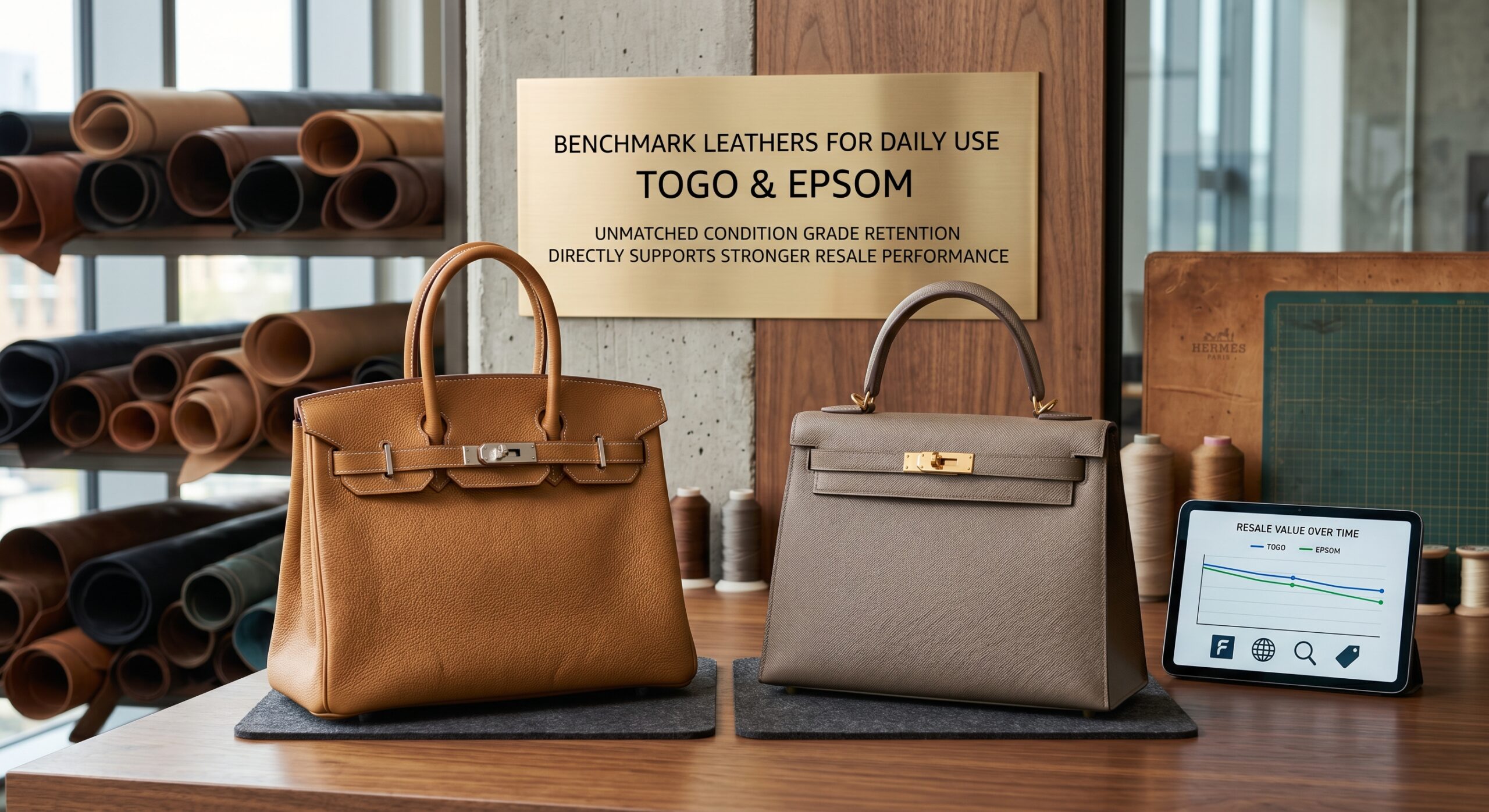
Hermès leathers most durable for daily use are not a matter of opinion — the secondary market grades them objectively. Epsom resists surface abrasion. Togo handles impact without permanent marking. Clemence develops structural sag. Box Calf scratches readily. These are consistent, platform-verified patterns that should inform every leather decision in a quota bag acquisition — not just how the bag feels in the boutique, but how it grades on Fashionphile or The Real Real eighteen months later.
This article gives you the full market picture: which leathers maintain condition grade under daily use, which platform buyers reward with faster sales and stronger premiums, and how to factor leather durability into your acquisition strategy from the first boutique conversation.
Durability and the Resale Connection
Every Hermès leather ages differently — and that aging directly determines the condition grade your bag achieves when it reaches the secondary market. The full range of Hermès leathers and their properties is documented in the Hermès Leathers & Materials Guide, but the investment framework requires understanding one principle above all: durability is not about how a leather feels new. It is about how it grades after use.
Resale platforms use different grading systems, but they are assessing the same thing: surface condition, structural integrity, and hardware preservation. Vestiaire Collective grades from A (pristine) through B+ (excellent) to B (good) and C (fair). The Real Real uses Pristine, Excellent, Good, and Fair. On both platforms, a single grade drop on a Birkin or Kelly in standard leather represents a price reduction that can exceed the cost of two years of careful storage and maintenance.
The leather you choose at the point of quota bag acquisition determines how hard it is to maintain that top condition grade. A daily-carry Birkin in Epsom has a realistic path to remaining at Grade A or Pristine for 18–24 months with basic care. The same bag in Clemence under the same use pattern will likely drop a grade within 12 months as the softer leather develops base sag, corner rounding, and surface micro-scratching that platforms cannot overlook.
Fashionphile and The Real Real have dedicated authentication and grading teams who physically handle every incoming piece. Corner wear, base stud condition, interior lining state, zipper pull patina, and hardware oxidation all factor into the final grade. Leather surface — scratches, fading, staining, and structural deformation — is the primary grading variable for standard leathers.
Vestiaire Collective relies on seller-assigned grades verified by their authentication team, which means a seller who over-grades a soft-leather piece will have the grade corrected post-authentication — sometimes after the listing has attracted buyer interest. Understanding how platforms assess your specific leather type helps you list accurately and avoid the reputational penalty of a corrected grade.
The resale implication is straightforward: leather durability is a financial decision as much as an aesthetic one. A buyer who chooses Epsom over Clemence for daily use is not just choosing a different texture — they are choosing a leather that is more likely to support a top condition grade at the point of resale, and therefore a stronger price-to-resale ratio across the full holding period.
Epsom and Togo: The Daily Use Leaders
The two leathers that dominate the secondary market for good reason are Epsom and Togo — and for daily use buyers, they represent two distinct but equally defensible choices, each with its own durability profile and resale dynamic.
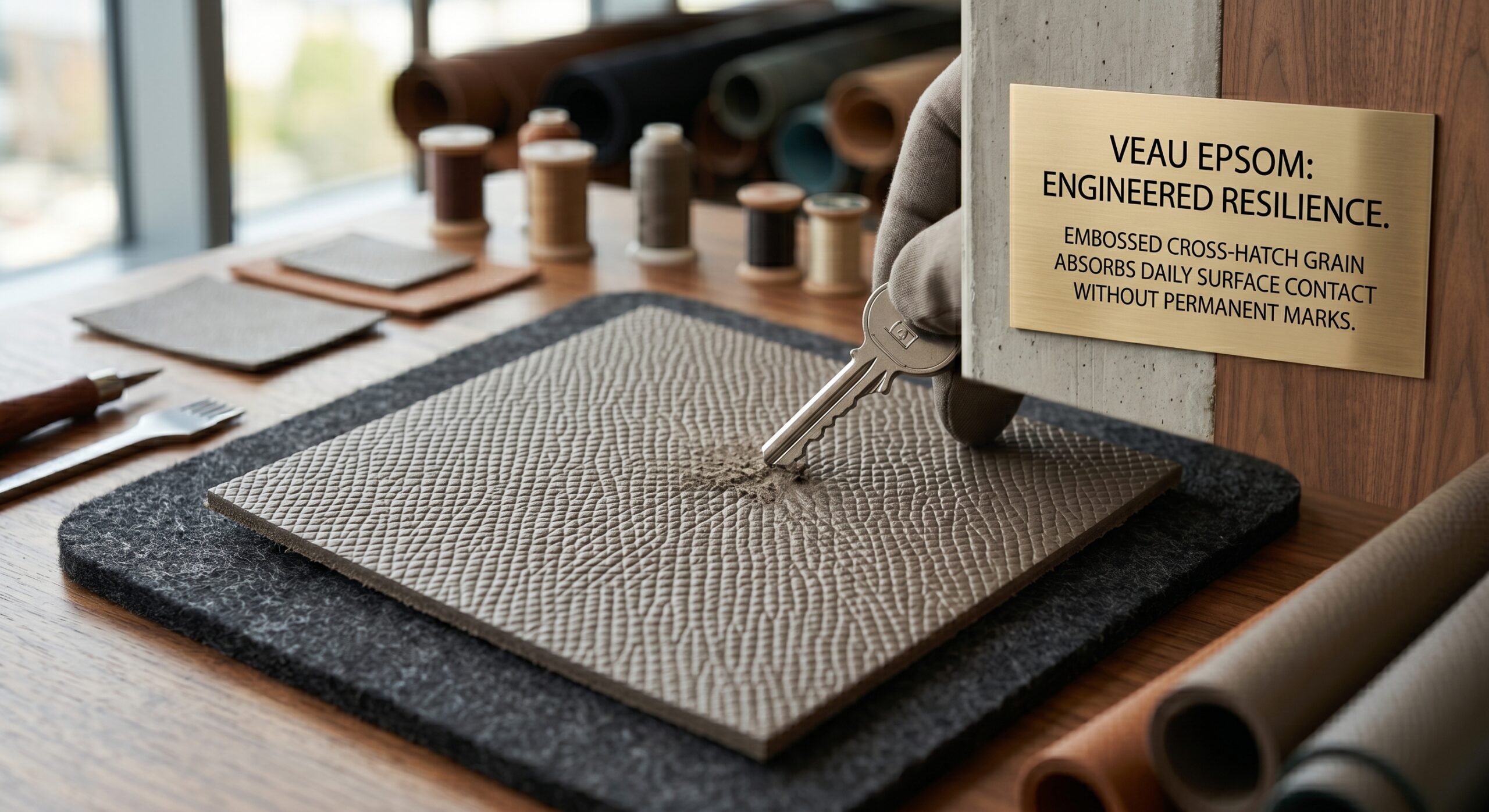
Epsom is the most technically resilient standard Hermès leather. Its embossed cross-hatch grain is created by pressing a pattern into the leather surface under heat, which simultaneously compresses the grain and creates a semi-rigid surface that resists abrasion. Scratches that would mark a smooth leather pass across Epsom's textured surface without leaving a visible trace in most cases. Its treated surface also resists moisture better than vegetable-tanned leathers, making it the most forgiving choice for buyers in wetter climates or urban environments.
"Epsom's durability advantage is not cosmetic — it is financial. A Birkin in Epsom used daily for two years has a higher statistical probability of achieving Grade A on Vestiaire than the same bag in any other standard leather."
The trade-off with Epsom is rigidity. Its structured surface does not develop the soft, lived-in character that Togo acquires over time — a quality some buyers and collectors value. On the secondary market, this is neutral: both Epsom and Togo command equivalent demand and comparable premiums in the same color and hardware configuration. The choice between them is durability profile, not resale outcome.
Togo's pebbled texture provides its own scratch resistance — surface marks tend to disappear back into the grain when the leather is gently rubbed. It develops a beautiful natural patina over time and retains structural integrity well in the 25 and 30 Birkin sizes. The Kelly in Togo Retourne construction benefits particularly from the leather's softness, which allows the bag to hold its characteristic shape without the stiffness of Epsom. For resale, Togo in popular colors with PHW is the single most liquid configuration across all four major platforms.
- For maximum daily durability and grade retention, specify Epsom — its treated surface is the most resistant to the surface abrasion that triggers condition downgrades.
- For buyers who prioritise the classic pebbled Birkin aesthetic alongside strong durability, Togo is the correct choice — its surface recovery from minor contact marks is excellent.
- Both Epsom and Togo in standard colors with PHW deliver the strongest resale liquidity on Fashionphile and The Real Real — these are the fastest-moving configurations on both platforms.
- Avoid light colors in either leather for daily use unless your storage and handling discipline is exceptional — color transfer risk is real and significantly affects condition grade assessment.
Clemence, Box Calf, and the Softer Leather Tier
Below the Epsom and Togo durability tier, Clemence, Box Calf, and several other leathers present meaningful resale risks for buyers who intend to use their quota bag daily. Understanding these risks before acquisition is essential — the secondary market grades these leathers on their actual condition, not on their reputation.
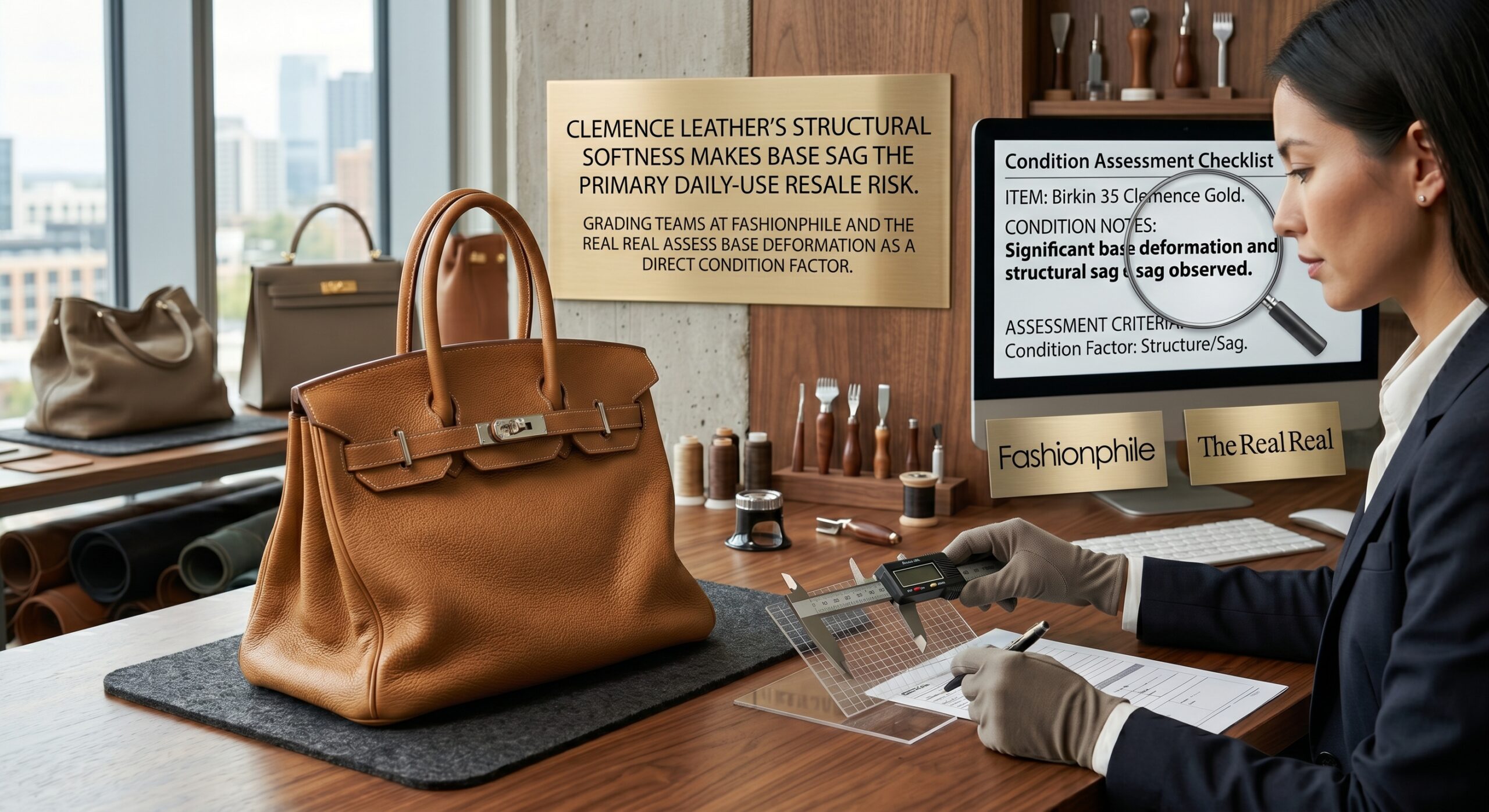
Clemence is the most popular Hermès leather after Togo — and for many buyers, the most dangerous choice for daily use. Its large, loose pebble grain feels luxurious and substantial, but the leather's softness means it does not hold structural shape under sustained weight and daily handling. Birkins in Clemence develop base sag — a subtle but platform-visible deformation of the bag's flat base — within months of regular use. The Birkin 35 in Clemence is particularly susceptible: the larger format amplifies the structural stress on the softer leather.
Fashionphile's grading team explicitly assesses base sag as a condition factor on Clemence pieces. A Birkin 30 in Clemence with visible base deformation will be graded Excellent at best — never Pristine — regardless of surface condition. On Vestiaire Collective, seller descriptions of "light sag" translate to Grade B in practice. That grade reduction can represent a price difference of approximately 12–20% versus an equivalent structurally intact piece.
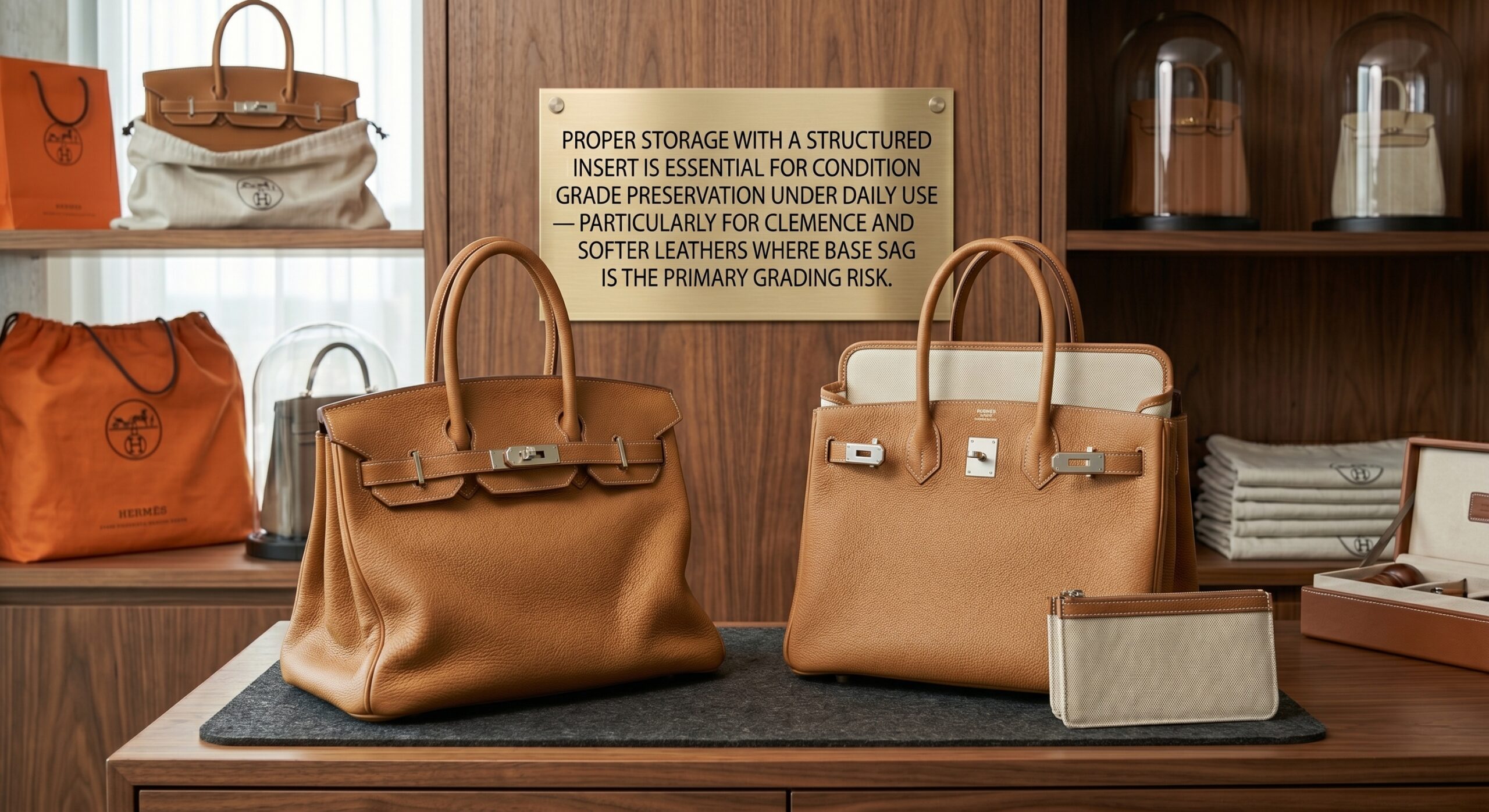
The practical implication: if you own a Clemence Birkin and intend to sell, use a bag insert to support the base during storage and minimise carrying time with heavy loads. Preventing sag is significantly easier than reversing it.
Box Calf presents a different problem. Its smooth, polished calfskin surface develops extraordinary patina over decades — vintage Box Calf Kellys on 1stDibs command serious collector premiums precisely because of this aging quality. But for daily use, Box Calf is uniquely vulnerable: its smooth surface registers every scratch, scuff, and contact mark with high visibility. Rain exposure without immediate attention can leave permanent watermarks. The grading penalty for a scratched Box Calf Birkin is disproportionate — what looks like a small mark in hand translates clearly in platform photography and triggers significant grade reductions.
Our detailed comparison of Hermès Chevre vs Epsom for durability and resale provides additional context on the mountain goat leather that sits between these tiers — a genuinely durable option with strong collector interest that many buyers overlook. And for understanding how weather and moisture affect leather condition over time, our analysis of whether the Hermès raincoat damages leather provides useful supporting data.
Buffalo Sindhu and Barenia are worth addressing briefly. Buffalo Sindhu — a soft, grainy leather occasionally offered in boutiques — has a similar durability profile to Clemence with lower collector recognition, making it a poor daily-use choice from both wear and resale perspectives. Barenia, by contrast, is a collector leather that develops a distinctive honey-toned patina with careful use — but it marks easily and requires specialist maintenance. Both are specialist leathers for selective buyers, not general daily-use options.
Choosing Your Daily Leather: The Acquisition Framework
When your SA presents a quota bag offer, the leather question is not just about aesthetics — it is about the use pattern you intend and the resale outcome you need. The framework for making that decision is straightforward once you know your holding timeline and daily use intensity.
For buyers who will carry the bag daily in an urban environment — commuting, client meetings, travel — Epsom is the defensible first choice. Its surface resilience means you can carry it with genuine confidence without sacrificing the condition grade that underpins your price-to-resale ratio. Togo is the correct alternative if you prefer the natural pebbled texture and are willing to apply basic leather conditioning every six months to maintain surface suppleness.
- Daily urban use — specify Epsom or Togo. Epsom for maximum surface resilience; Togo for texture preference with strong durability second.
- Occasional use, careful handling — Clemence is acceptable; budget for a bag insert to prevent base sag during storage and avoid loading the bag beyond approximately 1kg during carry.
- Collector purchase, minimal carry — Box Calf and Barenia are defensible for occasional use with specialist care, and command collector premiums on 1stDibs over time with a maintained patina.
- Avoid Box Calf entirely if you intend to sell within 5 years and cannot commit to specialist care and minimal use — the grade risk is too high relative to the premium available.
- For HSS (Hermès Special Service) leather choices, apply the same daily-use framework — an HSS commission in a durable leather with full documentation is significantly more resaleable than an HSS piece in a delicate leather without provenance.
The hardware interaction with leather condition is also relevant to this decision. Our analysis of how Hermès hardware type affects resale price breaks down how palladium and gold hardware patina differently across leather types — a factor that compounds the condition grade outcome over a daily-use holding period.
The broader secondary market context is available through the All Topics archive — leather durability strategy works most effectively when viewed alongside color, hardware, and size decisions as part of a coherent quota bag acquisition framework.
| Leather | Daily Use Rating | Grade A Retention | Resale Liquidity | Primary Risk |
|---|---|---|---|---|
| Epsom | Excellent | 18–24 months | Very High | Rigidity (no patina) |
| Togo | Very Good | 15–22 months | Very High | Corner wear at base studs |
| Chevre (Goatskin) | Good–Very Good | 12–18 months | Moderate–High | Less platform recognition |
| Clemence | Moderate | 6–12 months | Moderate | Base sag under daily load |
| Vache Liegee | Moderate | 10–16 months | Moderate | Stiffness, limited availability |
| Buffalo Sindhu | Poor | 4–8 months | Low | Sag + low buyer recognition |
| Box Calf | Poor (daily use) | 3–6 months | Moderate (collector only) | Surface scratch visibility |
| Barenia | Poor (daily use) | 3–8 months | Moderate (collector only) | Marks readily, needs specialist care |
Grade retention estimates reflect typical daily use conditions. Storage quality, climate, and carry weight significantly affect outcomes. All resale data approximate and based on observed secondary market patterns.
Epsom and Togo Win for Daily Use — Everything Else Is a Trade-Off
The secondary market grades leather condition objectively, and the data is consistent: Epsom and Togo hold condition grade better than any other standard Hermès leather under daily use. Epsom's treated surface resists the surface abrasion that triggers grade reductions on Vestiaire Collective and The Real Real. Togo's pebbled texture recovers from minor contact marks and maintains structural integrity across the most popular Birkin and Kelly sizes.
Clemence is the most commonly misunderstood leather from an investment perspective. Its popularity at retail — driven by its sumptuous hand feel — masks a significant durability disadvantage for daily users. Base sag is not cosmetic; it is a grading event. A Clemence Birkin that arrives at Fashionphile with a deformed base will not be graded Pristine regardless of surface condition, and the price reduction that follows is real and meaningful.
Box Calf belongs in a collector's rotation with careful stewardship — not in a daily-carry slot. Its vulnerability to surface marking under regular use makes it incompatible with maintaining the grade premium that justifies its collector positioning at resale.
Bottom Line: For daily use with resale value preservation, specify Epsom first and Togo second — these are the only two standard leathers that reliably support a Grade A or Pristine condition outcome over an 18-month daily carry period.
Popular Searches
Explore our most searched Hermès leather durability and resale questions
Frequently Asked Questions
Epsom is the most scratch-resistant and structure-retaining Hermès leather for daily use — its tight cross-hatch grain resists surface abrasion better than any other standard leather. Togo is the preferred choice for buyers who want durability combined with the natural pebbled texture that characterises the classic Birkin look. Clemence is the softest and most prone to developing sag over time, which directly affects condition grade and resale value under sustained daily use. For a full comparison of Chevre vs Epsom specifically, see our guide on Hermès Chevre vs Epsom for durability and resale.
Significantly. Togo and Epsom are the two leathers with the broadest buyer recognition on Vestiaire Collective, The Real Real, Fashionphile, and 1stDibs — they sell faster and with more predictable pricing than rarer leathers. Clemence bags in lower condition grades can sit on platforms for extended periods, as buyers associate the leather's softness with structural wear. Box Calf commands strong premiums among collectors but requires specialist care to maintain grade — a scratched Box Calf Birkin loses value disproportionately.
Condition grade degradation is the primary resale value risk for daily-use quota bags. On Vestiaire Collective, the difference between a Grade A and Grade B+ listing in the same leather and configuration can represent a 15–25% price reduction. Epsom degrades most slowly under daily use due to its treated surface. Togo shows wear at corners and base studs first but holds surface condition well. Clemence and Buffalo Sindhu are most vulnerable to sag and base wear, which accelerates grade reduction. See our Hermès raincoat leather damage test for the impact of weather exposure on leather condition.
Box Calf is not recommended for daily use by buyers whose primary concern is resale value preservation. Its smooth, polished surface shows scratches and scuffs readily — a single season of daily use can drop a Box Calf piece from Pristine to Good condition grade, erasing a meaningful portion of its premium. Box Calf is best suited for occasional use with careful storage, or for vintage collecting on platforms like 1stDibs where patina is understood and valued rather than penalised.