Hermès Rare Colors That Outperform on the Resale Market
A platform-by-platform breakdown of which discontinued and limited shades command the strongest price premiums — and which rare colors are traps for uninformed buyers.
On Vestiaire Collective, a Birkin 30 in Rose Shocking Togo with palladium hardware can list at a 35–45% premium above an equivalent Birkin 30 in Etain — same size, same leather, same hardware. That price delta is not about taste. It is about secondary market scarcity, active collector demand, and the fundamental economics of Hermès rare colors: when a shade is discontinued, retail supply ends permanently while buyer interest does not.
In 2026, the gap between top-performing rare colors and underperforming ones has widened. Not every discontinued shade commands a premium — some colors that generated collector excitement years ago have quietly dropped back toward neutral territory on The Real Real and Fashionphile. Meanwhile, a small cluster of blues, pinks, and jewel tones continue to deliver some of the strongest price-to-resale ratios in the entire quota bag market.
This article gives you the market intelligence to make color-informed acquisition decisions: which rare Hermès colors consistently outperform, which platforms reward patience with rare shades, and how to weigh the liquidity trade-off between a fast-selling neutral and a premium-commanding statement color.
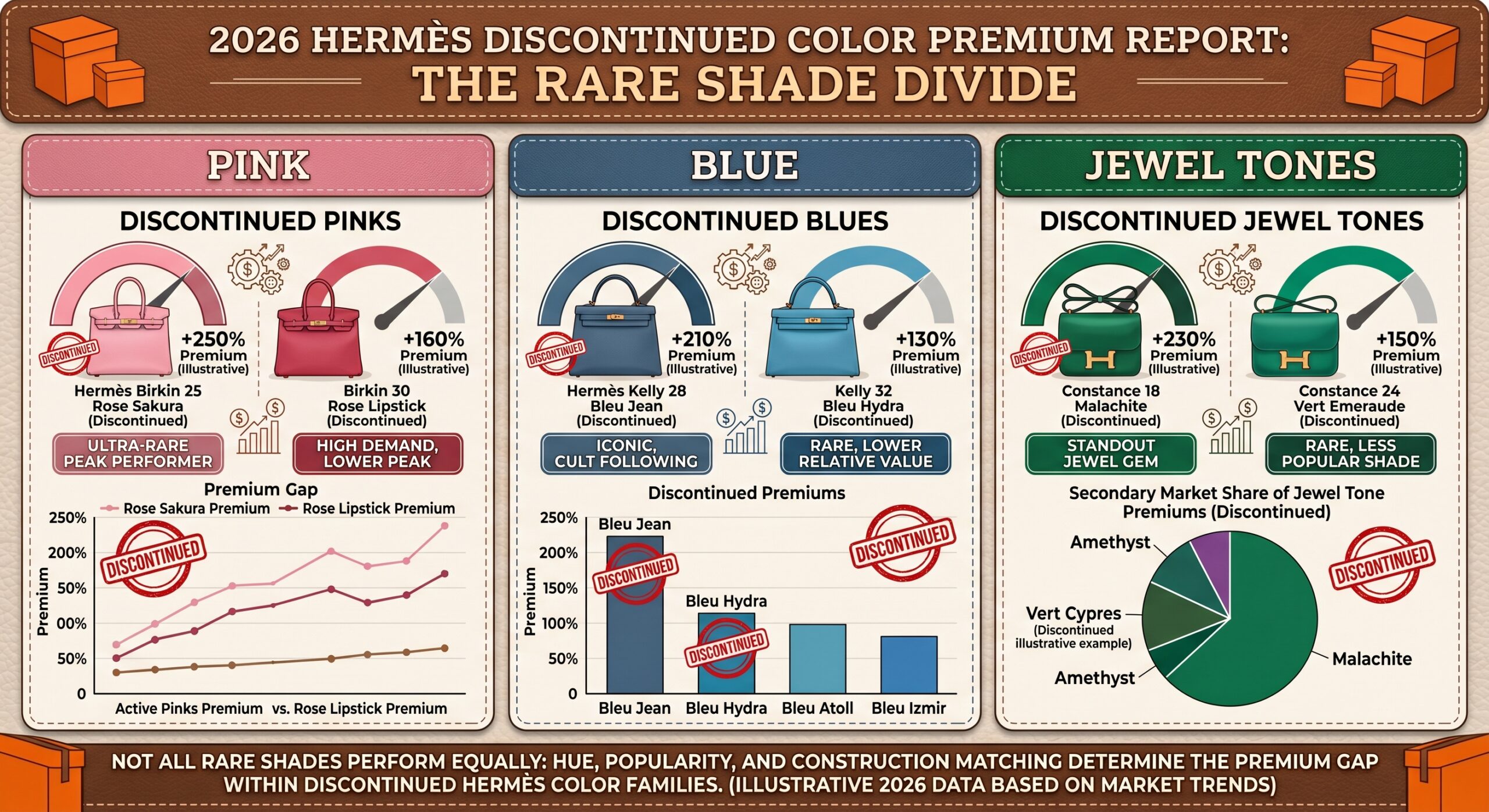
How Hermès Color Rarity Translates to Resale Premium
Hermès produces approximately 35–45 active colors in any given season across its leather range. Over the brand's history, an estimated 400 or more distinct shades have been introduced and subsequently retired. That discontinuation mechanism is what creates secondary market value: a buyer who missed a specific color at retail has exactly one route to acquisition — the resale platforms.
The full spectrum of available shades is documented in the Hermès Colors Reference Hub, but the investment principle is straightforward. Colors that Hermès has permanently retired command premiums proportional to three factors: how visually distinctive the shade is, how large the collector community around it has grown, and how long since it was last in active production. A recently discontinued color in a muted family may command little premium initially. A vibrant shade retired a decade ago with an active collector following commands the strongest premiums consistently.
Platform dynamics matter significantly here. Vestiaire Collective and 1stDibs both serve international buyer pools — the global reach means a collector in Tokyo or Dubai can compete for a Rose Shocking Birkin listed in London, pushing final prices higher. Fashionphile and The Real Real are more US-centric, which means rare colors that appeal primarily to American buyers perform well there, while colors with stronger Asian or European collector bases underperform relative to their true global market value.
When Hermès retires a color, secondary market prices do not spike immediately. The initial 12–18 months post-discontinuation are often flat or only modestly elevated — existing stock from recent seasons still filters through resale channels. The premium builds over 2–4 years as retail-sourced stock diminishes and only well-maintained older pieces remain in circulation.
This creates a buying opportunity: a recently discontinued shade in excellent condition, acquired at a modest premium today, may appreciate significantly over a 3–5 year holding period if collector demand remains active. The risk is that some discontinued colors simply fail to attract sustained collector interest — which is why tracking which color families consistently outperform is essential before making a color-driven acquisition.
Understanding this timeline is central to any color-informed acquisition strategy. Buying a recently discontinued shade at a small premium carries real upside — but only if you have read the collector demand signals correctly.
The Rare Colors That Consistently Outperform
Across Vestiaire Collective, The Real Real, Fashionphile, and 1stDibs, a consistent pattern emerges: the strongest-performing rare colors cluster in three families — saturated blues, vivid pinks and reds, and jewel-tone greens. Within those families, specific shades have built collector communities large enough to sustain premium pricing regardless of broader market conditions.
Rose Shocking is the standout performer in 2026. Originally produced in multiple leather types across different eras, it has maintained collector demand that places it at the top of the rare-color premium ranking on Vestiaire Collective and 1stDibs consistently. A Birkin 25 in Rose Shocking Togo with PHW in condition grade A can command prices that rival some smaller exotic leather configurations — a remarkable position for a standard leather in a single color.
"Rose Shocking and Bleu Electrique are the two rare Hermès colors where collector demand is deep enough to absorb supply spikes — even when multiple examples appear on Vestiaire simultaneously, prices hold."
Bleu Electrique commands the second-strongest sustained premium, driven by the enduring collector appetite for vivid blues across the Hermès range. Its distinctiveness from the blues currently in production — Bleu de Malte, Bleu Saphir, Bleu Brume — means it reads as genuinely irreplaceable to buyers who know the color history. On 1stDibs, Bleu Electrique pieces in excellent condition with provenance are among the fastest-moving rare color listings.
- Prioritise blues and pinks when evaluating a rare-color quota bag offer — these families deliver the most reliable collector premiums across platforms.
- Vert Criquet and jewel-tone greens perform strongly on Vestiaire's international buyer pool — European and Asian collectors drive demand for these shades specifically.
- Jaune Ambre and related ambers attract a dedicated collector tier but are slower to sell than blues and pinks — plan for a longer listing period if you need to exit.
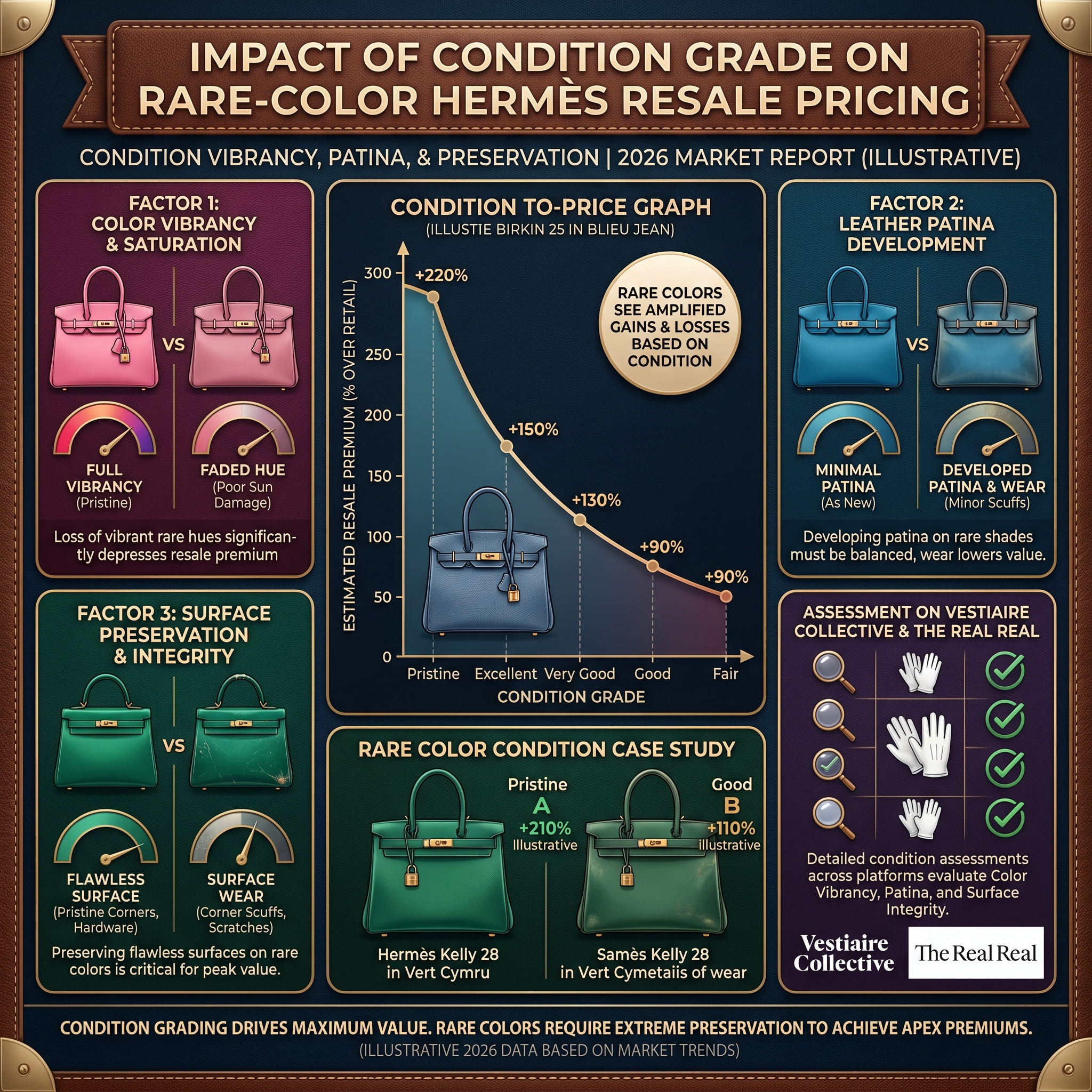
- Condition grade A or Pristine is non-negotiable for maximum rare-color premium — a grade drop on a statement color costs proportionally more than on a neutral.
Rouge Casaque and related reds occupy a middle tier — strong collector interest, but a larger pool of comparable listings means competition is higher and prices are somewhat more variable. Anemone (a rich purple-violet) has built genuine collector depth in the past three years and is now performing consistently in the 20–30% premium range on Vestiaire.
Neutrals vs Rare Colors: The Liquidity Trade-Off
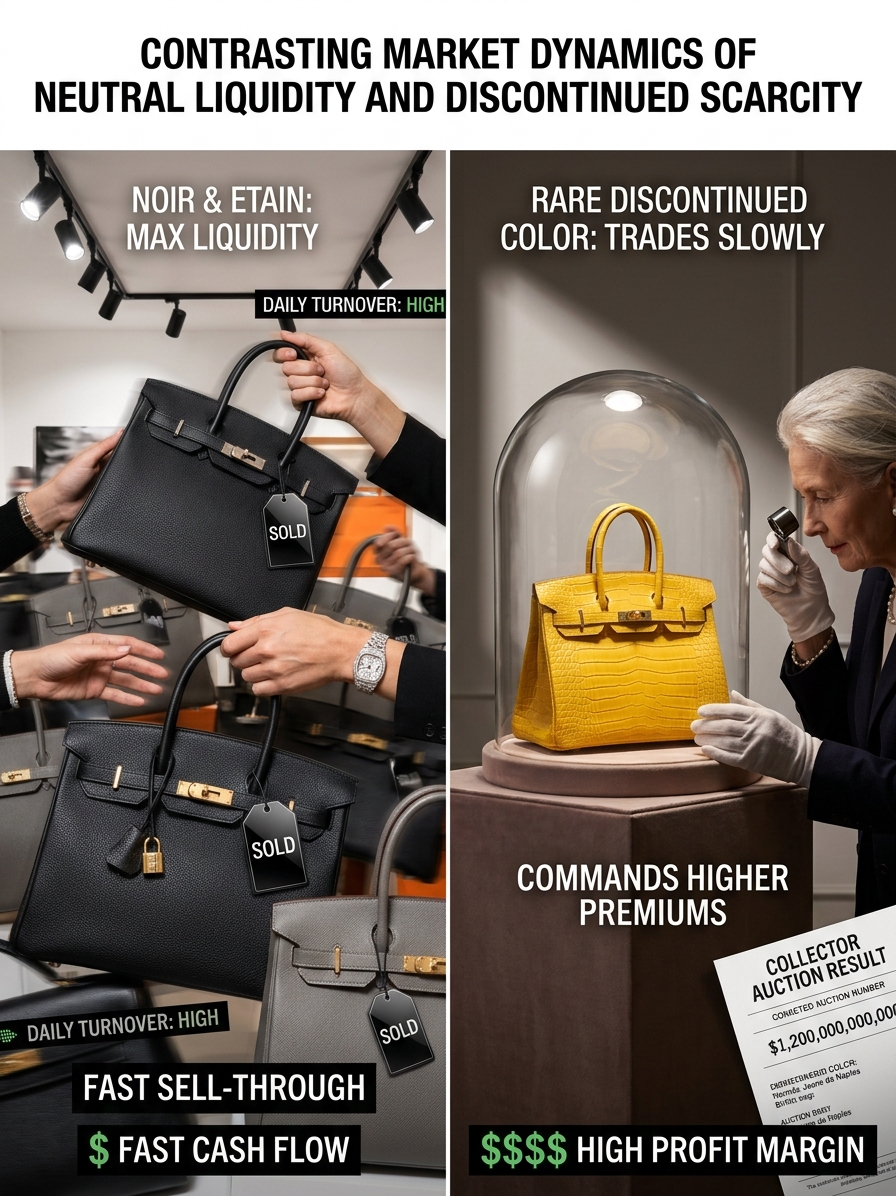
The most important tension in color-driven acquisition strategy is not which rare color outperforms — it is whether the liquidity trade-off of a rare color is acceptable given your holding timeline and exit flexibility requirements.
Neutral colors — Noir, Etain, Gold/Fauve, Etoupe, and Nata — are the workhorses of the secondary market. A Birkin 30 in Noir Togo with PHW sells within days on Fashionphile or The Real Real at a consistent premium of approximately 20–30% above retail in excellent condition. The buyer pool for Noir is essentially unlimited: it appeals to first-time quota bag buyers, experienced collectors, and resellers building inventory. When you need liquidity quickly — whether for financial reasons or because a better acquisition opportunity has appeared — a neutral delivers it reliably.
Rare colors invert this dynamic. The buyer pool is smaller but more motivated. A collector searching specifically for Rose Shocking will pay significantly more than a general buyer looking at Birkins broadly — but that collector may only appear once a week or once a month on any given platform. This means rare-color listings require patience and the right platform selection to achieve maximum price.
For rare colors in the blue, pink, and jewel-tone families, Vestiaire Collective is the strongest platform — its international reach surfaces the specific collectors who have been waiting for that exact shade. List at your target price and allow 4–8 weeks for the right buyer to appear. Dropping the price early is a common mistake that costs sellers 10–20% of achievable value.
1stDibs is the correct platform for vintage rare colors, exotic leather rare-color combinations, and any piece with exceptional provenance documentation. Its buyer pool skews toward high-spend collectors who understand and value color rarity. The Real Real and Fashionphile are better suited for neutrals and current-production colors where speed of sale matters more than price maximisation.
Our analysis of Hermès reseller market price drop trends from 2024 to 2026 provides useful broader context: the correction in the overall secondary market has affected neutrals more than top-tier rare colors, which have held premium levels more stubbornly. This divergence is meaningful for buyers considering whether to accept a neutral or rare-color offer from their SA.
The practical framework is this: if your holding timeline is under 12 months or your exit flexibility is limited, a neutral is the safer choice — liquidity is guaranteed. If you have a 2–5 year holding horizon and can wait for the right buyer, a top-tier rare color in excellent condition represents the stronger investment position. The price delta compounds over time as retail supply permanently diminishes.
For buyers tracking the Noir versus Etain debate specifically — our dedicated analysis at Hermès Noir vs Etain resale comparison breaks down the performance differential between the two most prominent neutral shades across all four major platforms. And for buyers trying to understand how hardware color interacts with leather color in the resale pricing equation, our hardware type resale price analysis provides the supporting data.
How to Use Color Intelligence in Your Acquisition Strategy
Color intelligence should inform your response to two specific moments in the quota bag acquisition process: when your SA presents an offer in a color you had not requested, and when you are evaluating a resale platform purchase in a rare shade you have been targeting.
When your SA presents an unexpected color offer, the instinct to decline anything outside your requested specification is understandable but financially costly. Before declining, check the secondary market immediately — a quick search on Vestiaire Collective and Fashionphile will tell you within minutes whether the offered color is trading at a premium, at retail, or below. A Rose Shocking Birkin offer declined because you wanted Etain is a significant financial error if you understand the resale differential. Accept the offer, hold the bag to the appropriate condition grade, and sell at the premium if the color is not right for your personal collection.
- Never decline a quota bag offer in a proven rare color without first checking its secondary market position — even a 30-second Vestiaire search can prevent a costly decision.
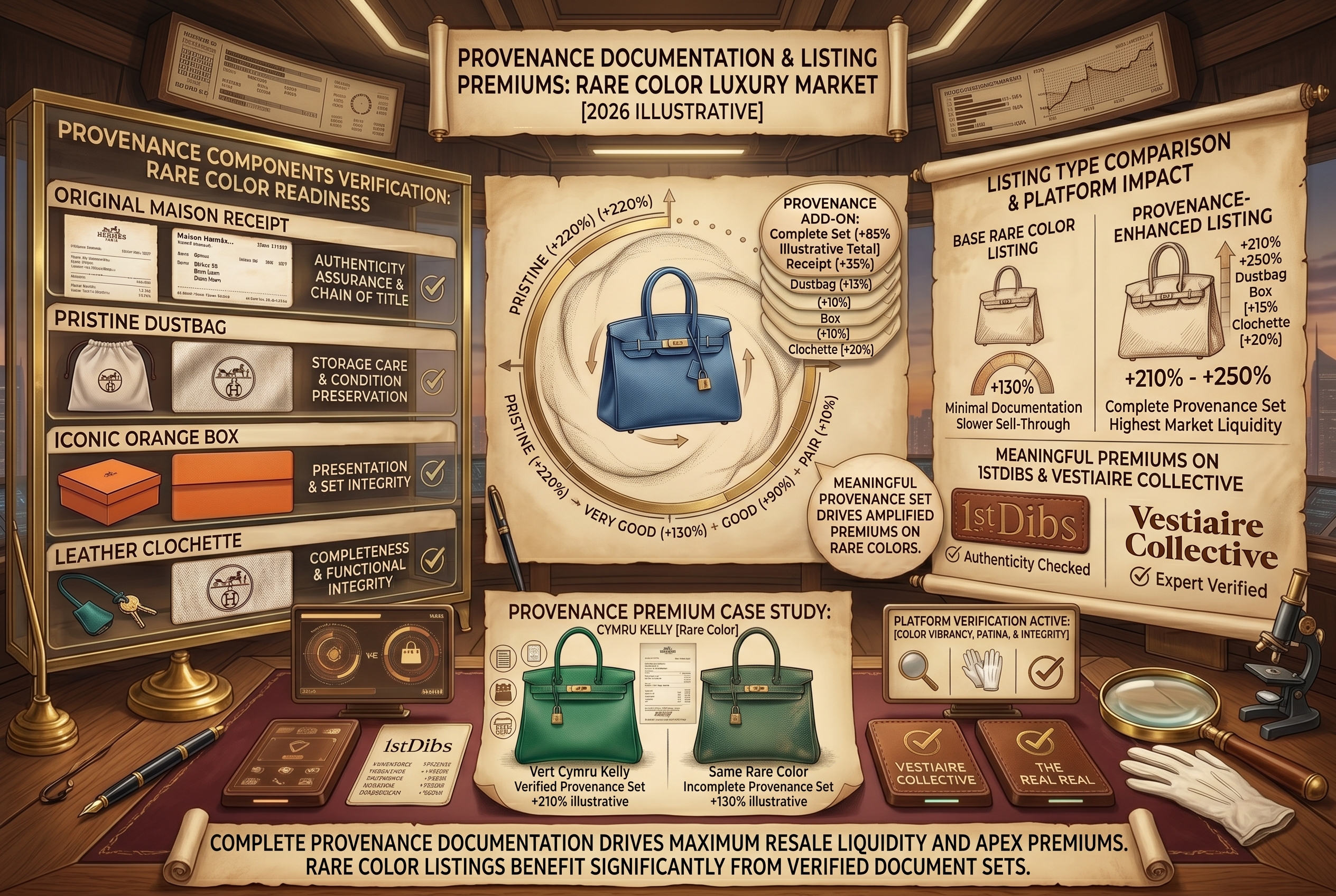
- If accepting a rare-color offer you intend to resell, document condition meticulously from day one — full provenance (receipt, dustbag, box, clochette) adds a meaningful premium at the point of sale.
- When listing a rare color, choose your platform before setting your price — Vestiaire Collective for international collector reach, 1stDibs for vintage or exotic configurations, not The Real Real where the rare-color buyer pool is thinner.
- Set your listing price at the top of the observed range and hold it — rare-color buyers are motivated and will pay if the color is genuinely scarce. Early discounting is the most common rare-color seller mistake.
- If acquiring a rare color via resale platforms for personal collection, condition grade A or Pristine is the only entry point worth considering — degraded rare colors lose their premium entirely and are very difficult to sell at any price.
For HSS (Hermès Special Service) color combinations — custom shades created through a special order — the resale dynamics are more complex. An HSS piece in a near-rare color with full documentation can outperform the retail equivalent significantly. Without provenance, buyers on Vestiaire and 1stDibs are cautious, and the achievable premium shrinks. If you pursue HSS as part of your boutique strategy, maintain all documentation from the moment of commission through to any eventual resale.
The category archive at All Topics provides the full market intelligence framework across styles, leathers, hardware, and colors — color strategy works best when viewed alongside the other variables that determine resale outcome.
| Color | Status | Price Delta vs Neutral | Liquidity | Best Platform |
|---|---|---|---|---|
| Rose Shocking | Discontinued | +35–45% | Moderate (collector-driven) | Vestiaire · 1stDibs |
| Bleu Electrique | Discontinued | +30–42% | Moderate | Vestiaire · 1stDibs |
| Vert Criquet | Discontinued | +28–38% | Moderate | Vestiaire Collective |
| Anemone | Discontinued | +20–30% | Moderate | Vestiaire · 1stDibs |
| Jaune Ambre | Discontinued | +22–32% | Low–Moderate | Vestiaire Collective |
| Rouge Casaque | Discontinued | +18–28% | Moderate | Fashionphile · Vestiaire |
| Noir | Current | +20–30% | Very High | Fashionphile · TRR |
| Etain | Current | +15–25% | High | Fashionphile · TRR |
| Etoupe | Current | +12–22% | High | The Real Real · Fashionphile |
| Obscure discontinued shades | Discontinued | 0–10% | Low | 1stDibs (specialist buyers only) |
Price delta figures are approximate and reflect observed secondary market ranges vs. comparable neutral-color quota bags in good to excellent condition. Exotic leathers, exceptional provenance, and specific size combinations can significantly exceed these ranges.
Rare Colors Add Real Premium — But Only the Right Ones
The secondary market data is clear: Hermès rare colors in the blue, pink, and jewel-tone families deliver genuine price deltas that justify careful color strategy. Rose Shocking and Bleu Electrique are the most consistent performers in 2026 — not because they are merely scarce, but because active collector communities maintain demand even when multiple examples appear on the market simultaneously.
The trap is treating all discontinued colors as equal. Colors without strong collector communities sit on Vestiaire and Fashionphile at near-retail prices for months — the rarity premium only exists where buyer demand is present. Before accepting or pursuing any rare-color piece, spend ten minutes checking active listings and recent sold prices on your target platforms. That research is what separates color strategy from color speculation.
The liquidity trade-off is real and must be factored in. If your boutique relationship is generating a rare-color offer, verify the secondary market position immediately. If it is a top-tier shade in excellent condition, accept — even if you intend to resell. The price delta over a neutral in the same configuration is meaningful enough to make that decision straightforward.
Bottom Line: In 2026, the highest-value color positions are Rose Shocking, Bleu Electrique, and Vert Criquet — accept SA offers in these shades at any opportunity, document condition and provenance from day one, and list on Vestiaire or 1stDibs with patience to achieve maximum premium.
Popular Searches
Explore our most searched Hermès color investment and acquisition questions
Frequently Asked Questions
Discontinued and seasonally limited colors consistently command the strongest premiums on the secondary market. Rose Shocking, Bleu Electrique, Vert Criquet, and Jaune Ambre in good to excellent condition regularly achieve price deltas of 20–45% above comparable neutral-color pieces on Vestiaire Collective and 1stDibs. Neutrals like Noir and Etain are the most liquid but deliver lower premiums — typically 10–25% above retail for quota bags. For a direct comparison of those two neutrals, see our Hermès Noir vs Etain resale comparison.
Almost always, yes — with important nuance. A discontinued color in a popular family (blues, pinks, jewel tones) commands a meaningful premium over its current-season equivalent because secondary market supply is finite and shrinking. However, a discontinued color in an unfashionable family or an obscure shade can sit on Vestiaire for months at below-retail prices. The premium belongs to colors with active collector communities, not simply to any color that Hermès no longer produces.
Significantly. Neutral colors — Noir, Etain, Gold/Fauve, Etoupe — sell fastest across all platforms because they appeal to the broadest buyer pool. Rare colors sell more slowly but achieve higher prices when they do sell, particularly on Vestiaire Collective and 1stDibs where international collectors browse actively. The liquidity-versus-premium trade-off is real: if you need fast exit, list a neutral. If you can wait for the right buyer, a rare color in excellent condition will outperform. See our Hermès reseller market price drop analysis for the broader platform trend data.
HSS (Hermès Special Service) pieces do command premiums on the secondary market — particularly when the color and leather combination is genuinely unusual. However, HSS bags take longer to sell because buyers cannot verify the combination against a known retail reference. On Vestiaire and 1stDibs, a well-documented HSS piece with receipt and original order paperwork can achieve a 15–30% premium over an equivalent retail-issue bag. Without provenance documentation, that premium shrinks considerably.