How to Tie a Twilly on a Kelly Handle Perfectly
The market-focused guide to Twilly tying — the techniques that maximise handle protection, the knots that stay secure under daily carry, and the direct impact on condition grade and resale value.
The Kelly handle is the most condition-sensitive structural element of the bag at resale. Handle darkening from hand oils and perspiration, surface wear from friction, and corner fraying at the attachment points are the three most commonly noted handle-specific issues in Fashionphile and The Real Real grading reports — and all three are significantly accelerated by daily carry without protection. A Hermès Twilly tied correctly around the Kelly handle creates a silk barrier that absorbs the majority of this contact wear, extending the period of Grade A or Excellent handle condition by months to years depending on carry frequency and climate.
The Twilly — the 5cm × 85cm silk ribbon that Hermès produces alongside its carré collections — was designed specifically for this purpose alongside its scarf-tying function. Its dimensions are not arbitrary: 85cm is the length required to wrap a Kelly handle fully and tie off at each end without excess bulk, and 5cm is the width that provides adequate coverage without covering the decorative side stitching that defines the Kelly's handle silhouette. Tying it correctly is not complicated once the correct technique is understood, but the most common mistakes — tying too tightly, using the wrong knot, or leaving the centre of the handle unprotected — reduce both the protection function and the aesthetic result simultaneously.
This article covers the complete handle Twilly system: the resale value mechanics that make handle protection a financial decision, the step-by-step technique for the spiral wrap that provides maximum coverage, and the four main knot variations with their specific use cases and protection coverage differences.
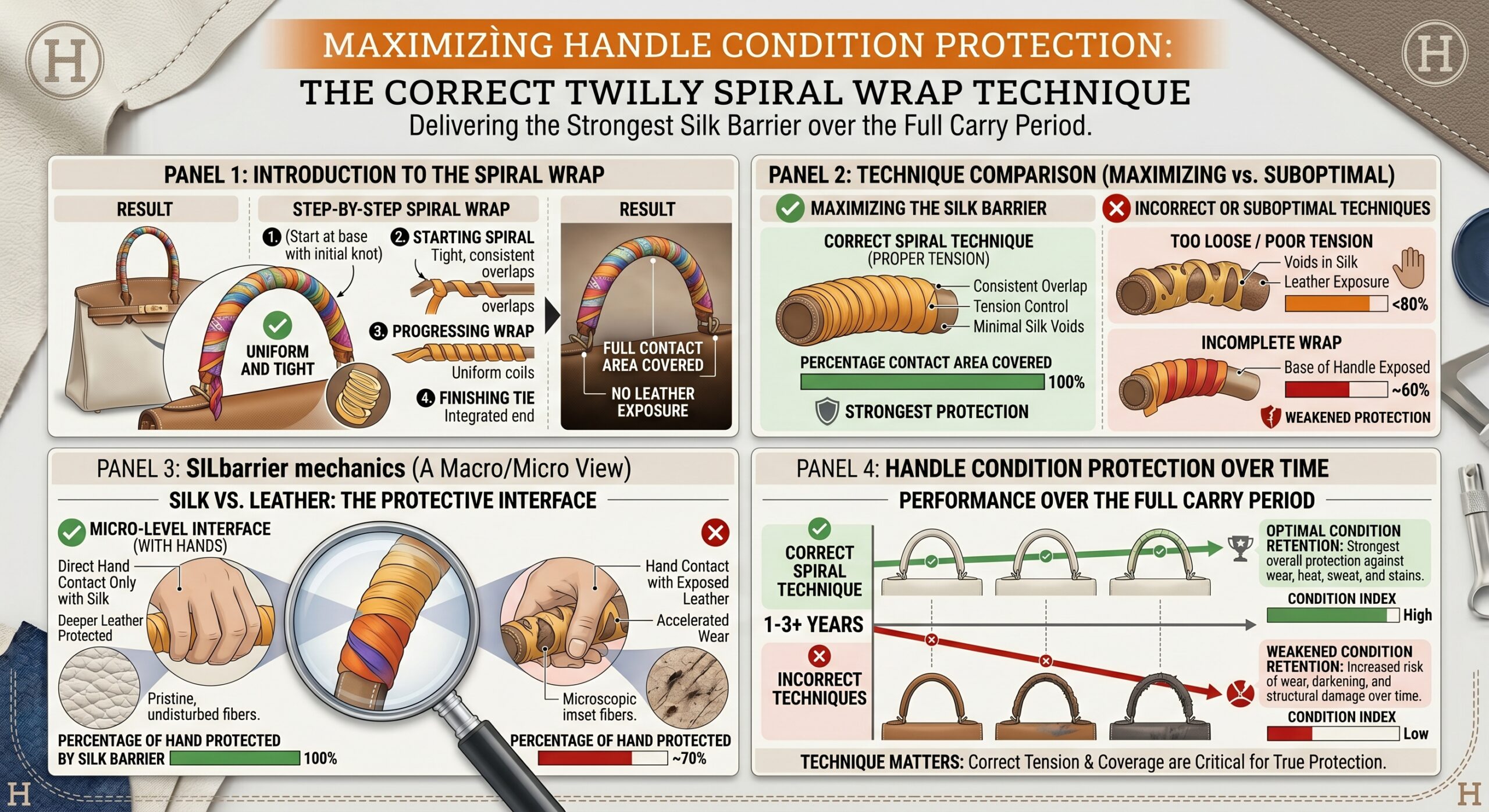
Why Handle Protection Is a Resale Value Decision
The connection between Twilly use and resale value runs directly through the condition grade system that all four major resale platforms apply to Kelly handles. Handle condition is assessed as part of the overall leather condition grade — a handle with visible darkening, surface wear, or corner fraying will not receive a Pristine or Grade A assessment regardless of how well the rest of the bag has been maintained. Platform graders photograph handles specifically, and handle condition notes appear explicitly in grading reports when any of the three main wear patterns are visible.
The full care framework that encompasses handle protection alongside structural support and humidity management is covered in the Hermès Care & Storage Guide. The handle-specific dimension requires understanding which of the three main wear mechanisms the Twilly prevents and which it does not, so that protection expectations are correctly calibrated.
Handle darkening is the most common handle wear pattern in Kelly grading reports — it results from the progressive transfer of hand oils and perspiration to the leather surface over repeated carry. The Twilly prevents this mechanism almost entirely when tied correctly, since the silk absorbs the oils before they reach the leather. This is the most significant protection benefit and the primary reason experienced Kelly holders tie Twillys for daily carry.
Surface friction wear — the subtle abrasion of the handle leather's surface finish from repeated contact — is also significantly reduced by Twilly use, since the silk distributes contact over a wider and softer surface than bare hand grip. Corner fraying at the attachment points, where the handle meets the bag's hardware attachment, is partially reduced by Twilly use but not fully prevented — the attachment point stress is structural rather than contact-driven and is more affected by carry weight and carry frequency than by surface protection. The Twilly protects two of the three main mechanisms completely and partially reduces the third.
The financial stakes of this protection are concrete. On Fashionphile, a Kelly 28 in excellent overall condition but with visibly darkened handles — a common presentation for daily-use bags carried without protection — is assessed at Excellent rather than Pristine. The price delta between these two grades on a Kelly 28 in Togo with GHW is approximately $1,200–$2,000 depending on colour and configuration. A Hermès Twilly costs approximately $200–$280 at retail. The return on the handle protection investment is one of the clearest cost-benefit calculations in the full Kelly ownership framework.
The aesthetic dimension of the Twilly on the Kelly handle — the styling options, colour selection, and how different knot styles read against different leather and hardware combinations — is covered in depth by the design team at Hermès Guidance Lounge's Twilly Kelly handle styling guide. This article focuses on the technique and protection function; the styling dimension is fully addressed there.
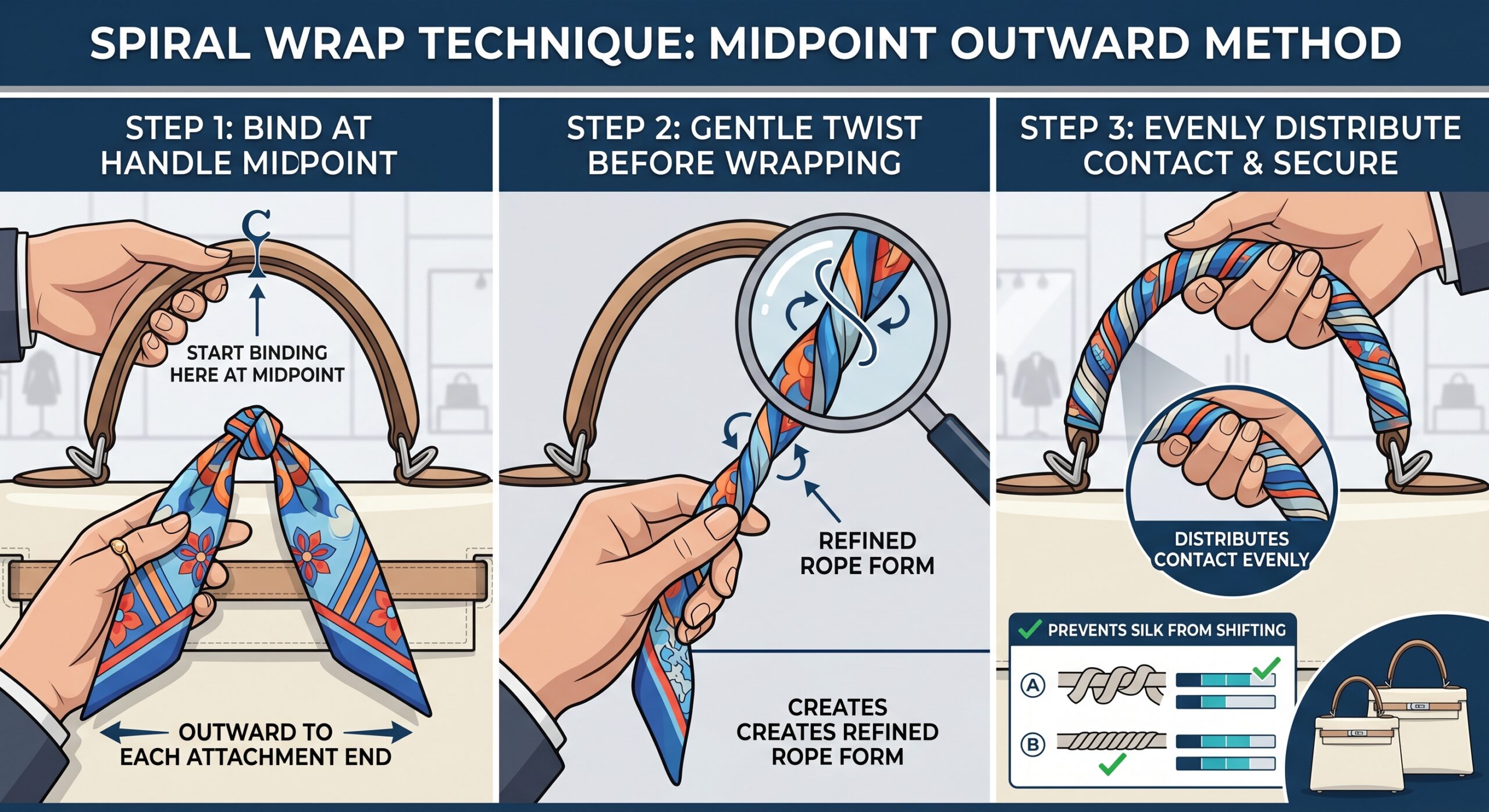
The Spiral Wrap: Step-by-Step Technique
The spiral wrap is the technique that provides the most complete handle coverage and the most secure hold under daily carry. It is also the technique that most closely approximates the way Hermès SA teams demonstrate Twilly use in boutique — the canonical approach that the bag was designed to receive. The following steps apply to a standard Kelly 25 or 28 handle; the technique is identical for both sizes, with slightly more Twilly length remaining at each end on the 28.
"The spiral wrap is not simply decorative — it is an engineering solution to the handle wear problem. The coverage geometry, the twist that creates the rope form, and the reef knot at each end are all functional choices, not arbitrary ones."
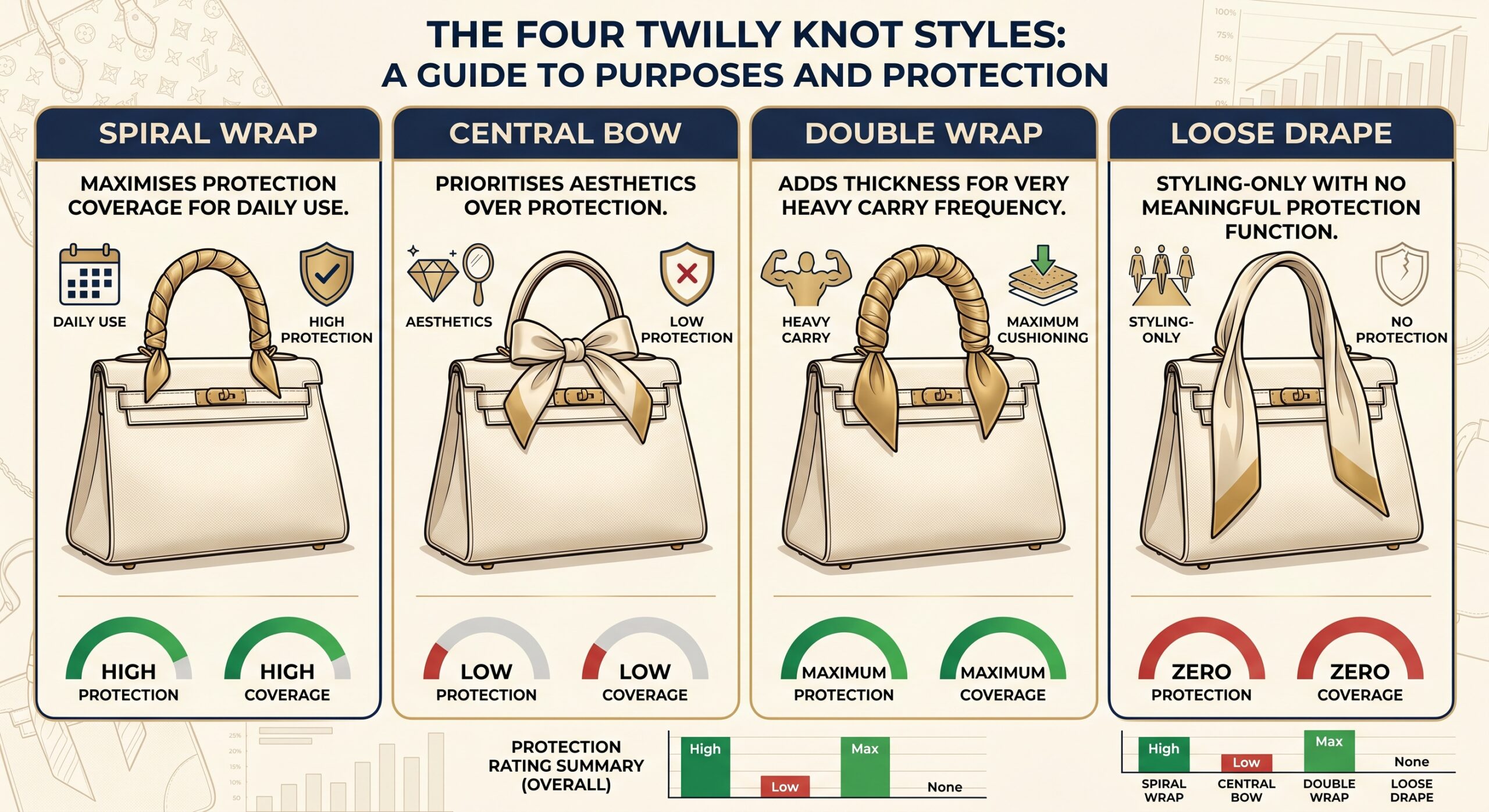
Four Knot Styles: Which Works for Which Purpose
The spiral wrap described above is the most practical technique for daily use and maximum protection. But several alternative knotting approaches are used by Kelly holders for different reasons — some prioritise aesthetic presentation over protection coverage, others suit specific carry contexts or Twilly lengths. Understanding the trade-offs of each allows holders to choose the approach that matches their specific priorities.
For holders whose primary objective is protection rather than styling — particularly those carrying their Kelly daily and targeting Grade A condition at eventual resale — the spiral wrap is the unambiguous technique choice. The central bow and loose drape achieve their respective aesthetic effects but sacrifice meaningful portions of the handle coverage that prevents the darkening and surface wear that affects grading. Holders who prefer the bow aesthetic can use a spiral wrap for daily carry and retie as a central bow for specific occasions where photography or presentation matters — the transition takes approximately 90 seconds once the spiral technique is fluent.
- For daily-use Kelly holders: tie the spiral wrap once and leave it in position for the full carry day — retying daily introduces the risk of imprecise coverage gaps that accumulate protection failures over time.
- Remove the Twilly before storage — the handle should breathe naturally during storage periods, and the Twilly can accumulate moisture during carry that should not remain against the leather overnight. The same principle applies before returning the bag to its dustbag.
- For Kelly 25 Sellier specifically: the Sellier's rigid construction means the handle sits in a more fixed position than the Retourne — the spiral wrap coverage geometry works identically on both constructions, but the Sellier's handle is slightly more exposed during carry due to its stiffer stance.
- For light-coloured Kelly leathers (Craie, Nata, Gold, Biscuit): handle protection is more urgent than for dark colours, since darkening from hand oils is more visible on pale leather backgrounds. Pair Twilly use with the colour transfer prevention approach covered in our guide to preventing colour transfer on light Hermès leather.
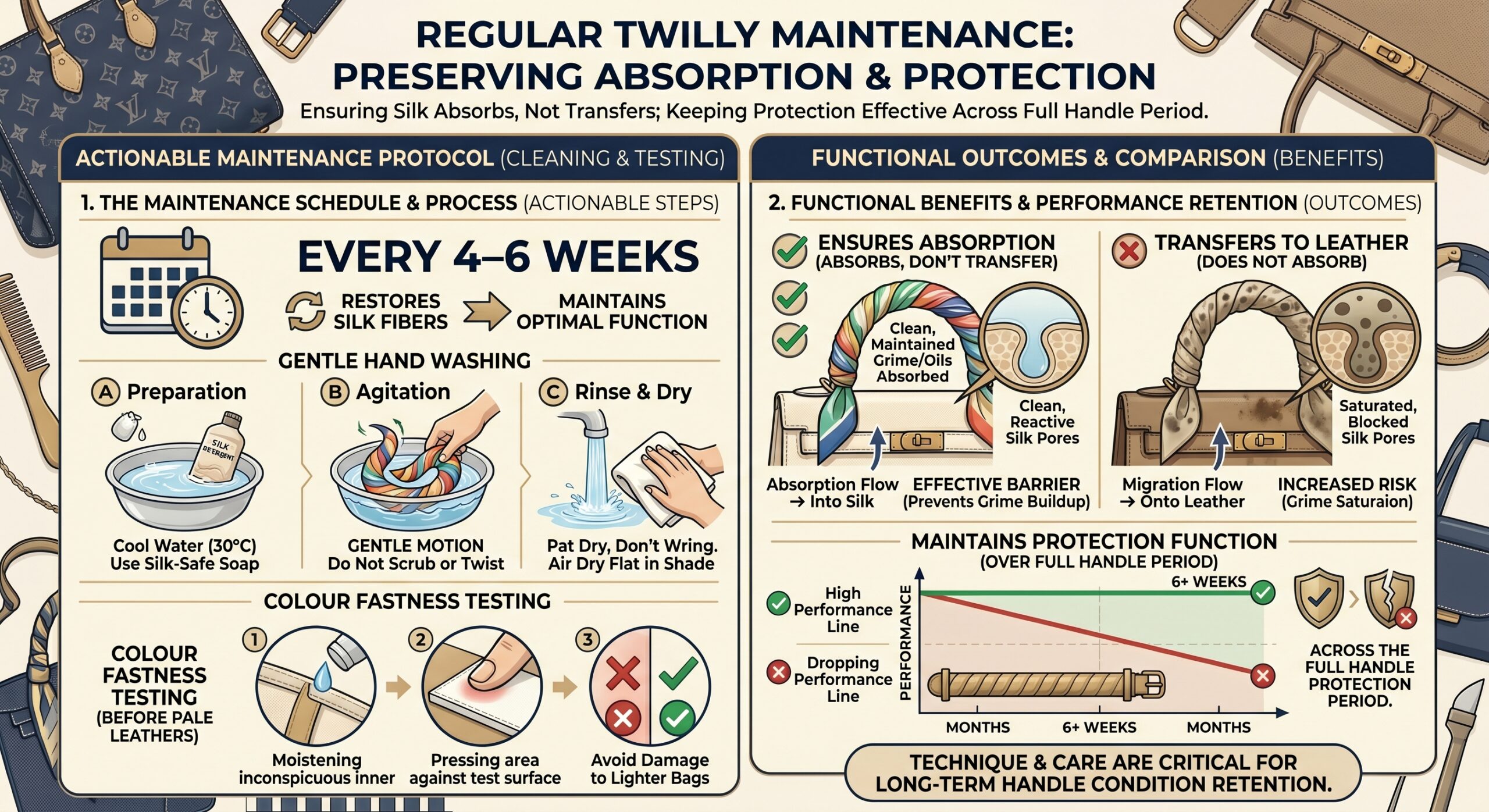
Care, Maintenance, and What to Avoid
The Twilly itself requires maintenance to remain effective as a handle protection tool — a dirty or dye-saturated Twilly provides less protection and introduces new risks. The maintenance routine is simple and infrequent, but understanding what to avoid during regular use prevents the most common Twilly-related handle issues.
- Hand wash the Twilly gently every 4–6 weeks of regular use — silk accumulates the same hand oils and perspiration that it is protecting the handle from, and a saturated Twilly can begin transferring rather than absorbing. Use cold water and a very small amount of gentle silk-safe detergent; rinse thoroughly and allow to dry flat away from direct sunlight.
- Do not machine wash — the agitation cycle distresses silk fibres and can cause colour bleeding that permanently stains the Twilly and potentially transfers to the handle during the next use if the colour has become unstable.
- Check the Twilly's colour fastness before first use on a pale or light-coloured Kelly handle — dampen a small white cotton cloth, press it firmly against the Twilly for 30 seconds, and check the cloth for any colour transfer. This test is particularly important for deep or saturated Twilly colours (navy, red, forest green) on ivory, craie, or gold leather handles.
- Replace the Twilly if it shows visible dye staining on the interior (handle-contact) surface — a stained Twilly contact surface may begin transferring colour to the leather handle under heat and pressure during carry, which is the exact problem it was purchased to prevent.
- Avoid knotting the Twilly when the silk is damp — wet silk is more vulnerable to tension-related fibre stress, and tying under tension when damp can permanently distort the fabric at the knot point.
- If a Birkin rather than a Kelly is being protected: the Birkin handle application follows the same spiral wrap technique, but the handle length and attachment point geometry differ — begin at the single centre attachment of the Birkin handle rather than working outward from a midpoint as on the double attachment of the Kelly. Our companion article on Birkin 30 bag inserts covers the complementary structural care approach for Birkin holders.
The complete care system for an actively carried Kelly — handle protection via Twilly, humidity management during storage, regular surface conditioning, and structural insert use during carry — represents the full investment in Grade A condition maintenance that the Kelly's secondary market premium justifies. Each care element addresses a distinct condition risk; the Twilly specifically addresses the most frequently noted failure point at resale. The full Ownership & Care archive is available at the Ownership & Care category.
| Knot Style | Handle Coverage | Security During Carry | Aesthetic Result | Best Use Case |
|---|---|---|---|---|
| Spiral Wrap (classic) | Full — 95%+ of handle | Very Secure — stays in position | Refined rope texture | Daily carry — primary choice |
| Double Spiral Wrap | Full — extra thickness | Very Secure | Bulkier — depends on preference | Very frequent / heavy carry |
| Central Bow | Partial — centre only | Moderate — loosens over time | Elegant and decorative | Occasional carry / event use |
| End Bow (at attachment) | Minimal — end zones only | Moderate | Subtle visual accent | Not recommended for protection |
| Loose Drape (no knot) | Negligible — shifts immediately | None — moves with carry | Casual styling effect | Photography / display only |
| Half-wrap (one side) | Partial — one half of handle | Moderate if knotted | Asymmetric styling | Not recommended — uneven protection |
| Cross-wrap (X pattern) | Good — covers most of centre | Moderate — shifts at ends | Distinctive geometric pattern | Light carry — aesthetic priority |
| No Twilly | None | N/A | Unobstructed handle | Not recommended for daily carry |
Coverage and security ratings reflect observed performance during typical daily carry conditions. Actual outcomes depend on carry frequency, carry weight, Twilly length, and the specific Kelly handle construction (Sellier vs Retourne). All knot styles should be assessed for colour fastness before first use on pale or light leather handles.
Tie the Spiral Wrap Every Time — The $200 Twilly Protects a $2,000 Grade Premium
The Twilly on the Kelly handle is not a styling choice that happens to have a care benefit — it is a condition grade protection investment that happens to look good. The $200–$280 retail cost of an Hermès Twilly protects against the $1,200–$2,000 price delta between a Kelly in Pristine handle condition and the same Kelly with visibly darkened or worn handles. That ratio makes the Twilly one of the highest-return care investments available to any Kelly holder.
The spiral wrap technique is the only approach that delivers complete handle coverage and maintains that coverage under the physical conditions of daily carry. The central bow and loose drape achieve their respective aesthetic objectives but do not protect the full handle contact surface that produces the darkening and wear that platforms note in grading. For holders whose primary objective is Grade A condition maintenance through the full holding period, the spiral wrap should be tied for every carry session without exception.
The maintenance routine — hand washing every 4–6 weeks and colour fastness testing before use on pale leathers — keeps the Twilly functioning as a protection tool rather than a condition risk. A dirty or dye-compromised Twilly inverts its function: instead of protecting the handle, it becomes a source of the same oils and colour transfer that the handle needs protection from. The protection logic holds only when the Twilly itself is maintained.
Bottom Line: Tie the spiral wrap before every daily carry session, remove it before storage, hand wash it monthly, and test colour fastness on pale leathers — this four-step routine turns a $250 silk ribbon into one of the most cost-effective condition grade protection investments in the full Kelly ownership toolkit.
Popular Searches
Explore our most searched Hermès Twilly and handle care questions
Frequently Asked Questions
Yes — when tied correctly, a Hermès Twilly provides meaningful protection to the Kelly handle by absorbing the friction and perspiration from hand contact that over time causes leather handle darkening, surface wear, and the corner fraying that affects condition grade at resale. The silk Twilly creates a physical barrier between the handle and the hand, distributing contact across a larger surface area and absorbing oils that would otherwise transfer directly to the leather. A consistently tied Twilly extends the period of Grade A or Excellent handle condition significantly. See our guide on best bag inserts for Birkin 30 structure for the complementary structural protection approach.
A correctly tied Twilly will not damage Kelly handle leather. Potential risks are limited to two specific scenarios: using a non-Hermès Twilly in a dyed fabric that is not colour-stable under heat and perspiration, which can transfer dye to the handle leather; and tying the Twilly too tightly, which can create pressure marks on softer leather handles (Clemence, Togo) over extended wear. Hermès Twillys use colourfast silk that does not transfer under normal wear conditions. Always verify colour fastness if using a non-Hermès alternative. The Twilly should be snug but not constricting against the handle.
Twilly use itself does not affect resale value — it is removed before any resale inspection or photography. What the Twilly does affect is the condition of the handle underneath it across the holding period. A Kelly handle consistently protected by a Twilly during daily carry will show significantly less darkening, surface wear, and corner fraying than an unprotected handle under equivalent use. Since handle condition is assessed as part of the overall leather condition grade at all major resale platforms, the Twilly's protection function directly supports the Grade A condition that commands a 15–25% price premium. See our Hermès Care & Storage Guide for the full care framework.
The classic spiral wrap is the most effective and most secure knot for handle protection — it covers the maximum handle surface area and stays in position during carry without shifting or loosening. Begin by centering the Twilly on the handle at the midpoint, then twist it gently to create a refined rope-like form before wrapping it in a spiral from the handle midpoint outward to each end, securing with a loose reef knot at each attachment point. The spiral wrap covers the full handle contact area, which is the primary protection objective. For the care context relevant to light-coloured handles, see our guide on preventing colour transfer on light Hermès leather.