How Often Does Hermès Increase Prices? Historical Analysis
The complete price increase timeline, the compounding return that results, and what the historical pattern means for your quota bag acquisition and resale strategy in 2026.
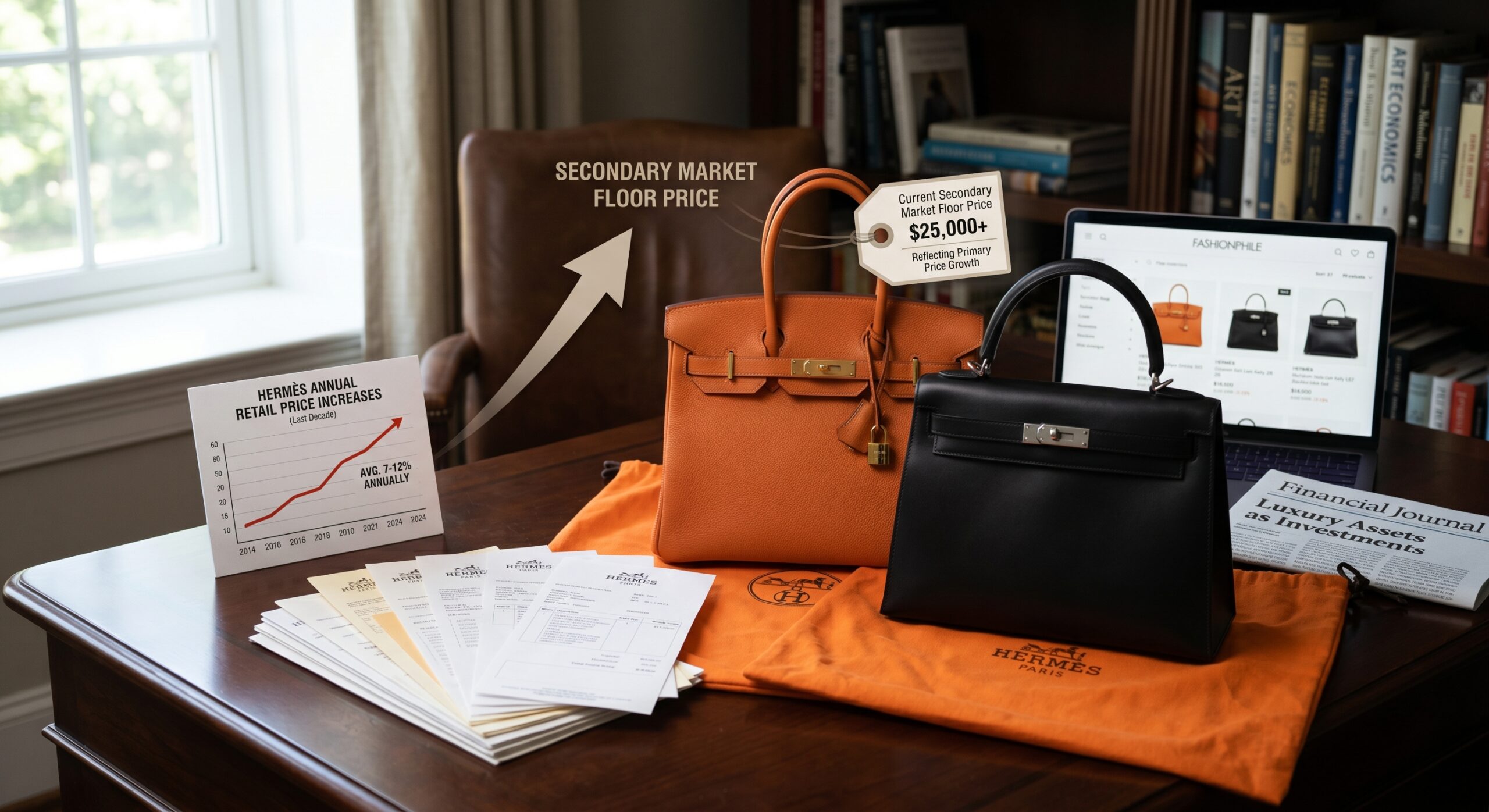
A Birkin 30 in Togo with palladium hardware that retailed at approximately $9,000 in 2014 now retails at approximately $13,000 to $15,000 depending on market and currency — a compound price increase that has outpaced general luxury goods inflation, CPI in most major markets, and the return on most conventional asset classes over the same period. Hermès price increases are not news. But their frequency, their compounding mechanism, and their direct translation into secondary market floor prices are the investment variables that most buyers fail to fully quantify when evaluating a quota bag acquisition.
Hermès has implemented observable retail price increases approximately once to twice annually over the past decade, with adjustments that have ranged from approximately 5% in modest years to 12–15% in years with significant currency or cost pressure. The January adjustment is the most consistent; a secondary adjustment in late summer or autumn has occurred in multiple years. The cumulative effect of this cadence — applied annually to a base retail price that compounds each time — is the primary engine of the Birkin and Kelly's long-term investment positioning.
This article provides the complete price increase picture: the historical frequency and scale of Hermès price adjustments, how each increase raises the secondary market floor price for existing holders, and how to factor this mechanism into acquisition timing, HSS wait period planning, and resale strategy decisions.
The Price Increase Mechanism and Why It Matters
Hermès does not publish a pricing schedule or announce retail adjustments in advance. Price changes are observed through SA community tracking, market monitoring by resale platforms, and the retrospective analysis of receipts and transaction records. The full investment context is documented in the Hermès Investment Guide, but understanding the mechanism requires recognising that Hermès retail price increases operate as a passive return booster for existing quota bag holders — every time retail prices rise, the floor value of secondary market listings rises with them.
The mechanism works as follows: quota bag secondary market premiums are typically expressed as a percentage above current retail price. When a Birkin 30 in Togo retails at $12,000 and trades at approximately 30% above retail on Fashionphile, the secondary market price is approximately $15,600. When Hermès raises the retail price to $13,000, the secondary market reprices toward approximately $16,900 at the same 30% premium — a gain of approximately $1,300 for a holder who did nothing except own the bag. This repricing happens naturally as sellers update their ask prices to reflect the new retail reference point.
Resale platforms track retail price movements actively. Fashionphile and The Real Real both monitor Hermès retail pricing and factor changes into their valuation models for pieces received for consignment. Vestiaire Collective's authentication and pricing team similarly adjusts fair price estimates when retail references change.
Individual sellers on Vestiaire are often the fastest to reprice — experienced sellers who track the market closely will update their ask prices within days of a confirmed retail increase, anticipating that buyers will recalibrate their willingness to pay against the new retail reference. This repricing speed means that existing holders benefit from price increases almost immediately, while buyers who were waiting for secondary market prices to "correct" find that the correction they were expecting does not arrive — the floor simply rises with retail.
The investment implication is significant: every year a quota bag is held in good condition represents both the ongoing secondary market premium and the passive benefit of any retail price increases implemented during the holding period. A buyer who acquired a Birkin 30 in 2020 and holds it in excellent condition in 2026 has benefited from multiple annual retail increases that have raised both their bag's replacement cost and its secondary market floor price — without deploying any additional capital. The underlying mechanism behind these pricing decisions — including the materials and production cost pressures that inform each adjustment — is analysed by the production team at Hermès Insights Hub's coverage of Hermès price increase drivers.
The Historical Record: Frequency, Scale, and Pattern
The documented history of Hermès price increases over the past decade reveals a consistent pattern: annual adjustments that have compounded into a retail price doubling for standard leather quota bag configurations over approximately ten years. The increases have not been uniform — some years have seen larger adjustments driven by currency shifts or raw material cost pressures; others have been more modest — but the direction has been consistently upward with no observed year of flat or declining retail pricing.
Figures are approximate annualised observed ranges across major markets. Hermès does not publish official increase percentages. Currency fluctuation affects market-specific pricing independently of global list price changes.
The 2022–2023 period represents the most aggressive pricing adjustment cycle in recent Hermès history. The combination of post-pandemic demand surge, raw material cost pressures (particularly crocodile and exotic leather supply constraints), and the brand's deliberate strategy of maintaining retail prices at a level that supports secondary market premiums produced increases that, in some markets and configurations, approached or exceeded 15% in a single adjustment cycle. These increases had a direct and immediate impact on secondary market floor prices — existing holders saw the value of their portfolios rise passively as retail references climbed.
"Every Hermès retail price increase is a passive return event for existing quota bag holders — the secondary market reprices within weeks, raising the floor value of every piece already in circulation."
The 2024–2025 period has shown some moderation — increases in the 7–10% observed range, which while lower than the 2022–2023 peak, remains significantly above pre-2020 baseline cadence. This moderation does not signal a change in the fundamental pricing direction; it reflects a return to a more normalised adjustment rhythm after the exceptional post-pandemic cycle. Buyers and holders who used 2022–2023 as their reference point for "normal" should recalibrate — the long-run trend remains upward at approximately 7–12% annually.
- January is the most reliable window for observing Hermès retail price adjustments — plan any non-quota purchases intended to build your spend ratio before this window if budget timing allows.
- Years with significant EUR/USD or EUR/GBP currency movements produce larger market-specific adjustments even when global list prices move modestly — monitor your target market's pricing independently.
- The 2022–2023 cycle demonstrated that Hermès is willing to implement above-average increases when cost pressures or demand dynamics support them — there is no observed ceiling on adjustment magnitude.
- HSS wait periods of 18 months to 3 years typically encompass 2–4 retail price increase cycles — the bag commissioned at today's retail price may be delivered into a market where retail is 20–40% higher, improving the price-to-resale ratio at the point of receipt.
How Price Increases Flow Through to the Secondary Market
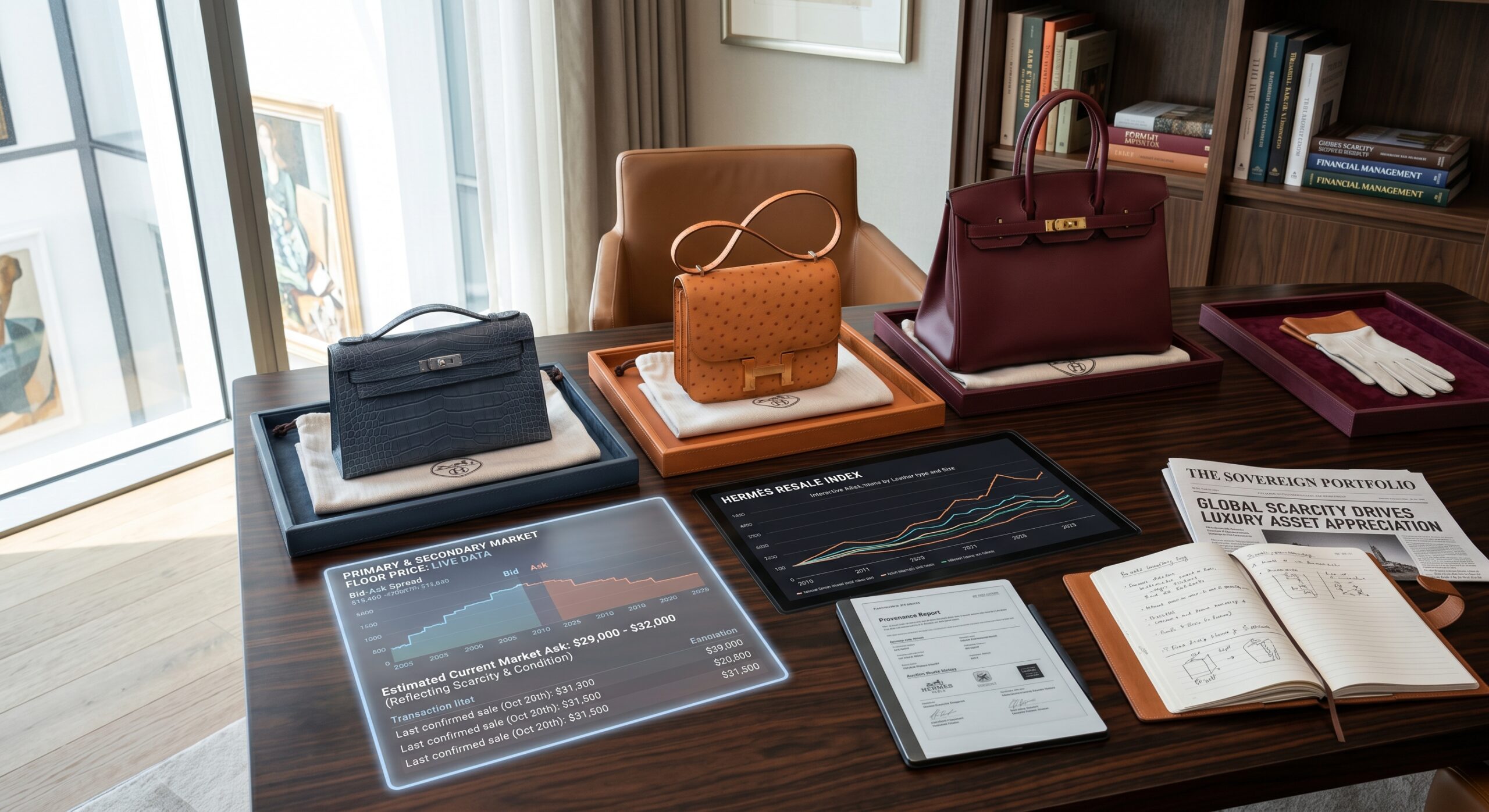
The transmission mechanism from Hermès retail price increase to secondary market repricing is faster and more direct than most holders recognise. Understanding the specific dynamics across each of the four major resale platforms helps buyers and sellers anticipate how quickly their portfolio value adjusts following a retail increase.
Vestiaire Collective moves fastest because its pricing is seller-set. An experienced Vestiaire seller who tracks the market will update their ask price within days of observing a confirmed retail increase — they understand that buyers recalibrate willingness to pay against the new retail reference immediately. This creates a brief window, typically one to two weeks post-increase, during which some Vestiaire listings still reflect the old retail reference and represent relatively better value for informed buyers. After that window closes, the platform has repriced broadly.
Fashionphile's consignment model means that their pricing team updates valuations for new intake based on current retail references, but pieces already listed may take two to four weeks to reprice as the team works through the portfolio. Sellers who have pieces at Fashionphile immediately following a retail increase should enquire about price adjustment — the platform's consignment agreement typically allows for repricing requests.
The most actionable intelligence in the Hermès price increase cycle for active secondary market buyers is the pre-increase window. In the weeks leading up to a known or anticipated January adjustment, secondary market sellers who are aware of the upcoming change often begin raising ask prices ahead of the official retail change — effectively front-running the increase. Meanwhile, less market-aware sellers maintain their pre-increase pricing.
A buyer who monitors Vestiaire and Fashionphile closely in November and December will occasionally find listings still priced at the old retail reference that represent genuine value relative to where the market will sit post-January. This window is narrow — typically two to four weeks — and requires active monitoring, but for buyers targeting a specific configuration, it is the most price-efficient secondary market entry point in any given year.
The broader secondary market trend context — including how the 2024–2026 correction in overall luxury resale affected quota bag pricing relative to the retail price trajectory — is covered in our companion analysis of Hermès reseller market price drop trends from 2024 to 2026. Reading these two articles together gives the complete picture: the long-run retail price growth trajectory alongside the shorter-term secondary market fluctuations that create buying and selling windows within that trend.
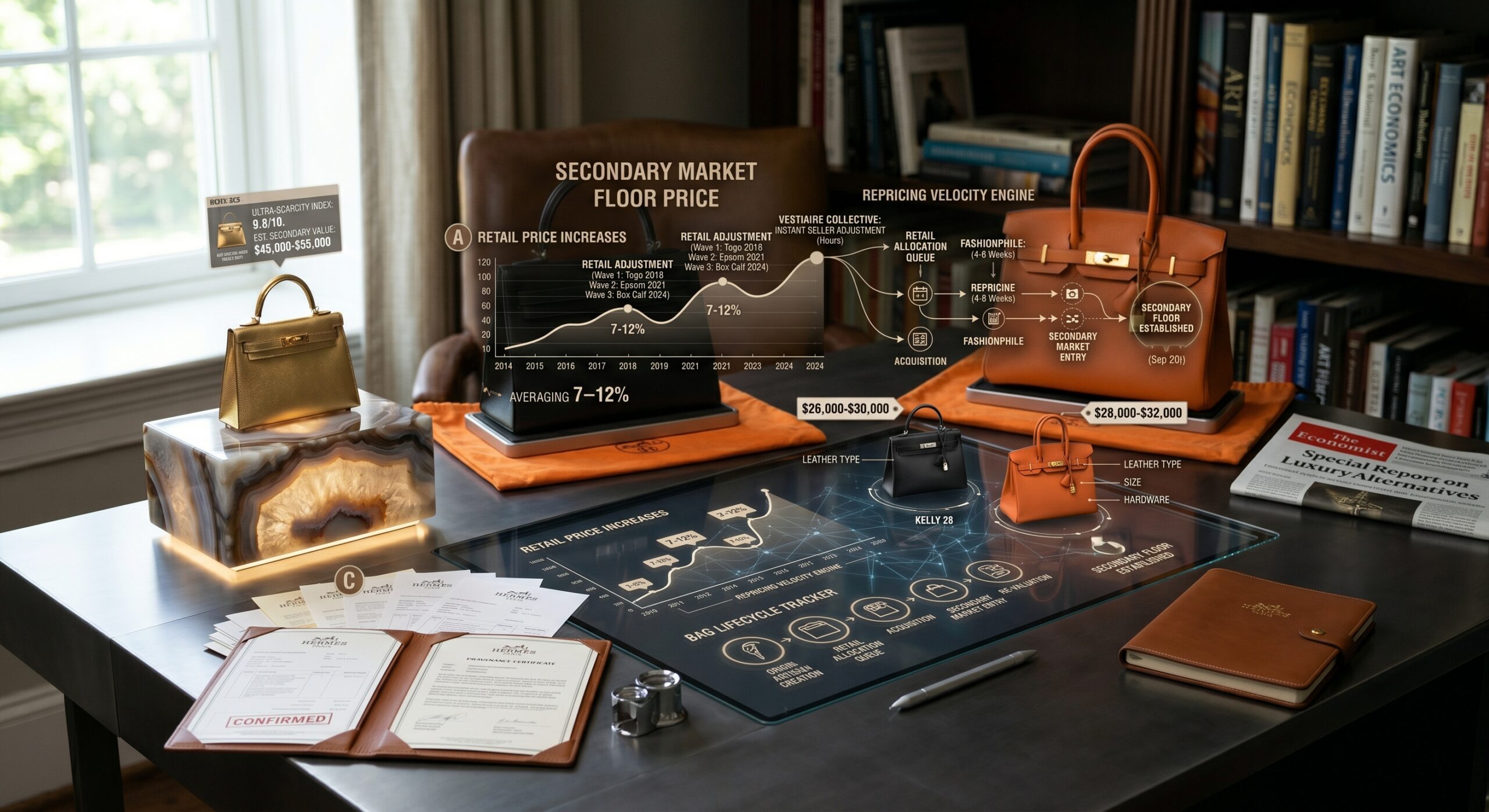
The long-run compounding of retail price increases is the most underappreciated element of the Hermès quota bag investment case. A buyer who acquired a Birkin 30 in 2016 at approximately $10,000 and held it in excellent condition is now sitting on a piece whose replacement cost at retail is approximately $13,000–$15,000 — meaning the secondary market floor has risen passively regardless of any premium movement. When the secondary market premium is applied to the higher retail base, the absolute dollar return on the original $10,000 investment is substantially stronger than the percentage premium figure alone suggests. Our analysis of Hermès fine jewellery vs bag investment return quantifies this compounding dynamic against other Hermès asset classes for buyers evaluating portfolio allocation decisions.
Using Price Increase History in Your Investment Strategy
Price increase history has three direct applications in a practical Hermès investment strategy: acquisition timing, HSS commission planning, and resale timing decisions. Each benefits from understanding the historical pattern and the expected trajectory of future increases.
For acquisition timing, the conventional wisdom — that buyers should act before a price increase — is correct but often misapplied. The secondary market reprices so quickly following retail increases that waiting to "buy the dip" post-increase rarely works. The more actionable approach is to monitor for the pre-increase window on secondary market platforms, where listings priced at the old retail reference persist briefly while the market adjusts. For retail purchases through boutique relationships, the timing is less controllable — quota bag offers arrive when the SA decides, not when the buyer's price increase calendar suggests.
- Monitor Vestiaire Collective and Fashionphile actively in November–December for listings still priced at the pre-January retail reference — this window is brief but real.
- For HSS commission planning, factor the expected number of retail increase cycles during your wait period into your price-to-resale ratio calculation — a bag commissioned today may be delivered into a market where retail is 20–40% higher.
- Do not time a secondary market sale to coincide with a retail increase anticipation — the market has already priced in expected increases by the time they are widely discussed. List when your condition grade is optimal, not when the price increase calendar suggests.
- Use the historical annualised rate of 7–12% as a conservative planning assumption for future retail price trajectory — this supports both hold-or-sell decisions and the comparison of Hermès quota bag returns against alternative asset classes.
- Non-quota bags do not benefit from the same price increase transmission mechanism — their secondary market pricing sits at or below retail regardless of retail increases, because the supply constraint that drives quota bag premiums does not apply.
For resale timing, the price increase history supports a clear holding principle: longer holds in good condition produce stronger absolute returns because they capture more retail increase cycles. A one-year hold captures one to two increase cycles; a three-year hold captures three to six — with each cycle compounding on the previous retail base. The condition grade degradation risk over longer holds is the counterbalancing factor: a bag that drops a condition grade over a three-year hold may lose more in grade discount than it gains from retail increase compounding. Maintaining condition is the variable that determines whether the long-hold strategy works.
For entry-level buyers evaluating the investment case for their first quota bag, our guide on best entry-level Hermès bags under $3,000 in 2026 provides context on which non-quota pieces participate in Hermès's general price increase trajectory — and where the quota bag price increase advantage is most concentrated. The full Market & Resale category archive provides the complete secondary market intelligence framework for buyers and sellers navigating this environment.
| Holding Period | Increase Cycles | Approx. Retail Movement | Secondary Market Impact | Condition Requirement |
|---|---|---|---|---|
| 6 months | 0–1 cycles | ~3–6% retail uplift | Modest floor increase | Grade A / Pristine essential |
| 12 months | 1–2 cycles | ~7–12% retail uplift | Meaningful floor increase | Grade A / Pristine essential |
| 2 years | 2–4 cycles | ~14–25% retail uplift | Strong floor increase | Grade A or B+ acceptable |
| 3 years | 3–6 cycles | ~22–40% retail uplift | Significant floor increase | B+ minimum for full benefit |
| 5 years | 5–10 cycles | ~40–70% retail uplift | Major floor increase | Condition discipline critical |
| 10 years | 10–20 cycles | ~100%+ retail uplift | Retail base effectively doubled | Specialist care / storage required |
| HSS wait (18–36 months) | 2–4 cycles during wait | ~14–40% retail uplift at delivery | Commission price locked; new retail higher | N/A — not yet in hand |
Retail uplift figures use approximate 7–12% annualised range compounded. Actual outcomes depend on specific year increases, market currency effects, and configuration-specific pricing. All projections approximate.
Price Increases Are Predictable, Consistent, and Investable — If You Hold Well
The historical record on Hermès price increases is clear: approximately 7–12% annualised retail price growth across a decade, compounding into a doubling of standard leather Birkin retail prices over ten years. This trajectory is not guaranteed to continue indefinitely, but the brand's demonstrated pricing discipline — consistent annual increases, no observed year of decline — makes it the most reliable planning assumption available for quota bag investment decisions.
The secondary market translation mechanism amplifies this. Each retail increase raises the floor value of every quota bag already in circulation, producing passive returns for existing holders without any active decision required. The repricing happens fastest on Vestiaire Collective — within days — and flows through to Fashionphile and The Real Real within weeks. Buyers who time secondary market entry ahead of confirmed increases capture the final pre-increase pricing; holders who maintain condition through multiple cycles capture the compounding uplift in full.
The condition variable is the one active requirement. A Birkin that declines from Grade A to Grade B over a three-year hold period may sacrifice more in condition discount than it gains from retail increase compounding. Condition preservation is not optional for long-hold investment strategy — it is the mechanism that allows the price increase benefit to fully materialise at the point of sale.
Bottom Line: Hermès retail price increases at approximately 7–12% annually are the most reliable passive return component in quota bag investment — maintain condition grade through the holding period and the compounding effect across multiple increase cycles delivers the strongest risk-adjusted return profile in the secondary luxury market.
Popular Searches
Explore our most searched Hermès price increase and investment return questions
Frequently Asked Questions
Hermès has implemented price increases approximately once to twice per year across its quota bag range over the past decade, typically in January and occasionally with a second adjustment in late summer. The frequency has accelerated since 2020, with observed annual increases ranging from approximately 5% to 15% depending on the year and the specific configuration. Years with significant currency fluctuations or raw material cost pressures have historically produced larger adjustments. The compounding effect of consistent annual increases has been a primary driver of Birkin and Kelly retail price growth over a ten-year holding horizon. For resale market context see our Hermès reseller market price drop analysis.
No — Hermès does not publicly announce price increases in advance. Changes typically take effect at the start of a new pricing period, often January, and are observed by SA community tracking and secondary market price movement rather than official communication. Buyers who maintain close SA relationships sometimes receive informal signals about upcoming price adjustments, which can inform the timing of non-quota purchases. The secondary market tends to price in anticipated Hermès retail increases ahead of their implementation, as sellers adjust ask prices to reflect the new retail floor before the official change takes effect.
Each Hermès retail price increase raises the floor price for secondary market listings because the premium that quota bags command is partly calculated relative to current retail. When a Birkin 30's retail price rises by approximately 8%, sellers on Vestiaire Collective and Fashionphile typically reprice existing listings within weeks to maintain their target premium over the new retail reference. Buyers already holding quota bags in good condition benefit directly from retail price increases — their secondary market position strengthens without any action on their part. For context on how the broader market has moved see our Hermès reseller market price drop analysis for 2024–2026.
Based on observed retail price tracking across major markets, Hermès Birkin retail prices have increased at an approximate annualised rate of 7–12% over the past decade, depending on the base currency and the specific leather configuration tracked. This rate has exceeded general luxury goods inflation and significantly outpaced CPI in most major markets over the same period. The compounding effect over ten years has approximately doubled or in some configurations more than doubled the retail price of a standard leather Birkin, which directly raises the secondary market floor price and supports the quota bag's investment positioning.