Best Hermès Boutique Locations for Walk-In Birkins (2026)
A frank assessment of which boutique locations, timing windows, and client profile conditions give the strongest odds of a quota bag offer — and where the conventional wisdom is simply wrong.
The walk-in Birkin is not a myth — but it is rarer than the secondary market price premium suggests, and far more location-dependent than most buyers understand. In 2026, the boutiques where a new or lightly established client has the most realistic odds of a quota bag offer are not the Paris flagship or Madison Avenue. They are secondary market locations — resort boutiques, smaller US city stores, and select European locations outside the major fashion capitals — where the established client base is thinner and SA recognition builds faster.
The investment case for understanding boutique location strategy is direct: a client who builds their boutique relationship at the right location will receive a first quota bag offer 6–12 months faster than an equivalent client who targets the most prestigious flagship. That time advantage translates to a faster price-to-resale ratio realisation and a shorter capital deployment window before the quota bag enters the secondary market as a premium asset.
This article gives you the full location intelligence picture: which boutique types give the strongest walk-in and early-relationship odds in 2026, how timing interacts with location to improve access windows, and how to build a boutique access plan that maximises allocation efficiency across your specific geography and travel patterns.
The Walk-In Birkin: What the Market Actually Shows
A walk-in Birkin — a quota bag offer extended to a client who enters a boutique without a pre-arranged appointment or a deep, multi-year SA relationship — does happen. It is more common at certain boutique types than others, and the conditions that produce it are consistent enough to be strategic. The full investment framework for quota bag acquisition is covered in the Hermès Investment Guide, but the location-specific dynamics deserve dedicated analysis.
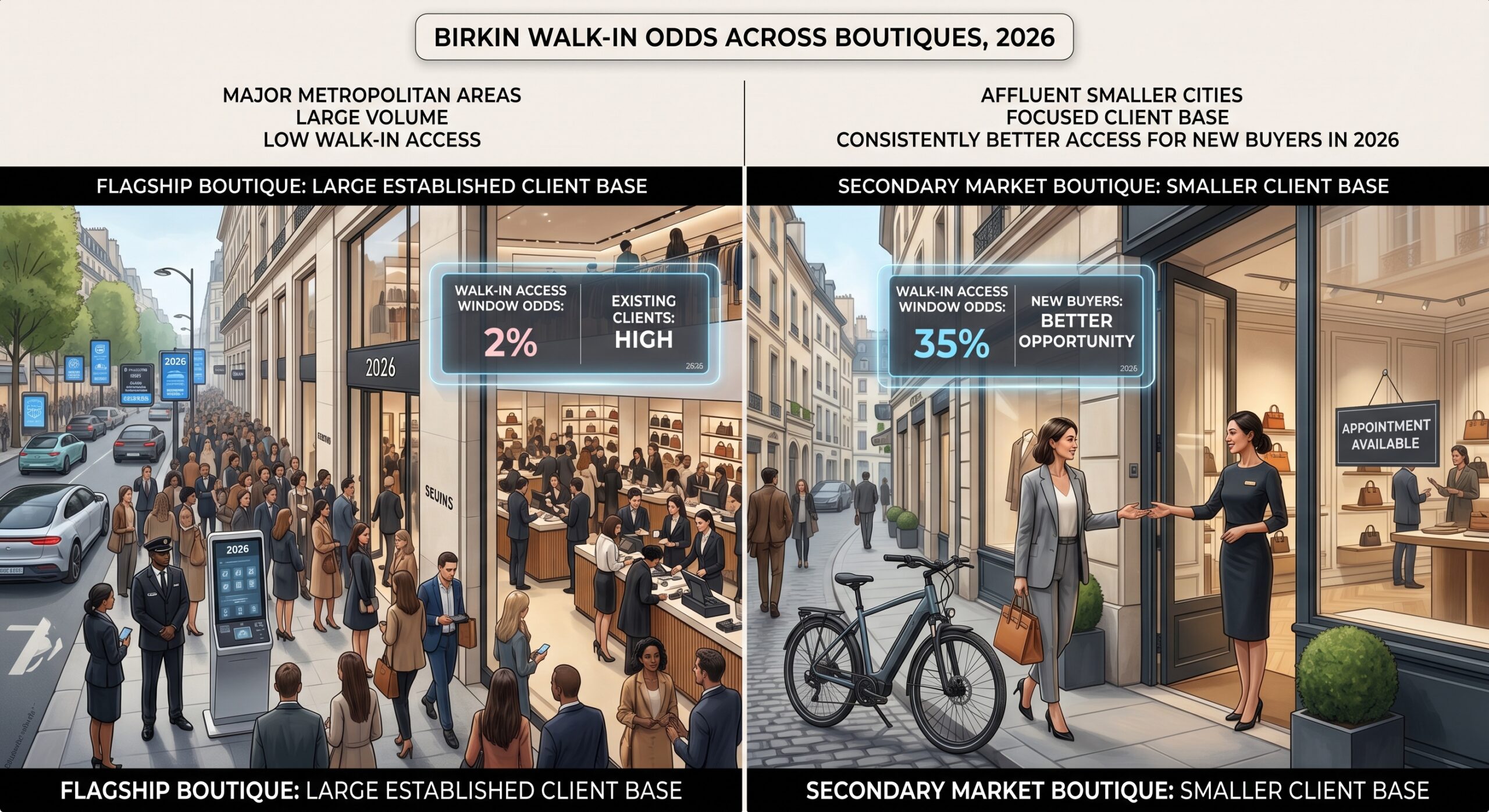
The key variable that determines walk-in access odds is not the boutique's prestige — it is the ratio of available quota bag inventory to the number of established clients actively competing for it. At a flagship boutique like Paris Faubourg Saint-Honoré or New York Madison Avenue, that ratio is deeply unfavourable for new clients: the established client pool is large, the SA relationships run deep, and quota bag inventory is spoken for many allocation cycles in advance. At a resort boutique in Maui or a secondary US city location, the established client base is smaller, SA recognition develops faster, and inventory competition is meaningfully lower.
Hermès allocates quota bag inventory to boutiques based on sales volume, client profile data, and regional demand patterns. A flagship boutique receives more total inventory than a resort location — but the flagship also has proportionally more established clients competing for that inventory. The relevant metric for a new client is not absolute inventory volume but inventory per competing established client.
This ratio consistently favours secondary and resort locations for buyers who are willing to travel or who happen to live in or near those markets. The boutique experience at a smaller location may be less elaborate than at a flagship — the architecture, the product range, the appointment services — but the quota bag access odds are structurally better for clients who are not yet established in that boutique's client ecosystem. The design and atmosphere differences between boutique tiers are covered by the team at Hermès Guidance Lounge's boutique design by location analysis for buyers who want the full picture before committing to a primary boutique.
The secondary market context matters here too. A buyer who accesses their first quota bag at a secondary market boutique in an accessible configuration — perhaps not their ideal color or size — is still acquiring a piece that trades at premium on Vestiaire Collective, The Real Real, and Fashionphile. The price-to-resale ratio on a standard configuration Birkin purchased at a Maui boutique is identical to the same piece purchased at Madison Avenue. The boutique's prestige does not transfer to the resale listing.
Flagship vs Secondary: The Location Intelligence
The boutique landscape in 2026 divides into four tiers from a walk-in and early-relationship odds perspective. Understanding where each tier sits helps buyers make rational location choices based on their geography, travel flexibility, and timeline expectations.
Faubourg · Sèvres
NYC · Beverly Hills · Chicago
Dallas · Atlanta · Miami · Seattle
Hawaii · Vegas · Palm Beach
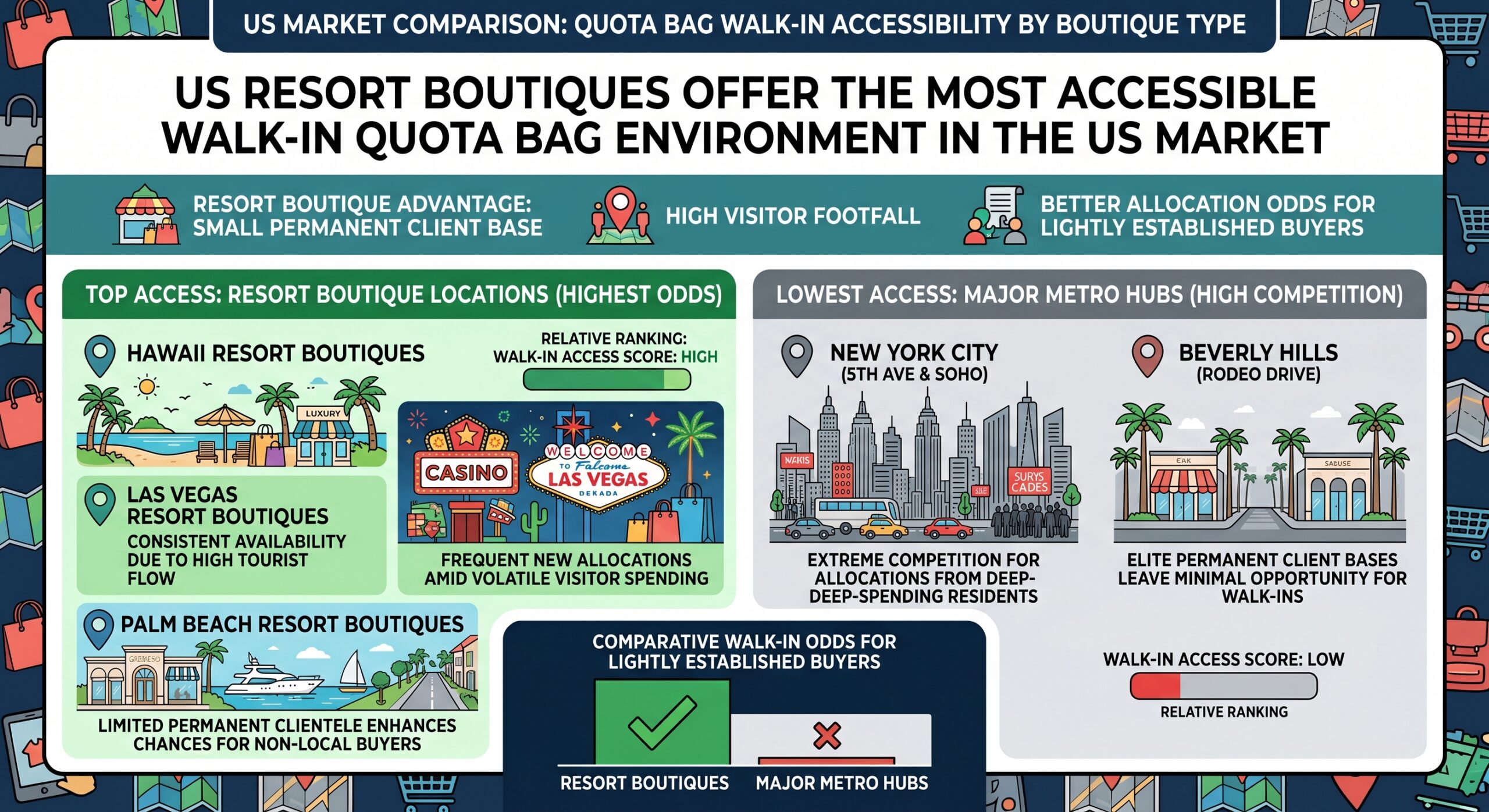
US resort boutiques — particularly Hawaii (Ala Moana), Las Vegas (Wynn and Bellagio locations), and Palm Beach — have consistently produced the most accessible walk-in quota bag environment for lightly established clients. The reasons are structural: these boutiques serve a high proportion of one-time or infrequent visitors alongside a smaller permanent local client base. SAs at these locations are accustomed to clients who make significant purchases during a single visit, and the allocation environment reflects this — pieces that would be reserved for long-established relationship clients at a flagship are more likely to be available for a well-presented, genuine buyer at a resort location.
"A client with a modest global spend history who visits a Hawaii or Las Vegas Hermès boutique on a Tuesday morning, engages genuinely with an SA, and makes a meaningful non-quota purchase in the same visit has a meaningfully higher probability of leaving with a quota bag offer than the same client at Madison Avenue."
European secondary locations — smaller city boutiques in Germany, the Netherlands, Switzerland, and select Southern European markets — follow a similar pattern to US secondary markets. The established client concentration is lower than in Paris, London, or Milan, and the SA-to-client ratio at these locations often allows for more sustained first-visit engagement. For buyers who travel in Europe, identifying and visiting a secondary European boutique during a trip is a worthwhile tactical addition to their access strategy.
- Prioritise resort and secondary market boutiques for relationship-building if your geography or travel patterns give you access — the timeline advantage over flagships is 6–12 months on average.
- If your primary boutique is a major flagship, consider supplementing with resort boutique visits during travel — global spend history accumulates, and a walk-in offer at a resort location during a vacation is a legitimate and increasingly documented access route.
- European buyers should consider secondary city boutiques in Germany, Switzerland, or the Netherlands as relationship-building alternatives to the Paris or London flagships.
- Asian buyers face the tightest flagship competition globally — Tokyo, Hong Kong, and Singapore flagship boutiques operate under intense established-client concentration. Secondary Asian city locations offer meaningfully better odds for newer clients.
Timing, Preparation, and the First Visit Strategy
Boutique location is the most important structural variable in walk-in access odds — but timing and first-visit preparation are the execution variables that determine whether a visit to the right location produces a result. Both are controllable, and both matter.
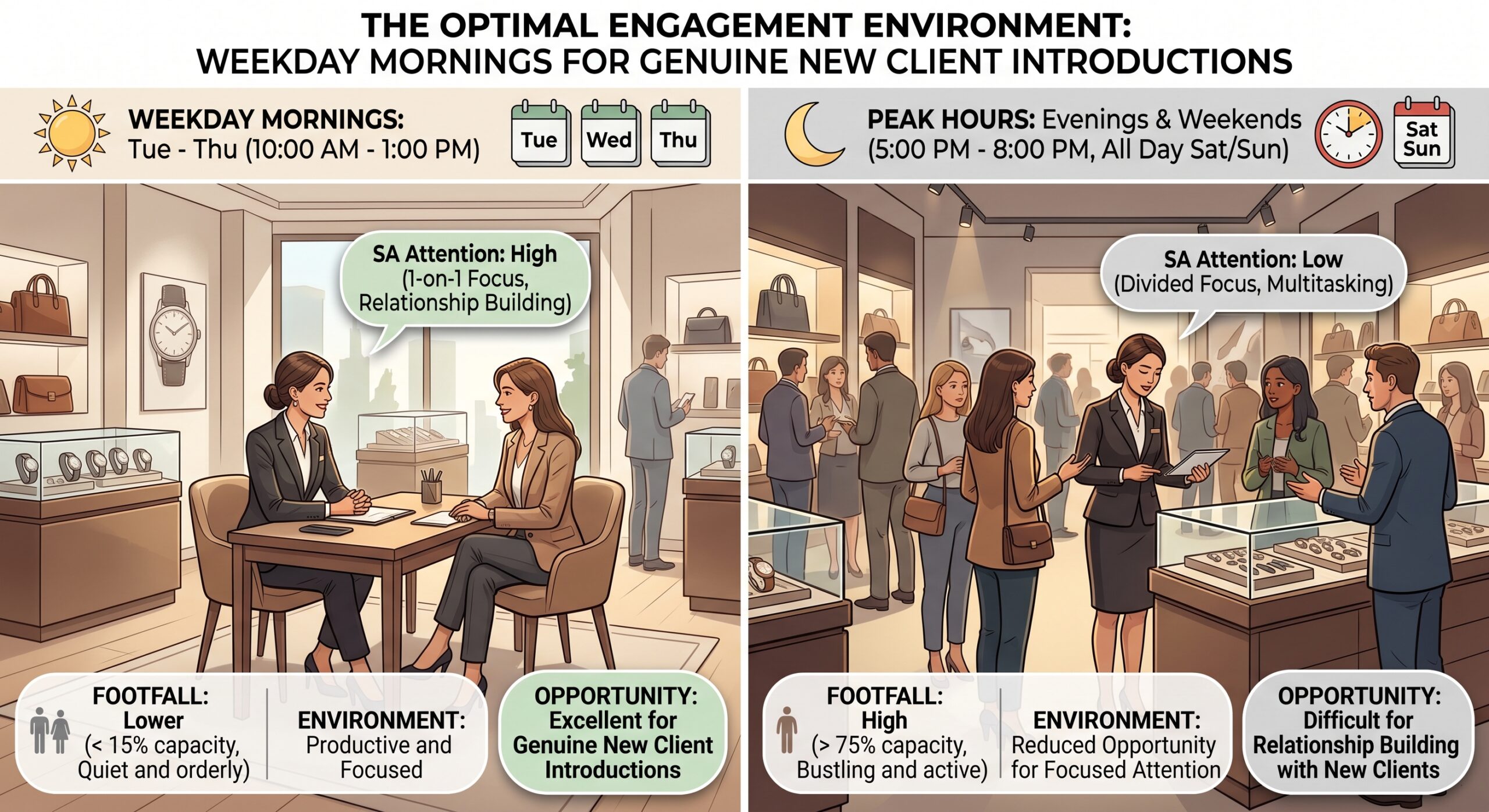
Timing operates at two levels: day of week and season. Weekday mornings — Tuesday through Thursday, ideally between store opening and noon — are the consistently most productive visit windows across boutique types. Weekend foot traffic is high, SAs are managing multiple clients simultaneously, and the sustained one-on-one engagement that supports a genuine relationship introduction is harder to achieve. On a Tuesday morning, an SA who is not managing a queue of weekend browsers can give meaningful attention to a new client who walks in with genuine interest and a non-pressured demeanour.
January through March is historically the most productive period for quota bag access at most boutiques. The post-holiday inventory reset introduces new allocation cycles; SAs are working through their client relationship commitments from the prior year; and the boutique footfall is lower than during peak travel and gifting seasons. Established clients who were passed over in the December allocation rush often receive their offers in Q1.
For new clients, the January–March window is valuable because SAs have more time for relationship introductions and the inventory pressure is lower relative to August-December. The May–June pre-summer window is a secondary opportunity — boutiques often see allocation activity before the summer travel season disrupts SA availability and client visit patterns. Avoid December, key fashion week dates (Paris, New York, Milan), and the high summer travel weeks (July–August) when boutique environments are most competitive and least relationship-conducive.
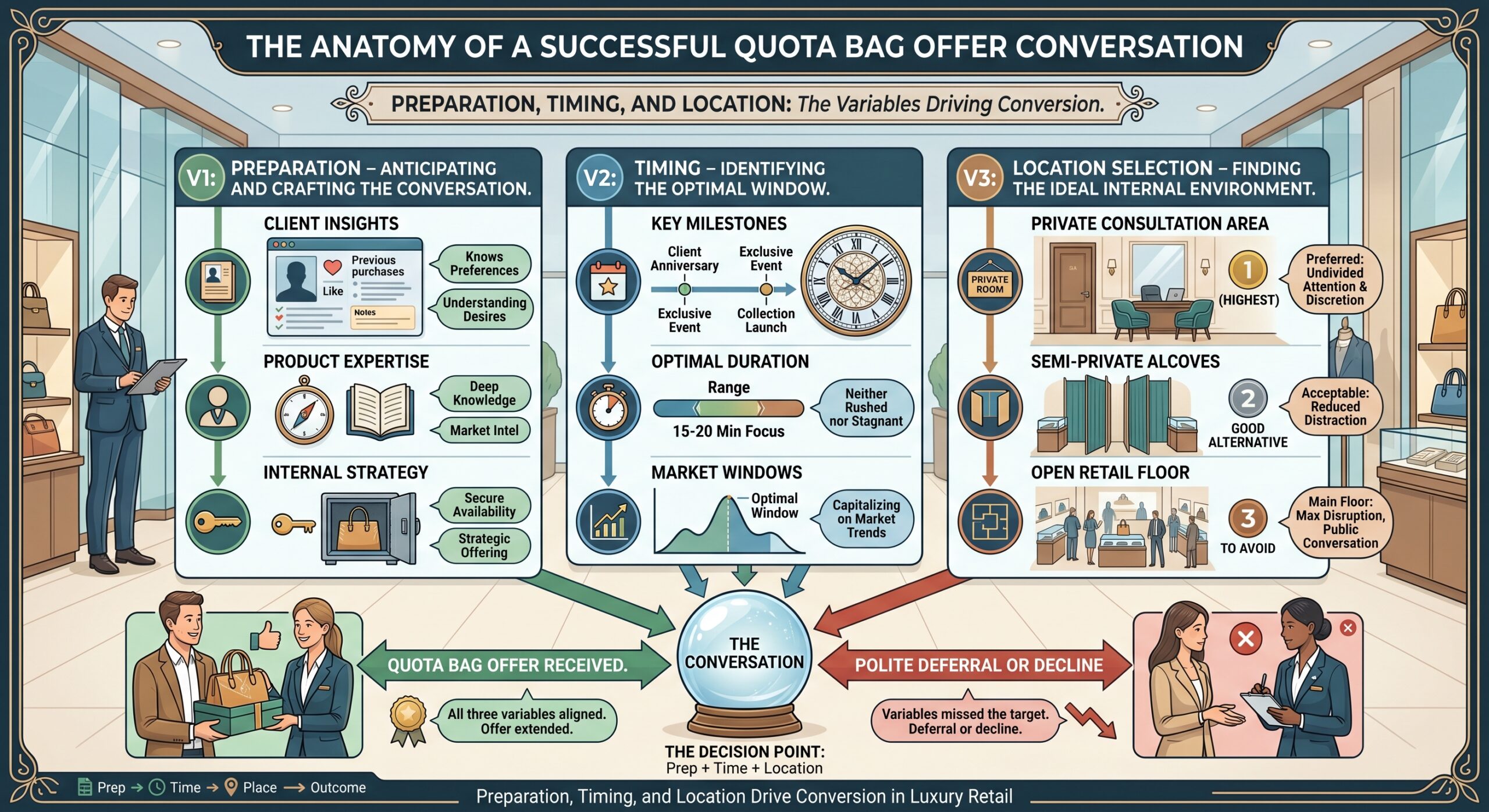
First-visit preparation is the variable most buyers underestimate. Arriving at a boutique with no Hermès purchase history, no registered client profile, and no clear sense of what they want beyond "a Birkin" produces the least productive outcomes. The buyers who report the most successful first-visit SA interactions arrive with a registered global client profile, a clearly stated preference when asked (style, size, leather, color, hardware), and a genuine interest in making a non-quota purchase during the same visit to establish the relationship on a transactional footing immediately.
- Visit on a Tuesday, Wednesday, or Thursday morning — avoid weekends and holiday periods when SA attention is divided and boutique dynamics are at their most competitive.
- Ensure your Hermès client profile is active and up to date before any strategic boutique visit — your global purchase history is the first thing an SA checks when assessing a new client interaction.
- Plan to make a meaningful non-quota purchase during the first visit — a scarf, a small leather good, or homeware establishes the relationship on a transactional basis immediately rather than positioning the visit as quota bag access seeking.
- Have your configuration preference ready if asked: "I'm particularly interested in a Birkin 30, ideally in Togo or Epsom with palladium hardware, in a neutral or classic color" is a prepared, specific answer that reads as genuine collector knowledge rather than generic demand.
- Do not mention the secondary market, resale value, or investment intent in any SA conversation — boutiques allocate to clients who present as personal collection buyers, not resellers.
The Paris Leather Appointment system — the lottery-based access route at the Paris flagships — operates on entirely different mechanics than the relationship-based model. Our dedicated guide on Hermès Leather Appointment Paris Lottery tips covers what actually works for international visitors pursuing that specific route. For buyers at the beginning of their boutique relationship, the Hermès wish list strategy for new clients covers the insider approach to expressing quota bag interest without triggering the wrong dynamic.
The global client profile is worth emphasising as a preparation element. Buyers who have made Hermès purchases at any location worldwide — even years earlier — carry that history into every new boutique visit. An SA who pulls up a client profile showing €8,000 in historic purchases across multiple categories is looking at a different client than one with zero history. Before any strategic boutique visit, ensure your profile is registered and your contact details are current. If you are unsure of your profile status, any boutique SA can check and update it.
Building Your Boutique Access Plan for 2026
A practical boutique access plan for 2026 combines location selection, timing optimisation, and the spend ratio strategy that builds the relationship over time into a coherent sequence. The goal is not to maximise the number of boutiques visited — it is to maximise the probability of a quota bag offer from a single, well-chosen primary boutique within your target timeline.
For buyers based in or near a major US city with multiple boutique options, the decision framework is straightforward: identify whether the city has a resort or secondary market location alongside the flagship, and make the secondary location your primary relationship-building boutique. Direct your spend ratio purchases there, build your SA relationship there, and use the flagship for supplementary visits only. The secondary location offer will come faster, and once you have received a first quota bag through the secondary boutique relationship, the flagship SA dynamic becomes easier to navigate with an established purchase history.
- Select one primary boutique and commit — relationship-building spend split across multiple locations produces half-relationships at each and extends your timeline unnecessarily.
- If you have travel flexibility, include one or two resort boutique visits per year in locations you visit anyway — Hawaii, Las Vegas, or a European secondary city during a trip. These visits supplement your primary relationship and occasionally produce walk-in offers independently.
- Time your most significant relationship-building purchases for Q1 (January–March) when boutique dynamics are most favourable for new client recognition and allocation activity is historically highest.
- When your SA changes or leaves, introduce yourself to a replacement SA promptly and make a purchase within the first two interactions — your client profile history transfers, but the personal relationship must be rebuilt.
- Maintain realistic timeline expectations: even at the most accessible secondary or resort boutiques, a first quota bag offer typically requires 10–16 months of consistent engagement. Faster timelines happen but cannot be planned for reliably.
The spend ratio that underpins any boutique relationship is covered in full detail in our Hermès quota bag spending ratio strategy for 2026 — boutique location strategy and spend ratio strategy are complementary, and the most efficient outcome combines the right location with the right purchase pattern. The broader secondary market context — including how the quota bag you eventually acquire performs at resale — is available through the Market & Resale category archive.
| Boutique Type | Walk-In Odds | Relationship Timeline | Inventory Variety | Best Strategy |
|---|---|---|---|---|
| US Resort (Hawaii, Vegas, Palm Beach) | Highest in US | 10–16 months | Limited | Walk-in + travel visits |
| US Secondary Cities (Dallas, Atlanta, Seattle) | Moderate | 12–20 months | Moderate | Primary relationship boutique |
| US Major Flagships (NYC, Beverly Hills, Chicago) | Low | 18–30 months | High | Established spend history first |
| European Secondary Cities (Germany, Netherlands, Switzerland) | Moderate | 12–18 months | Moderate | Travel supplementary visits |
| European Flagships (Paris, London, Milan) | Low–Very Low | 20–36+ months | Very High | Paris Lottery for internationals |
| Paris Lottery (Leather Appointment) | Competitive but open | Single visit potential | High (flagship stock) | International visitor route only |
| Asian Secondary Cities (outside Tokyo/HK/SG) | Moderate | 12–20 months | Moderate | Local relationship building |
| Asian Major Flagships (Tokyo, Hong Kong, Singapore) | Very Low | 24–36+ months | High | Long-term established clients only |
Timeline estimates are approximate and reflect observed patterns across markets. Individual boutique dynamics, SA relationships, inventory cycles, and client profile strength significantly affect outcomes. All figures based on observed secondary market and buyer community patterns.
Secondary and Resort Boutiques Win for New Clients — Every Time
The walk-in Birkin is a real phenomenon — but it overwhelmingly happens at secondary market and resort boutiques, not at the flagship locations that dominate the Hermès conversation. US resort boutiques in Hawaii, Las Vegas, and Palm Beach offer the most accessible walk-in environment in the American market in 2026. European secondary city boutiques and Asian non-flagship locations follow the same structural pattern: smaller established client bases, faster SA recognition, and more accessible allocation dynamics for buyers who are earlier in their relationship trajectory.
The timing variables reinforce this: Tuesday through Thursday morning visits in the January–March or May–June windows, with a prepared global client profile and a clear configuration preference ready if asked, represent the highest-probability combination of location, timing, and preparation available to a new or lightly established Hermès client in 2026.
The flagship locations — Paris, New York, Beverly Hills, Tokyo — are not inaccessible. They are long-game destinations for clients who have already established their relationship at a more accessible boutique and are building toward the deeper, longer-term SA dynamic that flagship allocation requires. Starting at a flagship is the least efficient use of a new client's relationship-building time and spend.
Bottom Line: Target a US resort or secondary market boutique as your primary relationship-building location in 2026 — the 6–12 month timeline advantage over flagship locations is the single most actionable improvement most new clients can make to their quota bag acquisition strategy.
Popular Searches
Explore our most searched Hermès boutique location and acquisition questions
Frequently Asked Questions
Secondary and resort market boutiques consistently offer better walk-in odds than major flagship locations in 2026. US locations in markets like Hawaii, Las Vegas, and select Southern states have historically shown more accessible allocation environments for newer clients — smaller established client bases mean quota bag inventory is less contested. Internationally, select European boutiques outside Paris, and smaller Asian city boutiques outside Tokyo and Hong Kong flagships, represent better walk-in opportunity windows. The Paris flagship Leather Appointment lottery remains a viable but competitive route for international visitors. For the spend ratio strategy that supports any boutique relationship, see our Hermès quota bag spending ratio strategy for 2026.
Yes — with important nuance. Smaller boutiques in secondary markets have fewer established long-term clients competing for quota bag allocation, which means a new client can build SA recognition faster and be considered for allocation sooner. However, smaller boutiques also receive smaller inventory allocations, so the available configurations at any given time may be more limited. The trade-off is: better access odds at smaller boutiques, better configuration variety at flagships. For most new clients, starting at a secondary market boutique and building a relationship there is the more efficient path to a first quota bag offer. See our Hermès wish list strategy for new clients for how to express your quota bag preference effectively once the relationship is established.
Weekday mornings — particularly Tuesday through Thursday — are consistently reported as the most productive timing for walk-in quota bag access across boutiques globally. Weekend foot traffic is higher and SA attention is divided; weekday mornings allow for more focused SA engagement. Seasonally, the post-holiday period (January to March) and the pre-summer lull (May to early June) have historically been periods when quota bag inventory refreshes and allocation activity increases, as boutiques work through client relationship commitments before peak travel season. Avoiding the December holiday period and key fashion week dates reduces competition significantly.
Your global Hermès client profile — including all purchase history from any authorised Hermès location worldwide — is visible to SAs at any boutique you visit. A new client with zero purchase history has a near-zero probability of a walk-in quota bag offer at any boutique. A client with an established purchase history at a different boutique who visits a new location is in a meaningfully stronger position — the SA can see the spend history, even without a personal relationship. At secondary market boutiques, a modest global spend history combined with a genuine first interaction has occasionally produced same-visit offers, though this remains an exception rather than a rule.