Hermès Spa Treatment: Cost, Wait Time and When It's Worth It
The complete market-focused guide to Hermès Spa treatment — what each service tier costs, how long it takes, and a clear decision framework for when Spa investment produces genuine condition grade and resale value improvement.
A Kelly 28 submitted to Fashionphile after a $150 Hermès Spa conditioning service that genuinely improves its handle condition from Excellent to Pristine achieves approximately $1,800 more than it would have without the service. A Kelly 28 submitted after a $600 Hermès Spa service attempting to address colour transfer staining that the Spa cannot reverse achieves exactly the same price it would have without the service — and $600 poorer for the experience. The Hermès Spa treatment decision is entirely an ROI calculation, and the ROI is only positive when the service can genuinely improve the assessable condition of the piece in a way that platforms recognise and price.
The Hermès Spa — available at major Hermès boutiques globally — provides a range of leather care, restoration, and repair services performed by trained Hermès leather specialists. It is a legitimate and often valuable service for holders who are managing their quota bag's condition grade across a holding period or preparing a piece for resale. But it is also widely misunderstood as a service that can reverse damage that leather chemistry makes irreversible. Understanding the precise boundary between what the Spa can and cannot address is the foundation of any rational Spa investment decision.
This article provides the complete picture: the service tiers with realistic cost and wait time ranges, the specific conditions where Spa treatment produces measurable resale value improvement, and the scenarios where the investment produces no return on the condition grade or achievable price.
What the Hermès Spa Actually Does — and Doesn't
The Hermès Spa service encompasses a broad range of leather care interventions performed by Hermès-trained artisans using Hermès-proprietary cleaning agents, conditioners, and repair materials. The service is available at most major Hermès boutiques globally, though the scope of work that can be performed locally versus work that must be sent to the Hermès atelier in Paris or other regional ateliers varies by boutique. The full care and maintenance framework that positions the Spa within a broader holding period care strategy is covered in the Buying Hermès Without the Wait hub.
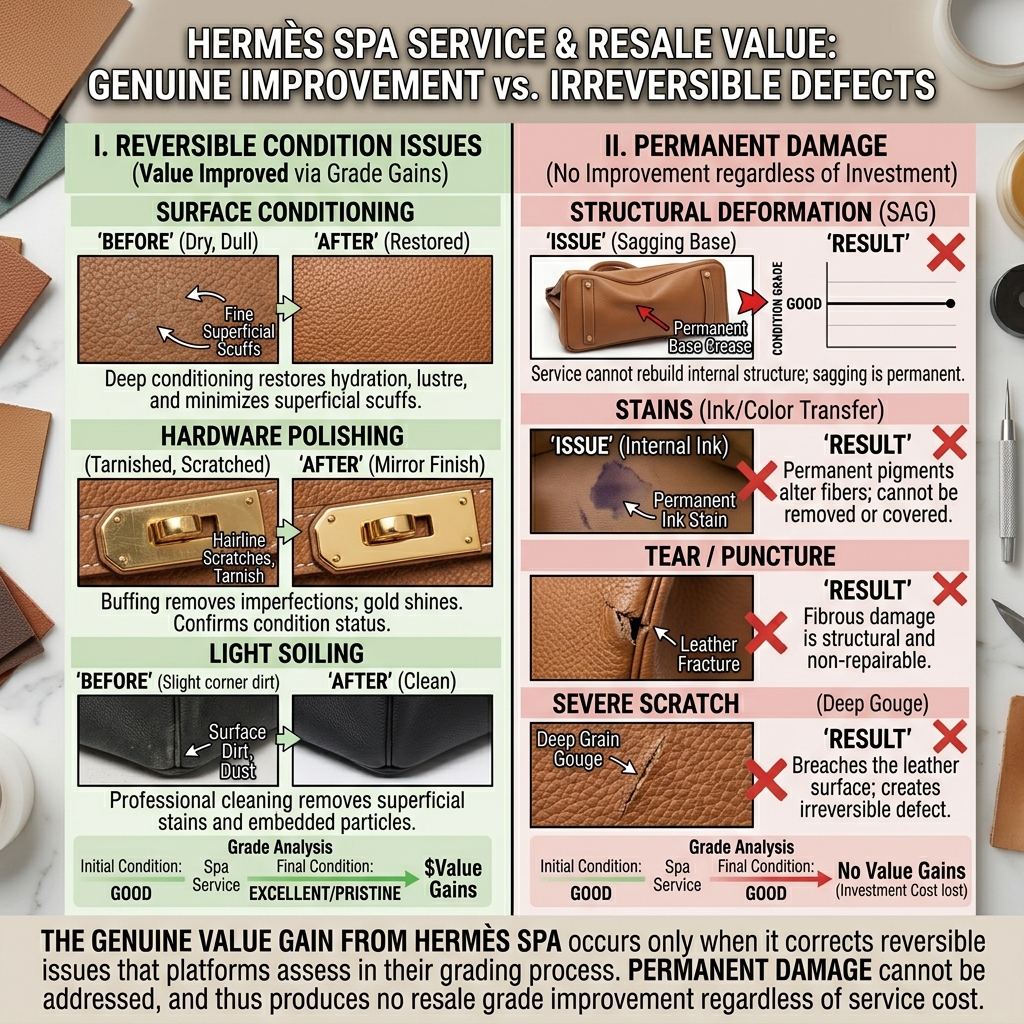
The most important distinction in any Spa service discussion is between reversible and irreversible conditions. The Spa can address conditions that remain at the leather surface or that are chemically reversible — cleaning surface dirt, conditioning dried or slightly stiff leather, polishing hardware tarnish to near-original appearance, replacing worn or damaged handles that have deteriorated beyond the threshold of cosmetic repair, and cleaning interior lining soiling that has not penetrated the lining material deeply. The technical details of which leather restoration processes can and cannot address various damage types — including the specific chemistry of why colour transfer and deep mould staining are irreversible — are covered by the leather science team at Hermès Insights Hub's Spa and leather restoration process guide.
The Spa cannot reverse colour transfer — dye that has bonded with leather tanning agents at the molecular level cannot be extracted without destroying the leather surface. It cannot restore structural deformation from sustained carry without support — base sag that has set over months requires physical restructuring that the Spa does not perform as a standard service. It cannot eliminate deep scratches on smooth leathers (Box Calf, Barenia) where the leather surface has been removed rather than merely compressed. It cannot address mould growth that has penetrated below the leather surface — surface cleaning removes visible mould but does not reverse the structural damage to sub-surface fibres that severe mould colonisation produces.
Understanding these limitations before submitting a piece for Spa assessment prevents the misaligned expectation that leads to frustration and wasted investment. The Spa is a maintenance and light restoration service; it is not a structural or chemical reversal service for permanent damage.
The SA relationship dimension of the Spa service is worth noting: submitting a piece to the Spa at your primary boutique is a boutique interaction that keeps you engaged with your SA and your purchase history active. For clients in the relationship-building phase before a first quota bag offer, periodic Spa submissions for legitimate care needs serve a secondary function as boutique contact points. This dimension is covered in our Hermès wish list strategy guide.
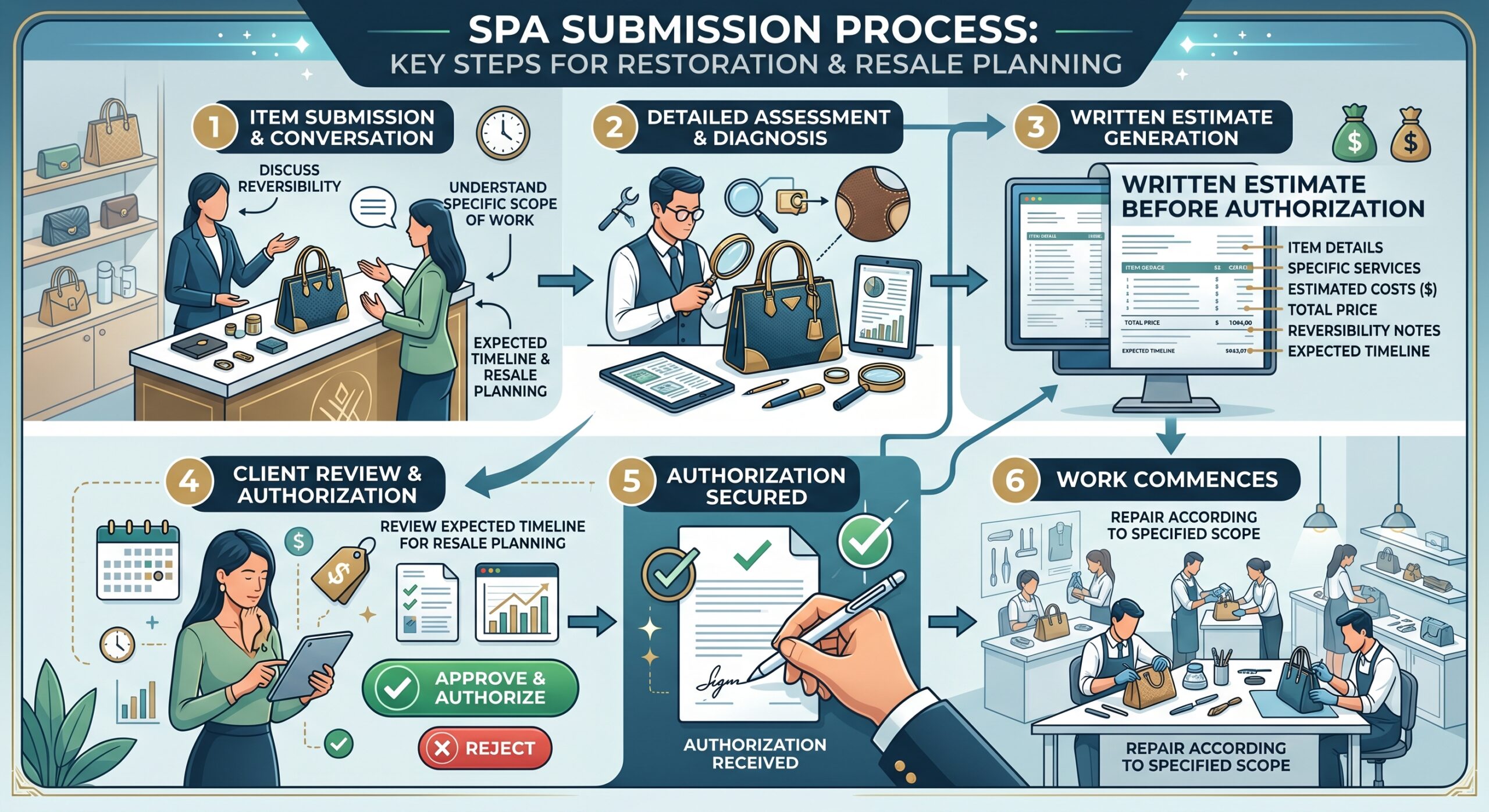
Spa Service Tiers: Cost and Wait Time by Level
The Hermès Spa does not publish a fixed price menu — each piece is assessed individually upon submission, and the quoted service scope and cost reflect that assessment. The ranges below are based on observed service quotes across major boutique locations and represent realistic expectations rather than published tariffs. Actual quotes at your specific boutique may differ, and all figures are in USD at approximate 2026 US market rates.
"The wait time for Tier 3 and 4 Spa services — 3 to 6 months — is a material factor in the resale timing calculation. A piece submitted for major restoration in January cannot be relisted until July at the earliest, affecting liquidity planning."
- Always request a written service estimate before authorising any Spa work — verbal estimates are not binding, and the scope of work can expand once the piece is assessed at the atelier.
- Ask specifically whether the service will be completed at the local boutique or sent to a regional atelier — atelier-bound work has significantly longer wait times and may not be trackable during transit.
- For resale-timed submissions: submit at least 3–4 months before your target listing date for any Tier 2 or above service, and 6–8 months ahead for Tier 3 or 4 work that may involve Paris atelier routing.
- Confirm that the piece will be insured during the Spa process — ask specifically about coverage during transit to and from the atelier and what the boutique's policy is for damage incurred during service.
The Worth-It Decision Framework
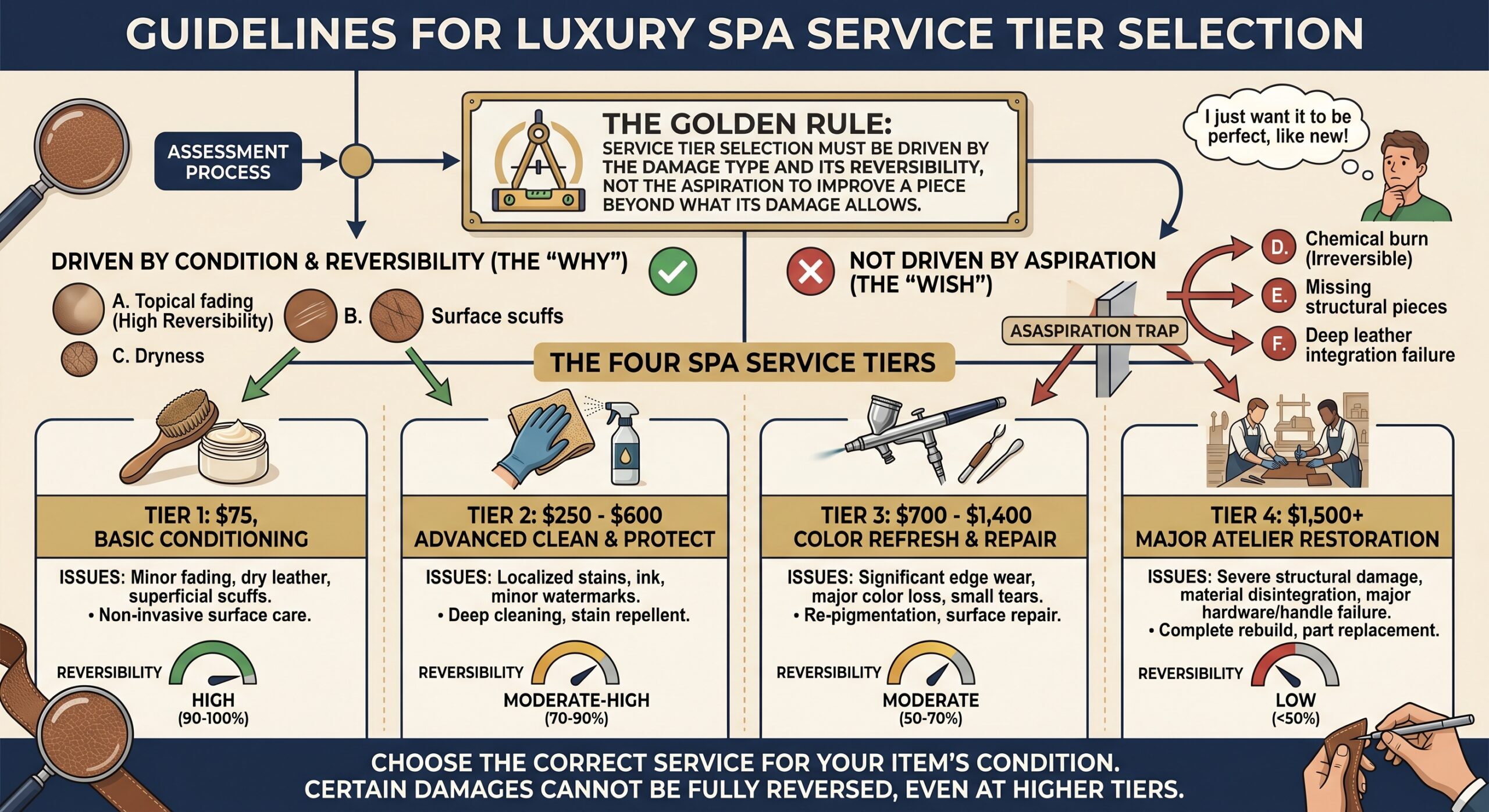
The Spa service investment is worth pursuing when three conditions are simultaneously met: the condition issue being addressed is reversible by the Spa's available interventions, the grade improvement that reversal produces is recognisable and priceable by major resale platforms, and the service cost is proportionate to the resale value improvement it enables. When any of the three conditions is not met, the service cost does not produce a return.
The worth-it framework produces a clear operational principle: submit to the Spa only when the specific condition issue being addressed is reversible and the grade improvement it produces on a resale-ready piece covers the service cost by at least a factor of two. For pieces not approaching resale — pieces being held for continued use over a multi-year period — the ROI calculation is different: a conditioning service that extends Grade A condition by another 12–18 months is worth its cost even if the immediate resale uplift is modest, because it defers the grade degradation that would otherwise compound. The long-term condition grade preservation value of periodic Spa conditioning is real, even if the immediate return on any single service is less dramatic than a handle replacement before resale.
The conditions where the Spa genuinely produces grade improvement — surface soiling, hardware tarnish, handle darkening, light lining issues — are all conditions that correct care practices would have prevented in the first place. Our complete preventive care guides for colour transfer prevention, humidity storage management, and handle protection via Twilly address the prevention side; the Spa is the corrective intervention for conditions that prevention has not fully managed.
The Submission Process and What to Expect
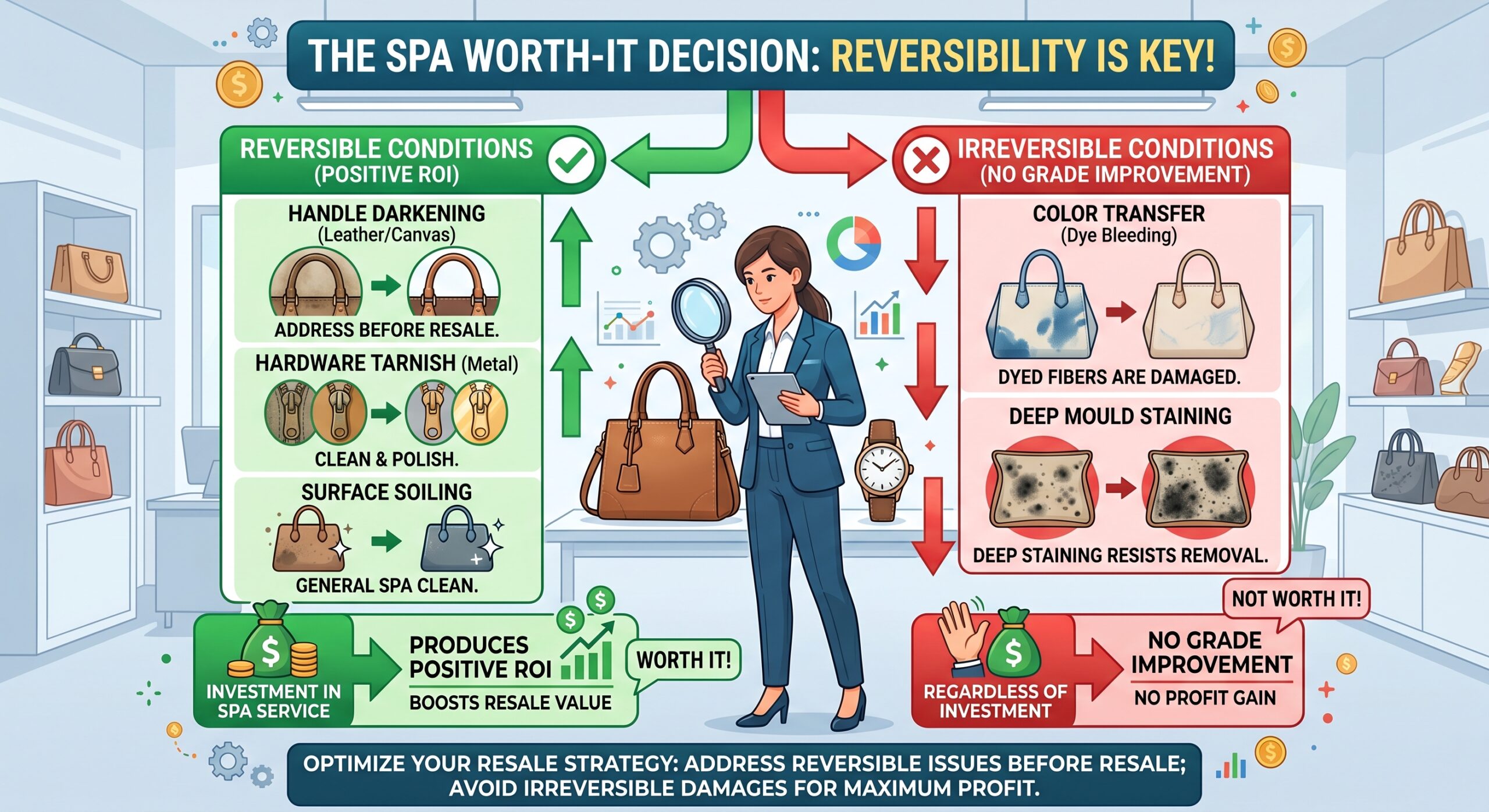
The Hermès Spa submission process begins at any Hermès boutique that offers the service — which includes most major boutiques globally, though availability of higher-tier services varies by location. No prior boutique relationship is required; any owner of a genuine Hermès piece may submit it for Spa assessment.
- Contact your nearest Hermès boutique in advance to confirm their Spa submission process — some high-demand boutiques require a scheduled appointment for Spa submissions; others accept walk-in submissions during business hours. Flagship boutiques in Paris, New York, and Hong Kong frequently require appointments due to volume.
- Bring the piece with its original dustbag and any accessories (clochette, lock, keys) — the Spa team assesses the complete set and may include accessory cleaning or polishing in the service scope.
- At submission, the SA will inspect the piece with you and discuss the observed conditions. Ask them to walk through each condition issue and their assessment of whether it is addressable through the available service options — this conversation is your opportunity to understand what is and is not reversible before authorising any work.
- Request a written service estimate covering: (a) specific services to be performed, (b) estimated cost range, (c) estimated completion timeline, (d) whether the piece will remain at the local boutique or be sent to an atelier, and (e) the insurance and liability policy during the service period.
- Do not authorise open-ended service scopes — if the estimate is given as a range (e.g., "$200–$600 depending on what the atelier finds"), ask for a maximum authorisation amount above which they must contact you before proceeding.
- When collecting the completed piece, inspect it thoroughly in good natural lighting before accepting it — check that the completed work matches the agreed service scope and that no new damage has been introduced during the service process. Raise any concerns at the point of collection rather than after leaving the boutique.
- After Spa service, allow the leather to breathe at room temperature for 24–48 hours before storing in the dustbag — freshly conditioned leather needs air circulation to fully absorb the conditioner and stabilise before sealed storage.
The Spa relationship also interacts with the resale platform certification question. A piece that has received Hermès Spa service does not receive any formal documentation or certification from Hermès — the service is not accompanied by a certificate or report that can be presented to resale platforms. Platforms authenticate and grade based on the physical condition of the piece at submission; they do not adjust their assessment based on a seller's disclosure that Spa service was performed. The service improves the physical condition; the improved physical condition is what the platforms respond to. The condition grade vocabulary used by each platform is covered in our Hermès Market & Investment Glossary.
| Condition Issue | Spa Service Tier | Cost Range | Grade Improvement | Resale Uplift | Worth It? |
|---|---|---|---|---|---|
| Handle darkening (moderate) | Tier 1–2 | $150–$350 | Excellent → Pristine | +$1,500–$2,500 | Yes — strong ROI |
| Handle darkening (severe) | Tier 3 | $600–$900 | Good → Excellent | +$1,200–$2,000 | Yes — positive ROI |
| PHW oxidation / tarnish | Tier 1 | $100–$200 | Excellent → Pristine | +$800–$1,500 | Yes — very strong ROI |
| Interior lining soiling (light) | Tier 1–2 | $100–$250 | Excellent → Pristine | +$500–$1,200 | Yes — positive ROI |
| Surface conditioning (dry leather) | Tier 1 | $75–$150 | Maintains current grade | Defers grade degradation | Yes — for long holds |
| Colour fading (partial) | Tier 4 | $800–$1,500 | Possible partial improvement | Variable — $500–$2,000 | Marginal — assess first |
| Colour transfer (denim / dark fabric) | Any tier | $75–$600 | None — irreversible | No improvement | No — do not submit |
| Deep mould staining (sub-surface) | Any tier | $100–$400 | Minimal — surface only | No meaningful improvement | No — prevention only |
Cost ranges reflect approximate 2026 US market rates. Resale uplift figures are approximate and based on observed grade-to-price relationships at major platforms for standard quota bag configurations. Actual outcomes depend on specific piece, boutique, leather type, and platform assessment.
Submit for Reversible Conditions Before Resale — Avoid for Irreversible Damage
The Hermès Spa treatment is one of the most effective resale preparation investments available when applied to the right conditions — and one of the most wasted expenditures when applied to the wrong ones. The conditions that produce positive Spa ROI are consistent: handle darkening, hardware tarnish, surface soiling, and interior lining issues that have not penetrated below the cleanable surface. Each of these is reversible, assessable by platform graders, and commands a priceable grade improvement that typically exceeds the service cost by a factor of three to eight.
The conditions that produce zero Spa ROI are equally consistent: colour transfer from dyed fabrics, deep mould staining from humidity damage, and deep surface removal scratches on smooth leathers. These are chemically or structurally irreversible at the interventions the Spa can perform, and submitting a piece with these conditions produces a service cost with no grade improvement and no resale uplift. Understanding this boundary before submission prevents the frustration and financial waste that characterises uninformed Spa use.
The wait time factor is material in the resale calculation. A piece submitted for a full handle replacement in January has a best-case collection date of April — and a realistic date for complex atelier work of June or later. Holders with resale timelines must build Spa submission well ahead of any planned listing date and understand that unexpected atelier delays are common. Factor at least twice the quoted timeline into any resale planning that depends on Spa completion.
Bottom Line: Submit for Spa treatment when the specific condition issue is reversible and the grade improvement it produces covers the service cost by at least 2–3×. For permanent damage, save the service cost and apply it to prevention on the next piece — the Spa cannot undo what correct care would have prevented.
Popular Searches
Explore our most searched Hermès Spa and leather restoration questions
Frequently Asked Questions
Hermès Spa treatment costs vary by service level and location. Basic conditioning and cleaning services typically range from $75–$200. Intermediate services including handle replacement and hardware polishing range from $200–$600 depending on the specific work required. Major restoration services — full leather re-dyeing, strap replacement, or significant structural repair — range from $600–$1,500 or more. Prices vary by boutique location and the specific condition of the piece assessed at submission. The Spa service is not a fixed price menu; each piece is assessed individually. For the full condition grade context, see our leather durability and condition guide.
Wait times vary significantly by boutique location, service type, and current demand. Basic cleaning and conditioning services typically take 2–6 weeks. Intermediate services (handle replacement, hardware polishing) typically take 4–12 weeks. Major restoration work can take 3–6 months, particularly for pieces that must be sent to the Hermès atelier in Paris. Wait times are substantially longer at flagship boutiques in high-demand markets than at secondary market boutiques. Always request a written estimate of service scope and timeline before submission — and build at least double the quoted timeline into any resale plan that depends on Spa completion.
It depends entirely on the specific service and the piece's starting condition. For pieces where the Spa service can genuinely improve the condition grade assessment — conditioning moderately worn handles, polishing tarnished hardware, cleaning light interior lining soiling — the resale value improvement typically exceeds the service cost by a factor of 3–5×. A $150 conditioning service that moves a Kelly from Excellent to Pristine grade on Fashionphile can add $1,500–$2,500 to the achievable price. For pieces with permanent damage that the Spa cannot reverse, the service cost produces no grade improvement. See our Hermès Market & Investment Glossary for condition grade definitions by platform.
Yes — the Hermès Spa service does not require an existing boutique relationship or purchase history. Any owner of a genuine Hermès piece can submit it for Spa assessment at any Hermès boutique that offers the service. The submission process requires the piece to be authenticated by the Spa team upon receipt, and the boutique will contact you with a service estimate before commencing any work. In some busy boutiques, Spa submission may require a scheduled appointment. Contact your nearest Hermès boutique directly to confirm their current process.