Birkin vs Kelly: Which Holds Its Value Better Over 5 Years?
The definitive investment comparison — five-year secondary market data on premium retention, liquidity, correction resilience, and which quota bag produces the stronger long-term return across key configurations.
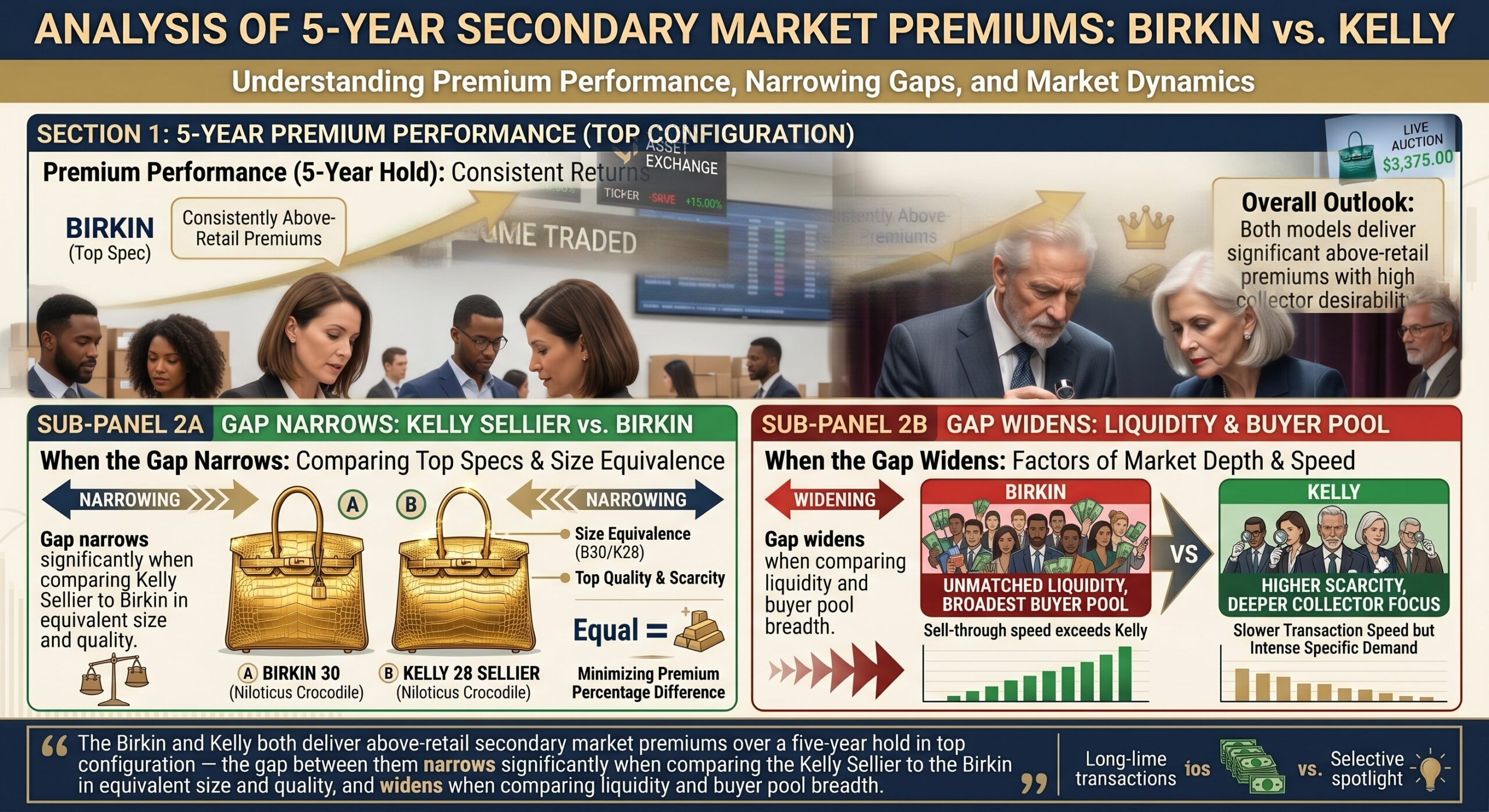
A Birkin 30 in Togo with palladium hardware purchased at retail in 2021 and held in Grade A condition through 2026 has, at current secondary market pricing, delivered an approximate annualised return of 9–14% — combining the ongoing secondary market premium above retail with the retail price increases that raised the floor value each year. The equivalent Kelly 28 Retourne in the same configuration has delivered a slightly lower but comparable return over the same period. The gap between the two styles, measured as an investment return differential over five years, is real but narrower than most buyers assume — and in the specific case of the Kelly 25 Sellier, the Kelly's return has matched or exceeded the Birkin in certain holding periods.
The Birkin vs Kelly question is one that every Hermès investor eventually confronts — either when choosing between competing SA offers, when evaluating secondary market acquisitions, or when assessing the five-year return profile of their existing quota bag portfolio. The answer is not simply "Birkin wins" or "Kelly wins." It depends on which Birkin, which Kelly, the construction of the Kelly, the specific holding timeline, and the platform best suited to exit each style. This article provides the complete comparative data across all these variables.
Both the Birkin and the Kelly are covered in their broader market context in the Hermès Bag Comparisons Hub. This analysis focuses specifically on the five-year value retention question — the most relevant investment horizon for most quota bag holders and the period that most clearly separates the two styles' distinctive performance characteristics.
The Investment Framework: What a Five-Year Hold Means
A five-year holding period for a Hermès quota bag encompasses approximately five to ten retail price increase cycles, one or more secondary market correction and recovery phases, and potentially two to three market trend cycles affecting buyer preferences for specific sizes, colors, and constructions. The investment return over this period is therefore not a static calculation — it is the product of the premium above retail maintained at exit, compounded by the retail price floor increases that occurred during the hold, and adjusted by the condition grade preserved across the period.
The key distinction between the Birkin and Kelly as five-year investments is not primarily return magnitude — both deliver strong returns in top configuration — but return consistency and exit certainty. The Birkin's broader buyer pool on all four major resale platforms means that a correctly priced, Grade A Birkin in a standard configuration can be sold within days to weeks regardless of market conditions. The Kelly's buyer pool is somewhat more specialised — it sells quickly in collector-favoured configurations (25 Sellier, neutral colors, top condition) but more slowly in less-sought configurations (32 Retourne, Clemence, B+ condition). This exit certainty difference compounds significantly over a five-year hold that may include periods of buyer market uncertainty.
The five-year return on a Hermès quota bag is the product of two compounding mechanisms: the secondary market premium above retail maintained at exit, and the retail price floor increases that accumulated during the hold. A Birkin 30 purchased at $12,000 in 2021, with retail now approximately $15,000 and a secondary market premium of 30%, exits at approximately $19,500 — a gain of approximately $7,500 or 62.5% over five years, equivalent to approximately 10.2% annualised.
The Kelly's return calculation follows the same structure. The key difference is that the Kelly's somewhat narrower buyer pool introduces more exit timing risk — a Birkin priced correctly sells in days; a Kelly in the same configuration may take weeks. Over a five-year hold, this timing difference is typically irrelevant for patient sellers. For sellers with time constraints at exit, it is a meaningful practical distinction.
The Birkin Case: Liquidity, Volume, and Consistent Premium
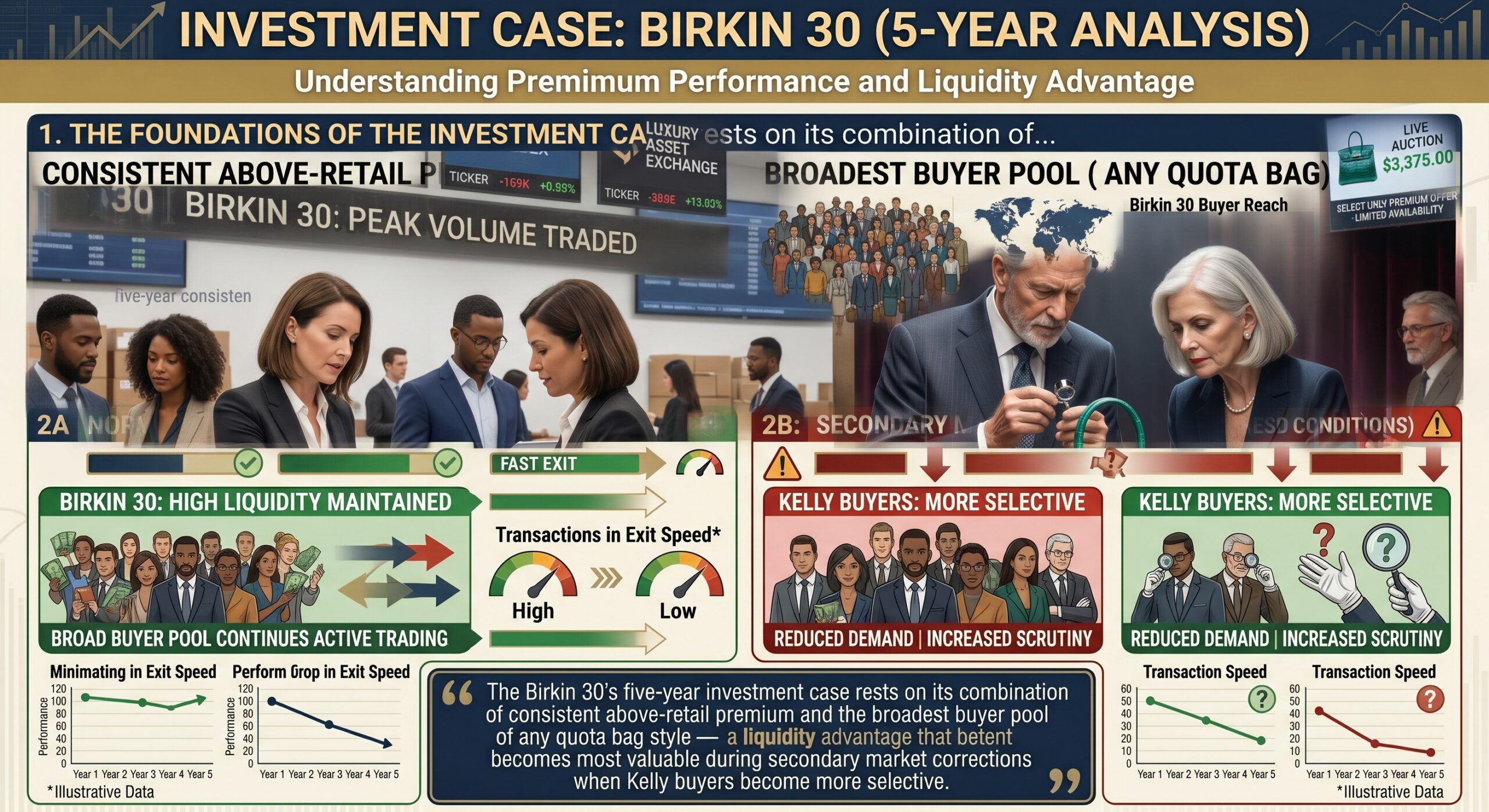
The Birkin's five-year investment case rests on three structural advantages that compound across the holding period: the broadest buyer pool of any Hermès quota bag style, the highest transaction volume on all four major resale platforms, and a secondary market premium history that has been consistent across five years of market conditions ranging from the 2021–2023 peak to the 2024–2025 correction and the 2026 stabilisation.
Buyer pool breadth is the most practically consequential Birkin advantage. On Fashionphile and The Real Real — the two platforms with the highest total Hermès transaction volume — the Birkin appears more frequently in search queries, receives more buyer enquiries per listing, and achieves faster sell-through than the Kelly in equivalent configurations. This is not because the Birkin is more desirable per se; it is because the Birkin is more universally recognised as the quintessential Hermès quota bag across the full range of buyer types that use volume platforms. First-time quota bag buyers default to searching Birkin; experienced collectors search specifically for the exact Kelly configuration they want. The breadth advantage compounds most significantly at the volume platforms and in standard (rather than exceptional) configurations.
The Birkin's premium consistency through the 2024–2025 correction is the most important five-year data point for investment planning. While the correction affected all quota bag styles, the Birkin's higher transaction volume allowed secondary market prices to clear and stabilise faster — sellers who needed to exit during the correction found a market for correctly priced Birkins when Kelly liquidity was more constrained. For holders with defined exit timelines — those who plan to sell at a specific point regardless of market conditions — the Birkin's liquidity advantage is a genuine risk reduction tool.
- For a five-year hold with a defined exit date, the Birkin 30 in Togo or Epsom with PHW is the most reliable configuration — its liquidity advantage ensures exit execution regardless of the market environment at your target date.
- The Birkin 25's higher premium percentage makes it the stronger pure-return specification for patient sellers without defined exit timelines — its collector buyer pool is deep enough to maintain premiums across market cycles.
- Birkin premium retention through the correction confirms that the five-year Birkin investment thesis is structurally sound — the 2024–2025 period was a stress test that the top-configuration Birkin passed with meaningful premium maintenance.
- Over five years with annual retail price increases of approximately 7–12%, the Birkin's floor value compounds significantly — a holder who maintains Grade A condition captures both the premium-above-retail and the floor appreciation simultaneously.
The Kelly Case: Construction Premium and Collector Depth
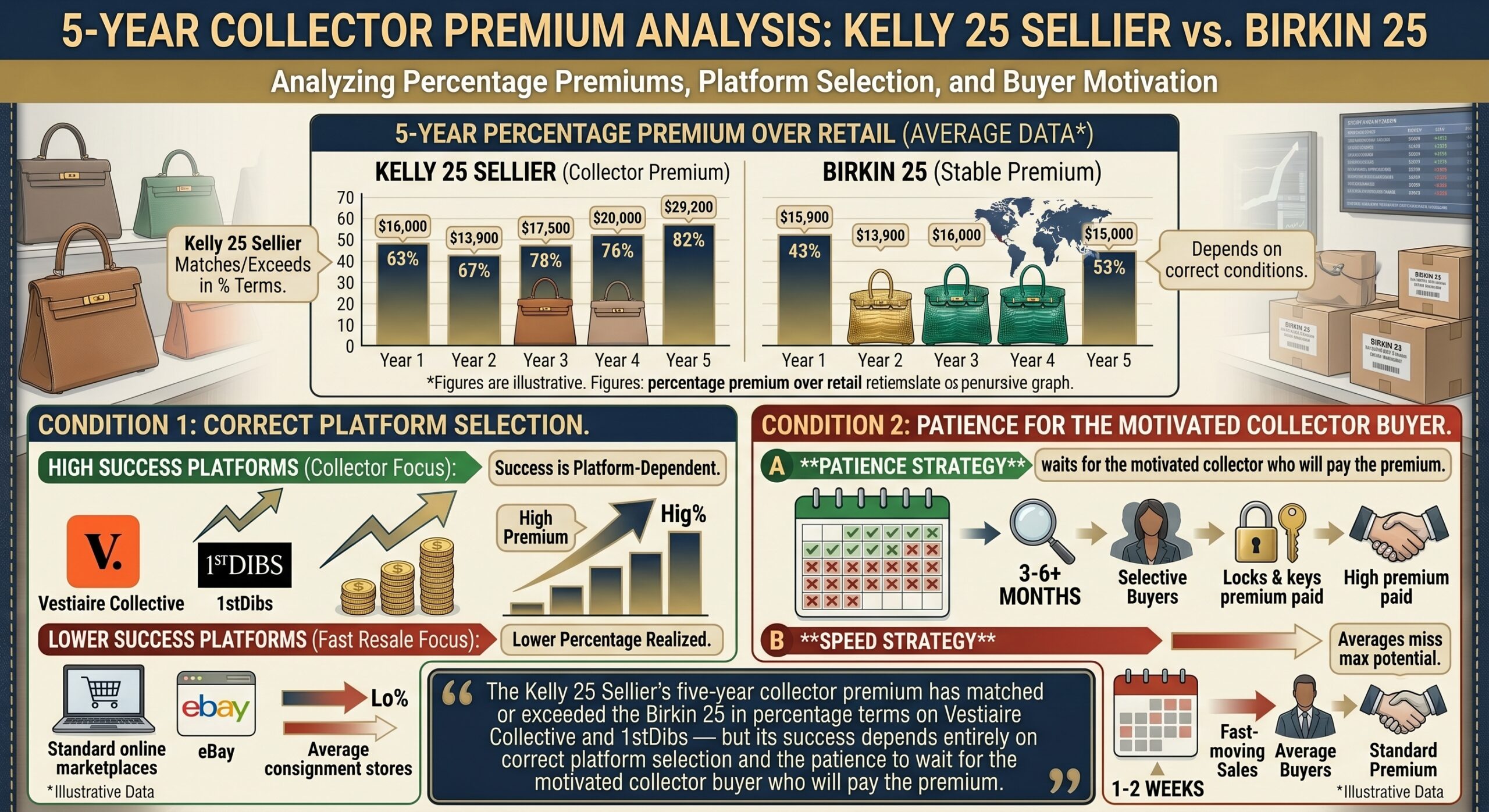
The Kelly's five-year investment case is more nuanced than the Birkin's — and in the right configuration, it is genuinely competitive. The Kelly Sellier 25 in a top configuration has produced percentage premiums over five years that equal or exceed the Birkin 25 in several observed holding periods, driven by the intersection of construction premium, size demand, and the deep collector community that has formed around the compact Sellier format specifically.
The construction premium is the Kelly's unique investment variable — one that the Birkin does not have. A Kelly Sellier commands approximately 10–18% more than an equivalent Kelly Retourne in the same configuration, as documented in our dedicated analysis of Sellier vs Retourne construction and value retention. Over a five-year hold, this construction premium compounds with the same retail price increase floor mechanism that benefits the Birkin — a Kelly 25 Sellier purchased at construction premium today holds that construction differential through the entire holding period and benefits from all retail price increases applied to its base retail price.
"The Kelly Sellier 25 is the only quota bag configuration where the premium percentage has consistently matched or exceeded the Birkin 25 across multiple market conditions — but its narrower buyer pool means patience at exit is non-optional."
The Kelly's collector depth is its second distinctive advantage. On Vestiaire Collective and 1stDibs — the two platforms with the most active international collector buyer pools — the Kelly Sellier attracts a specific buyer segment that is motivated, informed, and price-willing in a way that the broader Birkin buyer pool at volume platforms is not. A Kelly 25 Sellier in Rose Shocking or a rare neutral with full provenance on 1stDibs will attract competitive enquiries from buyers who have specifically been looking for that exact configuration — producing a premium outcome that can exceed the equivalent Birkin's market performance at Fashionphile in absolute dollar terms.
The design heritage and silhouette analysis that informs the Kelly's collector positioning — why the Sellier specifically commands collector devotion that the Retourne does not — is covered by the design team at Hermès Guidance Lounge's Kelly silhouette history guide, which provides useful context on why the collector community has formed around specific Kelly configurations rather than the style broadly.
- Always specify Sellier construction when pursuing a Kelly offer — the five-year construction premium advantage is consistent and durable, and it adds directly to the return calculation across the full holding period.
- Kelly Sellier 25 is the single strongest Kelly configuration for five-year investment — its size-construction combination produces the most concentrated collector demand of any Kelly format.
- Kelly Retourne 28 remains a reliable five-year hold in standard configuration — lower premium than Sellier, but more reliable transaction volume and faster average sell-through that reduces exit timing risk.
- Plan Kelly exits on Vestiaire Collective or 1stDibs — the collector buyer pool on these platforms is better calibrated to Kelly Sellier value than the volume platforms where Birkin liquidity advantages are most pronounced.
Our sister analysis of Hermès reseller market price drop trends from 2024 to 2026 provides the specific correction-period data that most clearly separates Birkin and Kelly five-year performance profiles — the correction phase is when the liquidity difference between the two styles becomes most visible and most practically significant for sellers who needed to exit during that period.
Making the Decision: Birkin or Kelly for Your Portfolio
The Birkin vs Kelly portfolio decision reduces to four practical questions that each buyer can answer for their specific situation. The answers determine which style's five-year investment characteristics better match the buyer's actual holding conditions.
The first question is exit timeline certainty. If you have a defined exit window — "I will sell in five years regardless of market conditions" — the Birkin's liquidity advantage makes it the safer choice. Its transaction volume means you can price at market and sell within a predictable timeframe. If your exit timeline is flexible — "I will sell when the right buyer appears at the right price" — the Kelly Sellier becomes more competitive, because you can afford to wait for the collector buyer who will pay the construction premium.
The second question is platform access and preference. If your resale strategy targets Fashionphile and The Real Real — where you value speed of sale and ease of transaction — the Birkin outperforms. If your strategy targets Vestiaire Collective and 1stDibs — where you value maximum price achievement and accept a longer listing period — the Kelly Sellier is more competitive.
- For a defined five-year exit date with any market condition tolerance: Birkin 30 Togo PHW — the most reliable combination of premium, liquidity, and sell-through speed across all market conditions.
- For a flexible exit timeline with patient platform strategy: Kelly 25 Sellier neutral leather — the highest percentage premium achievable in any Kelly configuration, on the right platform for the right collector buyer.
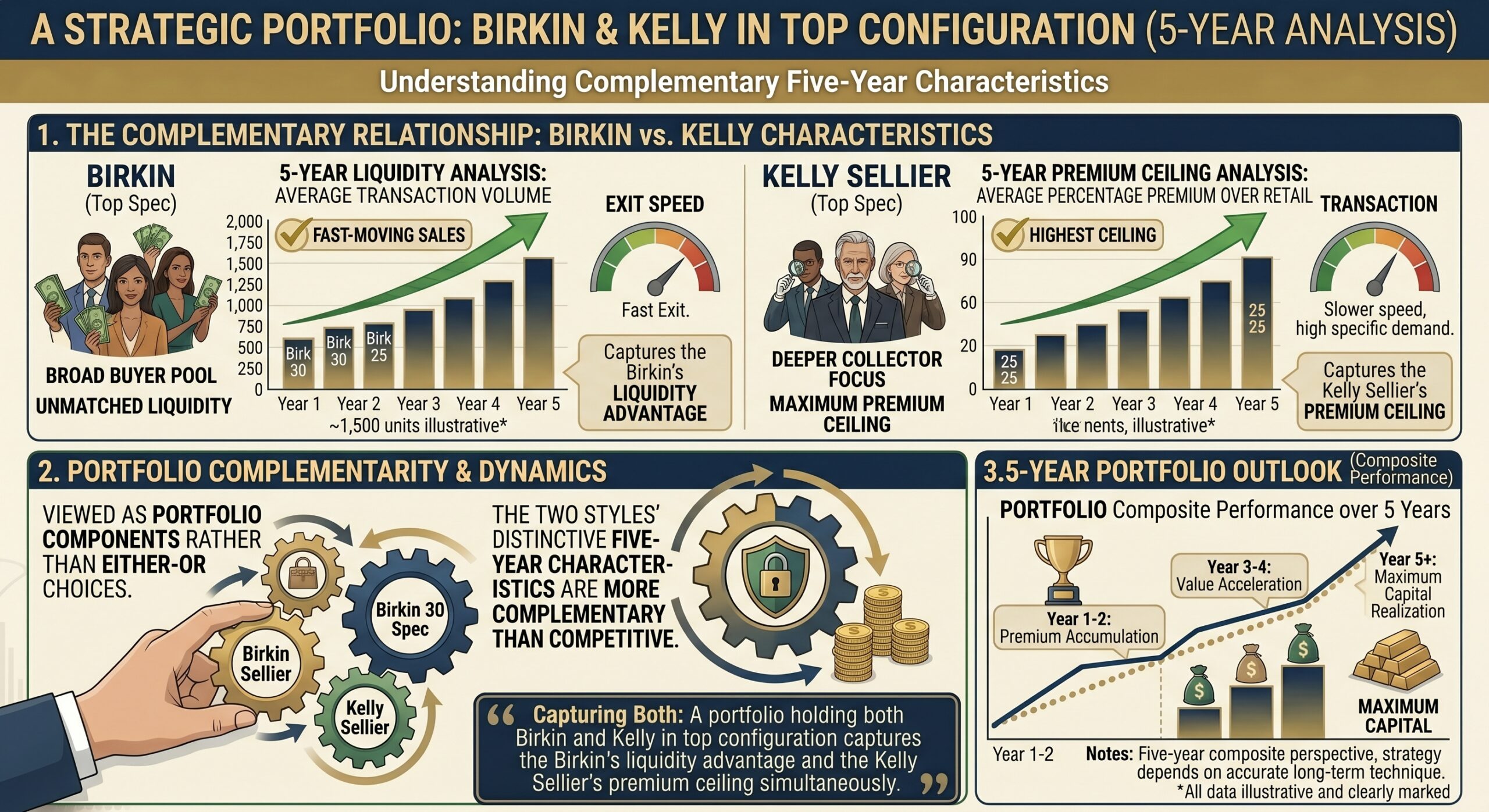
- For portfolio diversification across both styles: Birkin 30 as the liquidity anchor (holds resale value reliably in any market); Kelly 25 Sellier as the premium upside position (higher ceiling, lower liquidity floor).
- For buyers who receive both styles from their SA over time: accept all offers in top configuration — both deliver strong five-year returns, and a portfolio including both styles captures the liquidity advantage of the Birkin and the premium ceiling of the Kelly Sellier simultaneously.
- The annual price increase that compounds the floor value applies equally to both styles — the $7,500 five-year gain on a Birkin 30 example is replicated in structure, if not in exact magnitude, across the Kelly range in equivalent configurations.
The size data from our companion analysis of which Hermès bag sizes have the highest resale demand in 2026 provides an essential complement to this style comparison — the Birkin vs Kelly decision cannot be fully separated from the size decision, and the five-year return differences between styles narrow significantly when comparing top-tier size configurations in each style. The full market intelligence archive is available through the Market & Resale category.
| Configuration | Style | 5-Year Premium Range | Liquidity | Best Exit Platform |
|---|---|---|---|---|
| 25 — Togo/Epsom — PHW — Grade A | Birkin | 35–45% | High (collector-driven) | Vestiaire · 1stDibs |
| 25 Sellier — Togo/Epsom — PHW/GHW — Grade A | Kelly | 25–40% | High (collector-driven) | Vestiaire · 1stDibs |
| 30 — Togo/Epsom — PHW — Grade A | Birkin | 20–35% | Highest (volume leader) | Fashionphile · TRR |
| 28 Sellier — Togo/Epsom — PHW — Grade A | Kelly | 18–30% | High | Vestiaire · Fashionphile |
| 28 Retourne — Togo — PHW — Grade A | Kelly | 12–22% | Very High (highest Kelly volume) | Fashionphile · TRR |
| 25 — rare color — Grade A | Birkin | 35–50%+ | Moderate (collector wait) | Vestiaire · 1stDibs |
| 25 Sellier — rare color — Grade A | Kelly | 30–48%+ | Moderate (collector wait) | 1stDibs · Vestiaire |
| 35 — any leather — Grade A | Birkin | 5–15% | Low (corrected) | Fashionphile |
| 32 Retourne — any leather — Grade A | Kelly | 10–20% | Moderate | Fashionphile · TRR |
Five-year premium ranges reflect observed secondary market ranges in Grade A/Pristine condition. Rare colors, exotic leathers, full provenance, and specific market timing can significantly affect outcomes. All data approximate and based on 2021–2026 observed patterns.
Birkin for Reliability; Kelly Sellier for Premium — Both Win Over Five Years
The five-year secondary market data produces a nuanced but actionable verdict: the Birkin delivers the more consistent and reliable five-year investment return across the broadest range of market conditions and exit timelines. Its superior liquidity, broader buyer pool, and higher transaction volume at volume platforms means that a correctly priced, Grade A Birkin in standard configuration will exit the market within a predictable window at a predictable premium — regardless of whether the market is at a peak, in correction, or stabilising.
The Kelly Sellier — particularly the 25 — is not a lesser investment. In percentage premium terms, the Kelly 25 Sellier has matched or exceeded the Birkin 25 across multiple five-year holding periods. Its collector buyer depth on Vestiaire Collective and 1stDibs is genuine and durable. The difference is exit certainty and exit speed — the Kelly Sellier buyer exists, is motivated, and will pay, but requires the correct platform and the patience to wait. For sellers with defined exit dates or market-condition-sensitive timelines, this patience requirement introduces risk the Birkin does not carry.
The optimal portfolio position is both styles in top configuration: Birkin 30 as the liquidity anchor and Birkin 25 or Kelly 25 Sellier as the premium upside position. Both compound the same retail price floor increases; both maintain above-retail secondary market premiums in Grade A condition; both deliver strong five-year annualised returns. The choice between them, when the SA offers both over time, should be determined by configuration rather than style label — the specific leather, size, construction, and condition of each offer is the variable that matters most.
Bottom Line: The Birkin wins on five-year return reliability and exit speed; the Kelly Sellier wins on premium ceiling in top configurations — accept all offers in top configuration from either style, and let the secondary market do the rest.
Popular Searches
Explore our most searched Birkin vs Kelly investment and comparison questions
Frequently Asked Questions
Over a five-year holding period, the Birkin delivers stronger absolute dollar returns due to its higher average premium above retail and broader buyer pool across all platforms. The Birkin 30 in particular produces the most consistent five-year return profile — combining above-retail secondary market pricing with Hermès annual retail price increases that compound the floor value each year. The Kelly Sellier (particularly the 25) can match or exceed Birkin premiums in percentage terms in top collector configurations, but its narrower buyer pool introduces more exit timing risk over a five-year hold. For the style-level resale context, see our analysis of which Hermès bag styles hold their resale value best in 2026.
The Kelly 25 Sellier in premium configuration — Grade A, neutral leather, PHW or GHW — achieves percentage premiums comparable to or exceeding the Birkin 25 on Vestiaire Collective and 1stDibs. However, the Sellier's narrower collector buyer pool means that achieving those premiums requires more patience and more careful platform selection than the Birkin equivalent. Over a five-year hold in top configuration, the Kelly Sellier is a legitimate investment-grade alternative to the Birkin — particularly for buyers whose SA relationship produces consistent Sellier offers before Birkin offers.
Both styles showed similar correction patterns during 2024–2025, with standard neutral configurations experiencing 8–15% premium compression from peak levels and top-tier configurations (25s, Selliers, rare colors) showing stronger resilience. The Birkin's broader buyer pool provided slightly faster price stabilisation post-correction — its higher transaction volume allows market clearing to happen more efficiently. The Kelly Sellier's collector-specific demand base produced deeper initial correction depth in some configurations but also recovered faster in the collector tier as serious buyer demand returned. See our Hermès reseller market price drop analysis for the full correction data.
From a pure investment return perspective, accept the Birkin if offered in a comparable configuration — its broader buyer pool, higher transaction volume, and more consistent premium history make it the more dependable five-year hold. If the Kelly offer is in Sellier construction in the 25 or 28 size and the Birkin alternative is a less desirable configuration (size 35, Clemence, or an unusual color), the Kelly Sellier is the stronger choice. The key variable is the specific configuration of each offer, not the style label alone. Both are investment-grade quota bags; the configuration details determine which is the better specific hold.