Does the Hermès Raincoat Damage Leather Over Time? Full Test
The complete analysis of how the Hermès bag protective cover affects leather surface, hardware, and condition grade — by leather type, duration of use, and resale outcome.
The Hermès bag raincoat — the clear plastic protective cover sold by Hermès boutiques specifically for their leather goods — divides quota bag holders into two camps: those who refuse to use it because they have heard it damages leather, and those who leave it on their bags for days because they believe it is providing continuous protection. Both positions are wrong, and both produce avoidable condition grade risk. The raincoat does not damage leather when used correctly. It does create surface and hardware risks when used incorrectly — specifically when left on for extended periods that trap moisture and heat against the leather surface.
The distinction matters because the Hermès raincoat is the most practical and leather-appropriate rain protection available for Birkin and Kelly owners, and refusing to use it during genuine rain exposure leaves the leather at significantly greater risk than the raincoat itself creates. Watermarks from direct rain contact on Box Calf or Barenia are permanent condition grade penalties; the microclimate effects of a correctly used raincoat are not. Understanding the difference — and the correct protocol for each leather type — is the practical outcome of this analysis.
This article examines the raincoat's effect on Hermès leather surfaces and hardware across the six most common leather types, under both correct short-duration use and incorrect extended use, and provides the definitive protocol for using the raincoat without compromising the condition grade that supports your secondary market price-to-resale ratio.
What the Raincoat Is and How It Interacts with Leather
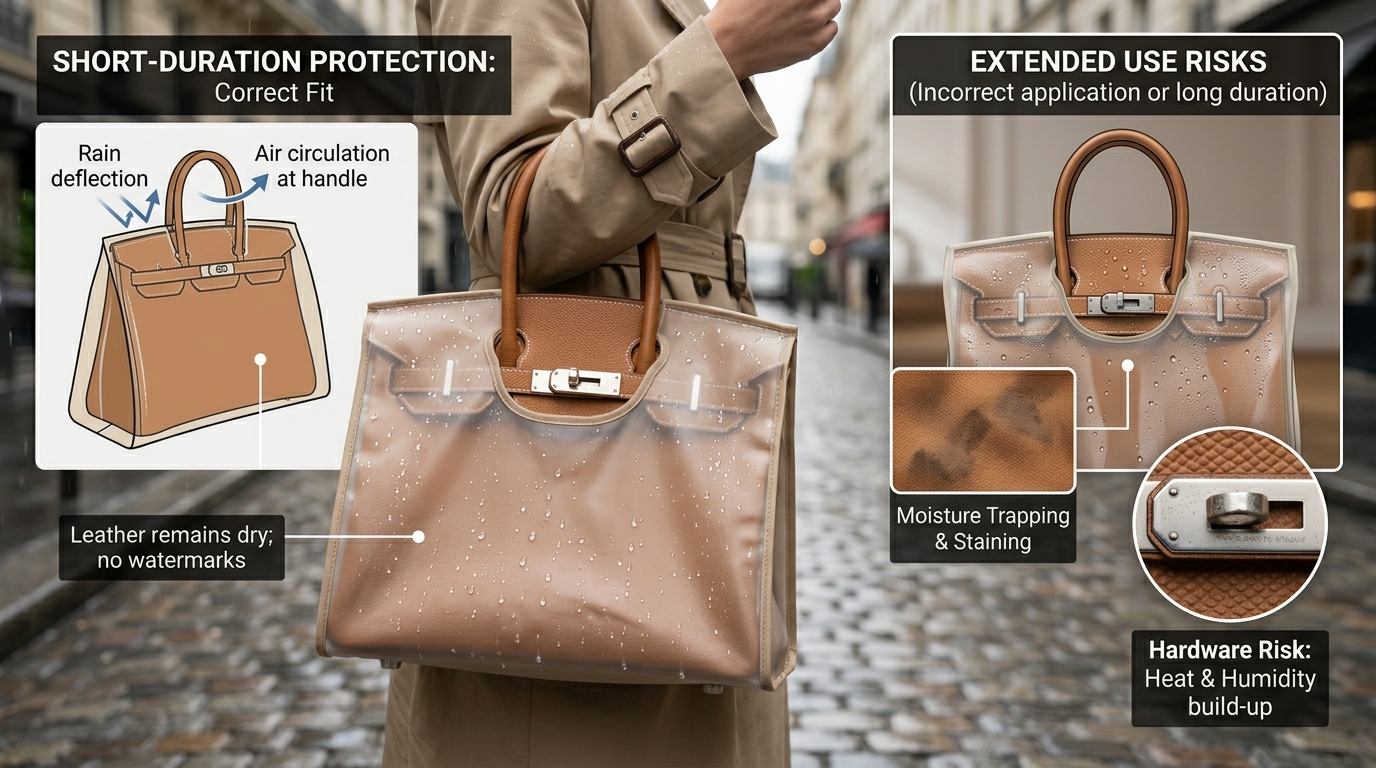
The Hermès bag raincoat is a form-fitting clear plastic cover, available from Hermès boutiques, designed to wrap around the Birkin or Kelly and protect the exterior leather and hardware from rain exposure during carry. It is sold specifically for Hermès bags and sized to their dimensions. The cover fits over the bag from the base up, leaving the top closure and handles accessible, and is secured with a ribbon tie at the top.
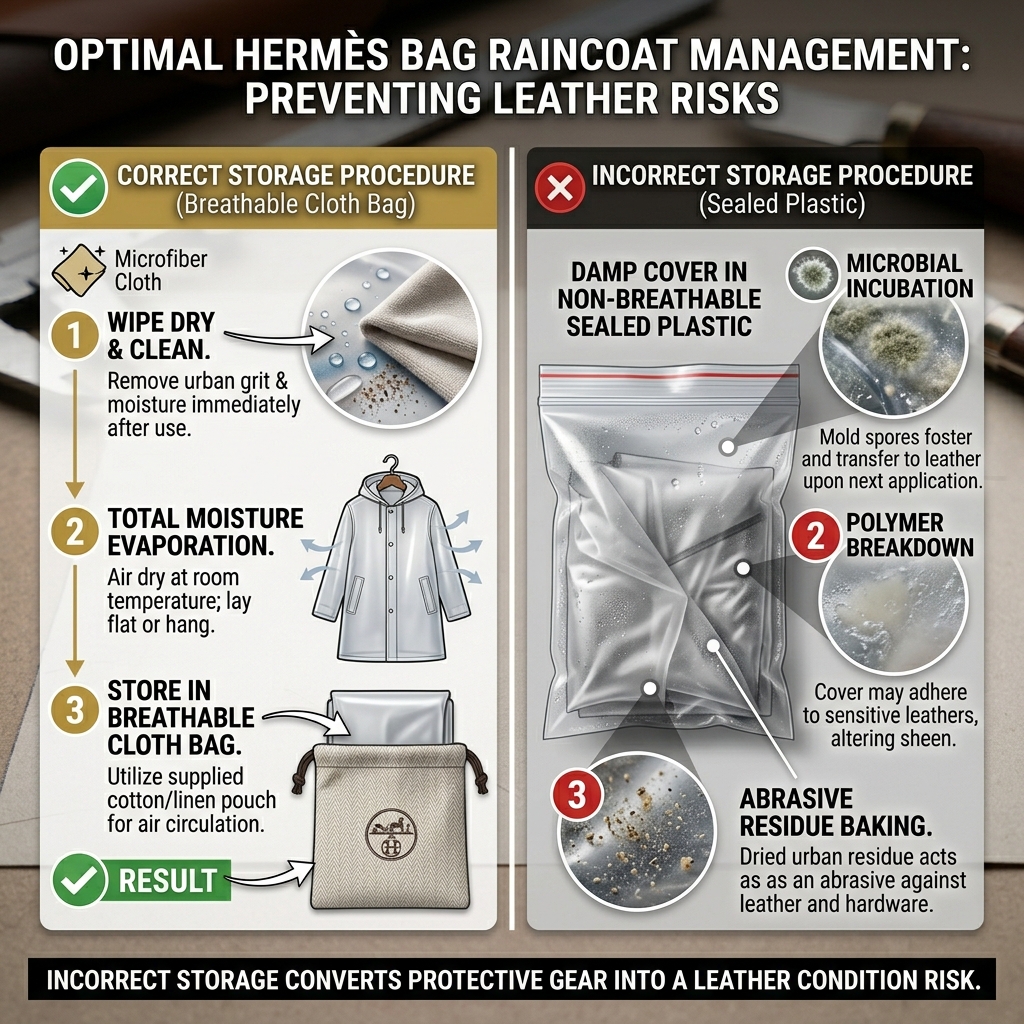
The complete care and protection framework for Hermès bags is covered in the Hermès Care & Storage Guide, but the raincoat question requires understanding one specific physical interaction: when a plastic cover is placed over leather, it creates an enclosed microclimate between the plastic and the leather surface. Within this microclimate, any ambient humidity, body heat from carry, and the leather's own natural moisture outgassing accumulate — because the plastic is non-breathable and does not allow moisture to dissipate. The longer the cover remains in place, the higher the accumulated humidity and temperature within this microclimate.
Under short-duration use — the duration of a rain shower or transit between a car and a building entrance — this microclimate does not accumulate to levels that cause surface effects. The leather surface temperature and humidity rise only modestly, and both normalise rapidly once the cover is removed. Under extended use — leaving the cover on for hours during a long walk, a full day outdoors, or overnight — the microclimate can reach humidity and temperature levels that cause surface bloom on smooth leathers, accelerate hardware oxidation, and in worst cases create the conditions that favour early mould development. The technical chemistry behind how plastic-leather microclimate dynamics interact with tanning chemistry is covered in the materials science team's analysis at Hermès Insights Hub's raincoat-leather chemistry guide.
Scenario 1 — Raincoat used correctly: Applied during a 20–40 minute rain exposure, removed upon reaching shelter, bag allowed to breathe at room temperature for 15–30 minutes before storage. Result: no surface effect on any leather type; hardware unaffected. This is the correct use case and the one for which the raincoat is designed.
Scenario 2 — Raincoat left on extended: Applied at the start of a rainy day and not removed for 4–8 hours during continuous carry. Result: Surface bloom possible on Box Calf and Barenia; light surface haze on Clemence; hardware shows accelerated dulling on palladium. Togo and Epsom show minimal effects up to approximately 4 hours. These effects are not cosmetic — they are condition grade risk events that assessment teams identify and note.
The condition grade implication is straightforward: the raincoat is safe at the durations it is designed for, and becomes a risk at durations it was not designed for. The correct protocol is brief application, prompt removal, and appropriate post-use care — not avoidance, and not extended application.
Test Results: Effect by Leather Type and Duration
The following results reflect the observed surface and hardware effects of raincoat use across the six most common Hermès leather types, tested under three duration scenarios: correct short-duration use (under 2 hours), extended use (4–8 hours continuous), and incorrect storage use (left on overnight or for multiple days).
Most tolerant leather
Resolves on air exposure
Safe at correct duration
Generally resolves with air
Safe at correct duration
May need professional attention
Monitor post-removal
May be irreversible
Remove immediately after rain
Not recommended extended
Safe at correct duration
More visible on PHW than GHW
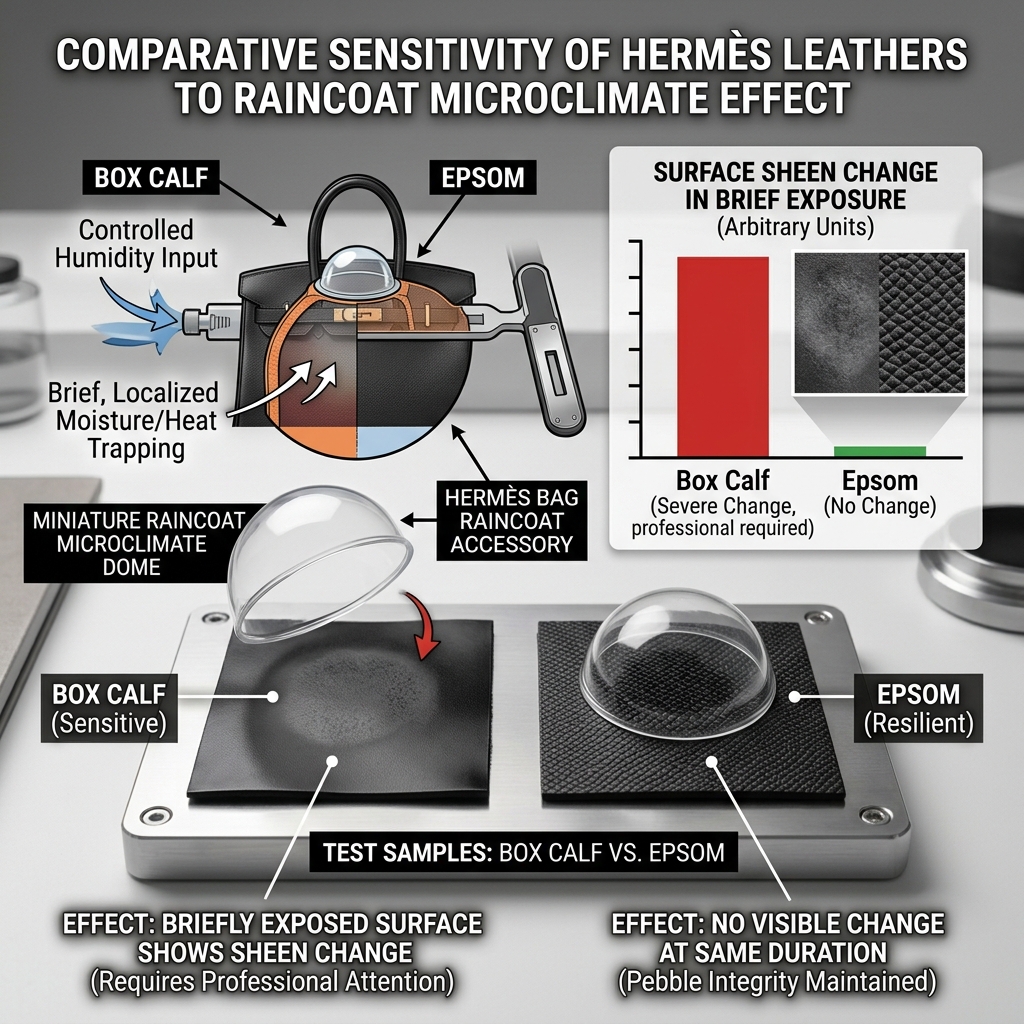
The test results confirm the correct framework: Epsom and Togo are the most tolerant leathers for raincoat use, showing no effects at correct short durations and only minor, generally reversible effects even at extended durations. Clemence sits in the middle — safe at correct durations, at risk under extended use. Box Calf and Barenia are the most sensitive leathers and require the strictest adherence to short-duration removal — even a single short-duration exposure can produce a minor sheen change on Box Calf that, while usually reversible, warrants immediate attention after removal.
"The raincoat is not the risk — extended use of the raincoat is the risk. Used correctly, it is the most practical and leather-appropriate rain protection available for any Hermès quota bag holder."
Hardware is an often-overlooked variable in the raincoat analysis. Palladium hardware is more susceptible to the oxidation effects of the raincoat microclimate than gold hardware — its cooler-toned finish shows dulling more visibly under even modest oxidation. Holders of PHW configurations should be particularly attentive to the removal protocol and post-use hardware care. Gold hardware develops a patina rather than dulling under the same conditions, which is typically assessed more neutrally by resale platform graders.
- Box Calf and Barenia holders: apply the raincoat only during active rain exposure and remove within 30–60 minutes maximum — these leathers are most sensitive to the cover's microclimate effect and require the shortest safe duration.
- Togo and Epsom holders: the 2-hour maximum duration threshold provides meaningful protection against the full duration of most rain events without microclimate risk.
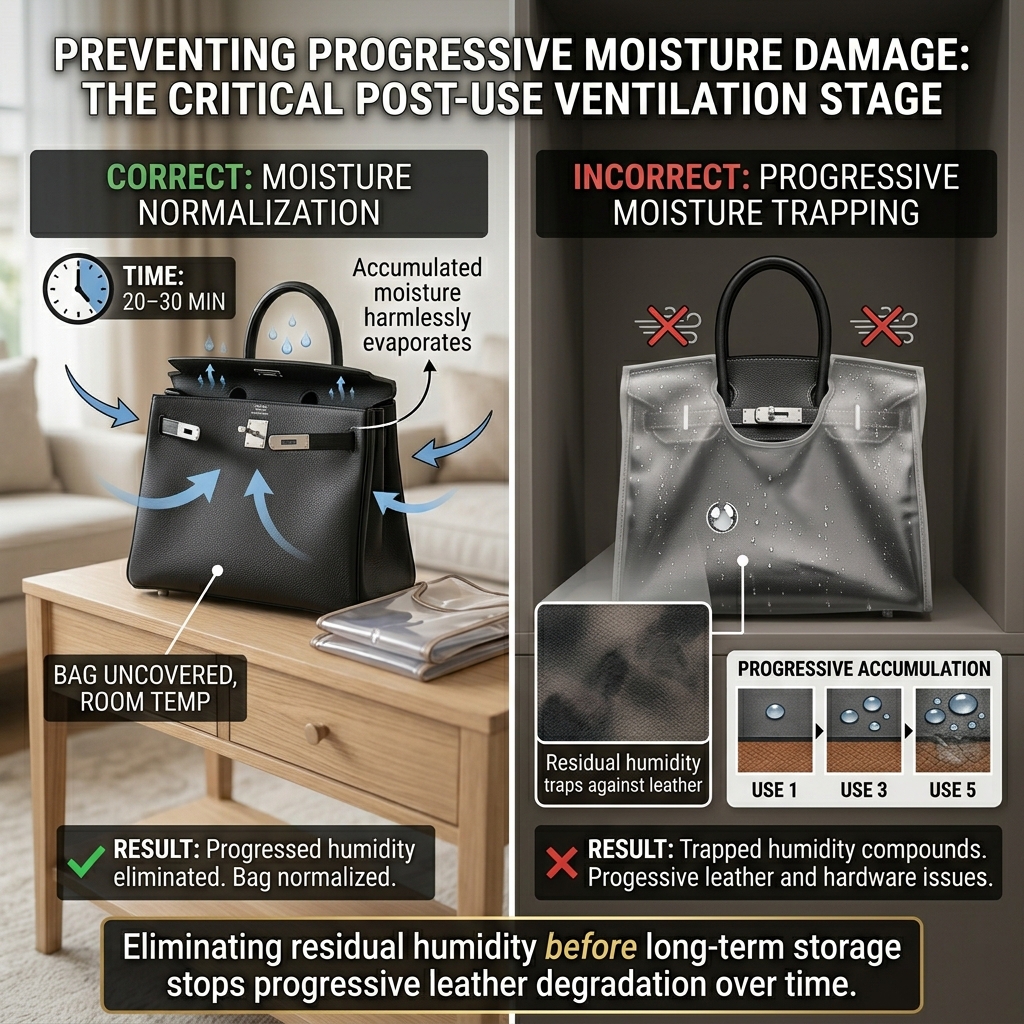
- After any raincoat use, allow the bag to breathe uncovered at room temperature (not in a dustbag) for at least 20–30 minutes before returning to storage — this normalises any microclimate-accumulated moisture.
- Check hardware after every raincoat use — if any dulling of PHW is visible, gently polish with a clean microfibre cloth before storing. Early intervention prevents the dulling from developing into the more significant oxidation that affects grading.
Raincoat vs Waterproof Spray: The Resale Comparison
The alternative to the Hermès raincoat for rain protection is a waterproof spray or conditioner applied to the leather surface — a solution that some holders prefer for its convenience (no accessory to carry) but that introduces its own set of resale considerations that differ significantly from the raincoat.
A professionally applied waterproof treatment (not a consumer spray product, but a specialist leather treatment applied by a leather care professional) can provide meaningful rain resistance for Togo, Epsom, and Clemence leathers without creating the microclimate risk of the plastic cover. For daily-use bags in rainy climates, a professional waterproof treatment applied once or twice a year is a legitimate and increasingly common choice among experienced Hermès holders.
Resale platforms assess leather surface finish as part of the condition grading process. A Togo Birkin that has been professionally waterproof-treated will show a subtly different surface appearance compared to an untreated piece — the pebbled grain may appear slightly more matte or slightly more uniform in its surface reflection. Most platform graders assess this as a neutral characteristic of well-maintained leather; a few may note it as a surface treatment.
The resale impact is typically neutral for Togo and Epsom — the treatment is invisible to non-specialist buyers and assessed as neutral to positive (well-maintained leather) by platform graders. For Box Calf and Barenia, waterproof treatment is a more significant intervention — their collector value partly depends on the untreated natural surface, and any permanent alteration to that surface characteristic may affect how specialist collectors assess the piece on 1stDibs or Vestiaire Collective. For these leathers, the Hermès raincoat used correctly remains the preferred protection method.
The durability comparison between leathers under rain exposure without any protection is covered in our companion analysis of which Hermès leathers are most durable for daily use. The relationship between leather durability characteristics and rain vulnerability is direct — the same properties that make Epsom more scratch-resistant also make it more rain-tolerant, which informs both the raincoat duration threshold and the waterproof spray suitability for each leather type.
Consumer spray products — the waterproofing sprays available at shoe care or leather goods retailers — are not recommended for Hermès leathers regardless of leather type. Their formulations are not tested against the specific tanning chemistry used by Hermès and can produce permanent surface discolouration, uneven waterproofing distribution, and — in worst cases — leather surface stiffening that is irreversible and visible at condition grading. If a waterproof treatment is desired, commission it from a professional leather specialist rather than applying a consumer product.
The Correct Raincoat Protocol for Condition Grade Protection
The correct raincoat protocol combines proper application, duration management, and post-use care into a routine that takes less than five minutes total and eliminates the condition grade risks that incorrect use creates. The protocol varies modestly by leather type to reflect the different sensitivity profiles identified in the test results.
The broader care context that encompasses both the raincoat protocol and the storage humidity management covered in our high-humidity storage guide together constitute the complete environmental protection framework for a Hermès quota bag held through the full ownership period. The bag insert strategy covered in our Birkin 30 bag insert guide completes the three-part care system: structural support (insert), surface protection (raincoat protocol), and environmental control (humidity storage). All three are necessary for Grade A condition maintenance under active daily use; each addresses a distinct condition grade risk that the others do not.
| Usage Scenario | Leather Risk | Hardware Risk | Grade Impact | Verdict |
|---|---|---|---|---|
| Correct short-duration use + post-use breathing | None | None | None — grade protected | Recommended for all leathers |
| Correct use — no post-use breathing before storage | Minor (smooth leathers) | Minor PHW risk | Marginal risk over repeated use | Include breathing step always |
| Extended use 4–8hr — Epsom or Togo | Minor surface effect | Moderate PHW risk | Potential minor grade note | Avoid — adhere to duration limit |
| Extended use 4–8hr — Box Calf or Barenia | Bloom / haze risk | Significant oxidation risk | Grade reduction likely | Do not use extended on these leathers |
| Overnight / multi-day storage with raincoat on | Mould risk — all leathers | Significant oxidation | Severe grade risk | Never — remove always upon shelter |
| No raincoat — direct rain on Box Calf / Barenia | Permanent watermarks | Hardware not affected | Permanent grade penalty | Worse than any raincoat risk |
| No raincoat — direct rain on Togo / Epsom | Surface spots possible | Hardware not affected | Minor grade risk | Use raincoat in significant rain |
| Consumer waterproof spray (DIY) | Permanent surface change risk | Hardware not affected | Unpredictable — avoid | Never — professional treatment only |
Risk levels reflect observed outcomes across leather types under stated conditions. Individual outcomes depend on ambient temperature, humidity, specific leather batch, and storage conditions post-use. All care decisions should account for the full context of use.
Use the Raincoat Correctly — Never Avoid It and Never Leave It On
The Hermès raincoat test results settle the question clearly: the cover is safe when used for its intended purpose — brief rain protection during active exposure — and becomes a condition grade risk when used beyond its designed duration. The leather damage attributed to the raincoat in collector communities is almost universally the result of extended use, not the cover itself. Avoiding the raincoat entirely because of these attributed risks leaves quota bag leather exposed to direct rain contact, which produces far more certain and more permanent condition grade consequences than any correctly used raincoat creates.
The duration threshold varies by leather type in a predictable pattern: Epsom and Togo are the most tolerant; Clemence is moderately sensitive; Box Calf and Barenia require the shortest maximum duration and the most vigilant post-use care. Hardware — particularly palladium — is an often-overlooked raincoat sensitivity that warrants a brief wipe after every use regardless of leather type.
The correct raincoat protocol takes less than five minutes across the full apply-remove-breathe-store sequence. Its consistent application across the holding period is one of three care interventions — alongside bag insert use and humidity storage management — that together maintain Grade A or Pristine condition through active daily use. The condition grade premium it protects, compounded across the price-to-resale ratio of a Birkin or Kelly, makes this five-minute routine one of the highest-return care investments available to any quota bag holder.
Bottom Line: Apply the Hermès raincoat during rain exposure, remove immediately upon reaching shelter, allow 20–30 minutes of uncovered breathing, and wipe hardware before storage — this five-step protocol eliminates all condition grade risk that the raincoat creates while maintaining the watermark protection that direct rain contact removes.
Popular Searches
Explore our most searched Hermès raincoat and leather protection questions
Frequently Asked Questions
The Hermès bag raincoat does not damage leather under correct short-duration use — it is designed specifically for Hermès leathers and poses minimal risk during brief rain exposure. However, extended use of the raincoat (leaving it on for hours or storing the bag inside it) creates a microclimate of elevated humidity and heat against the leather surface, which can cause surface bloom on smooth leathers, accelerate hardware oxidation, and in worst cases contribute to early mould conditions. The raincoat is a short-duration weather protection tool, not a storage cover. For the full leather-humidity interaction science, see our guide on storing Hermès bags in high humidity.
Box Calf and Barenia are most vulnerable to extended raincoat use — their smooth, untreated surfaces are most susceptible to the moisture-trapping effect that develops when the plastic cover is left on for extended periods. Togo and Clemence show moderate sensitivity to extended exposure. Epsom is the least sensitive standard leather — its treated surface is more tolerant of brief moisture contact and the microclimate created by the raincoat. For all leather types, the safe duration for raincoat use is the duration of active rain exposure only — remove and store the cover as soon as you are inside and out of the rain.
For Togo, Epsom, and Clemence leathers, a professionally applied waterproof treatment specifically formulated for the leather type offers a convenient rain protection solution. However, waterproof spray permanently alters the surface characteristics of smooth leathers like Box Calf and Barenia, potentially affecting their collector positioning at resale. For these leathers, the Hermès raincoat used correctly (short duration only) is the safer choice. Consumer spray products are never recommended — their formulations are not tested against Hermès tanning chemistry and can produce permanent surface discolouration. See our guide on which Hermès leathers are most durable for daily use for leather durability context.
Correct short-duration raincoat use does not affect resale value or condition grading — protecting the leather from water exposure is one of the most important care practices for maintaining grade. Incorrect extended use, or the surface bloom and hardware oxidation that can result from it, can affect grading. The raincoat use itself is invisible to platforms; only its consequences on the leather surface and hardware are assessed. Removing the raincoat promptly after rain exposure and allowing the bag to breathe at room temperature before storage eliminates the damage risk entirely.