Storing Hermès Bags in High Humidity: The Right Method
High humidity is the leading cause of preventable Hermès condition grade loss — the complete storage protocol for protecting leather, hardware, and lining in tropical, coastal, and monsoon climates.
A Birkin stored for six months in an uncontrolled tropical environment — at 80% relative humidity with periodic temperature fluctuations — will arrive at Fashionphile in a condition that no amount of surface cleaning can reverse. Mould growth on leather is a permanent grading penalty. Hardware oxidation beyond surface patina is irreversible. Interior lining bloom from sustained moisture exposure is noted explicitly in platform condition reports. High humidity is not an inconvenience — it is the leading cause of preventable Hermès condition grade loss among holders in Southeast Asia, coastal markets, and humid continental climates, and it destroys the price-to-resale ratio that makes quota bag ownership financially defensible.
The good news is that humidity damage is almost entirely preventable with the correct storage method. Unlike leather surface wear from daily carry — which accumulates gradually and is difficult to fully control — humidity damage happens in the storage environment, where every variable is controllable if the right system is in place. The investment in correct humidity storage is measured in dollars of silica gel, dehumidifier electricity, and routine maintenance time. The condition grade it protects is measured in thousands of dollars of secondary market premium.
This article covers the complete high-humidity storage method: the humidity thresholds that trigger different damage mechanisms, how each Hermès leather type responds differently to moisture exposure, and the layered storage system that reliably maintains Grade A or Pristine condition through extended periods in even the most challenging humid environments.
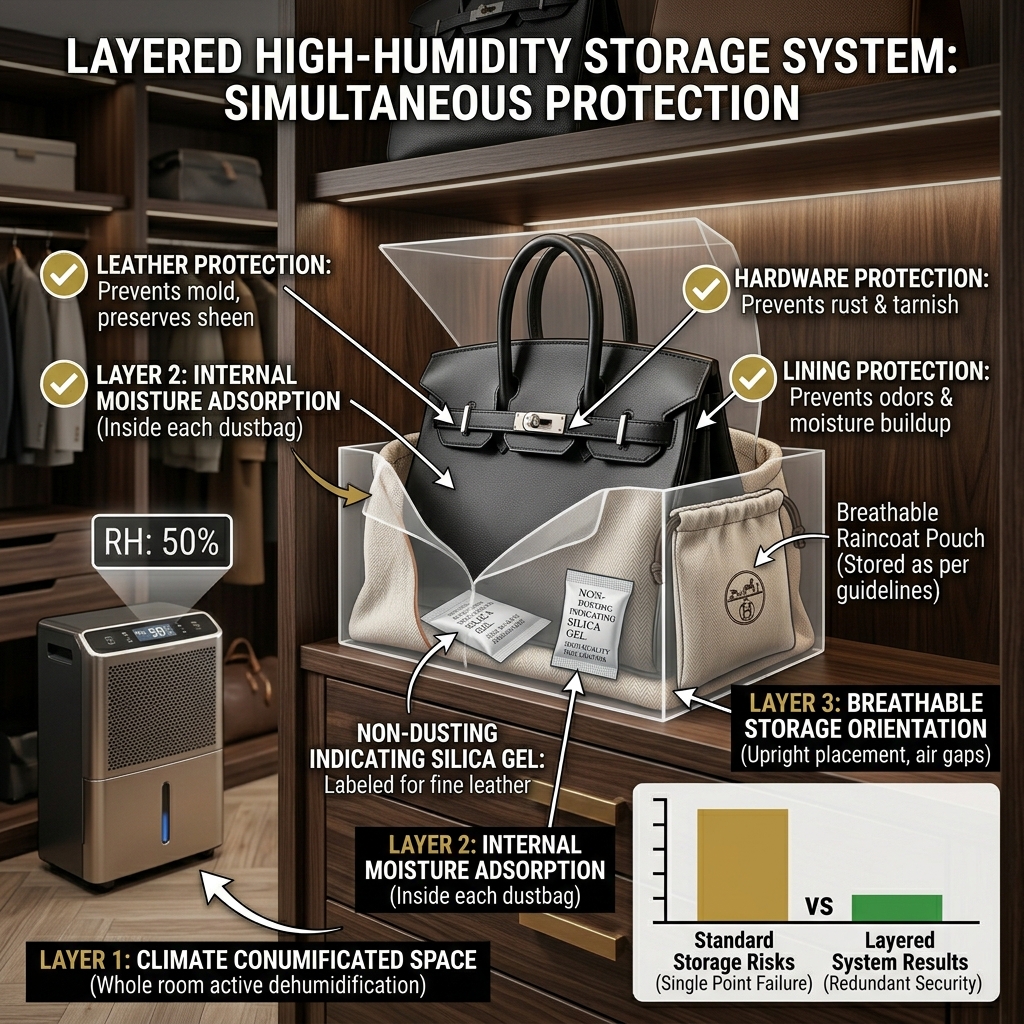
How Humidity Damages Hermès Leather and Grade
Humidity affects Hermès bags through three distinct damage mechanisms, each operating at different relative humidity thresholds and producing different types of condition grade penalties. Understanding which mechanism is active at which humidity level allows holders to target their storage interventions precisely — rather than applying maximum protection to all situations regardless of actual risk level.
The complete care and prevention framework is documented in the Hermès Care & Storage Guide, but the humidity-specific damage mechanisms require dedicated analysis. The first mechanism — mould growth — activates above approximately 65–70% RH and can produce visible surface contamination within days to weeks depending on temperature and leather type. Mould on Hermès leather is not a surface condition that platforms can overlook: it is visible in listing photographs, noted explicitly in condition reports, and represents a permanent grade reduction that typically moves a piece from Pristine or Excellent to Good or below regardless of all other condition variables. The technical chemistry of why mould colonises specific leather types at certain humidity thresholds — and how the tanning and finishing processes interact with moisture absorption — is covered in depth by the leather science team at Hermès Insights Hub's leather humidity science guide.
The second mechanism — hardware oxidation — begins at lower humidity levels (approximately 55–65% RH) and progresses more slowly. Palladium hardware develops a dulled, slightly oxidised surface appearance under sustained humidity exposure; gold hardware develops a tarnished patina that may read as positive aging on some platforms but as a condition issue on others. The lock mechanism is particularly vulnerable — humidity causes microscopic corrosion in the tumbler mechanism that affects the smooth operation that graders test at Fashionphile and The Real Real.
Fashionphile's grading team is specifically trained to identify humidity-related damage patterns: the white bloom on leather surfaces (efflorescence from moisture-mobilised mineral salts), the characteristic spotted discolouration of early mould growth, the particular dulling of palladium hardware from oxidation, and the distinctive texture change of leather that has been repeatedly wetted and dried. These are distinctive from other damage types and are noted as specific condition issues rather than general wear.
On Vestiaire Collective, humidity damage is the category most likely to produce a corrected authentication grade — sellers who describe "light aging" may find their pieces re-classified to Good or Fair when humidity-related issues are identified by the authentication team. The condition correction after listing can trigger buyer disputes. Preventing the damage is significantly less costly than managing the resale consequence.
The third mechanism — leather desiccation — operates at the opposite extreme: below approximately 35–40% RH, leather begins losing its natural moisture content and can develop surface cracking over extended storage periods. This mechanism is most relevant for holders in desert climates or air-conditioned environments where dehumidification has been applied without a lower humidity limit. The optimal storage range — 45–55% RH — balances prevention of both moisture excess and moisture deficit.
Humidity Risk Levels by Leather Type and Climate
Not all Hermès leathers respond identically to humidity exposure — the degree of tanning, surface treatment, and grain structure all affect how rapidly each leather type develops visible humidity-related damage under equivalent exposure conditions.
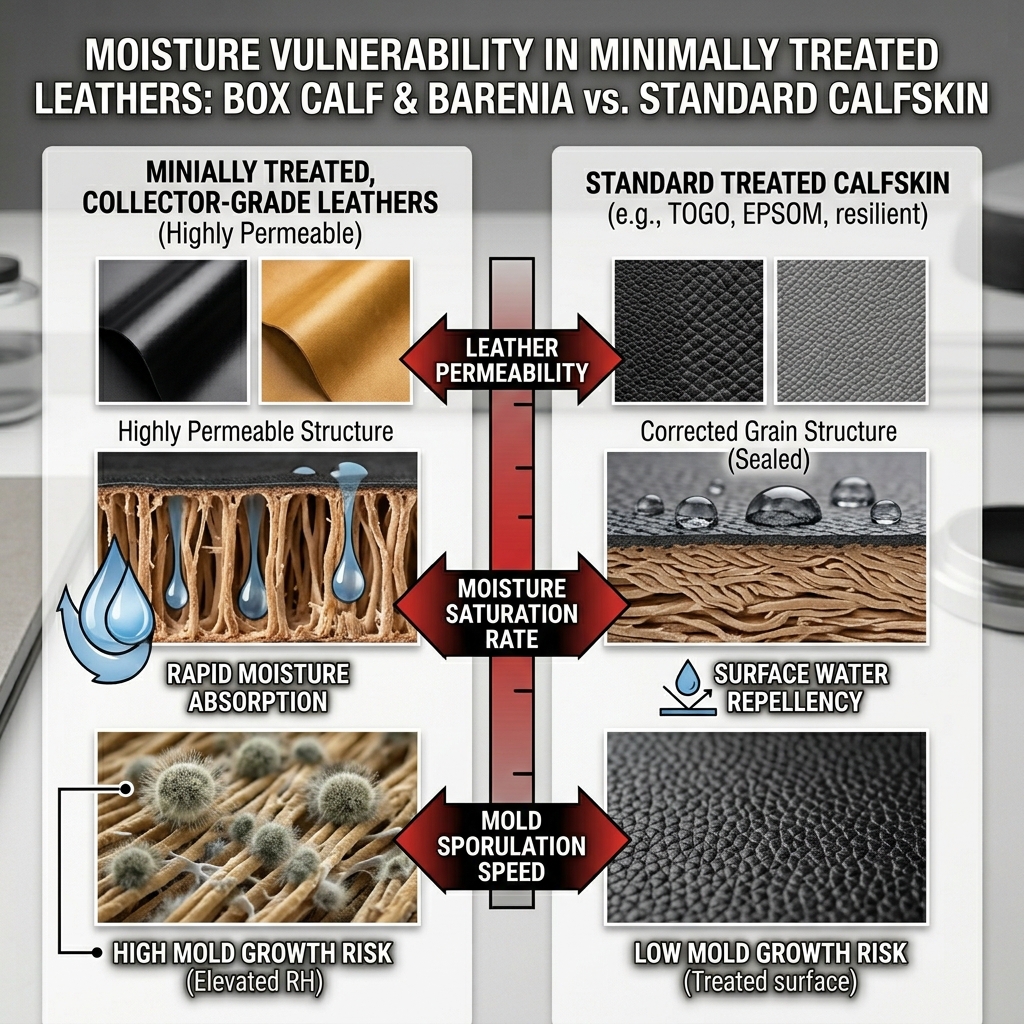
Box Calf and Barenia are the most humidity-vulnerable standard Hermès leathers because their smooth, minimally treated surfaces — the same characteristic that makes them beautiful and collector-coveted — also makes them the most permeable to moisture absorption. A Box Calf Birkin stored at 75% RH for three months will almost certainly develop surface bloom and potentially early mould growth, even with dustbag coverage. Holders of Box Calf pieces in humid climates should apply the highest level of humidity management in this article — active room dehumidification plus in-bag silica gel — as their baseline, not as a precautionary measure.
"Epsom leather's semi-treated surface is the most humidity-resistant standard Hermès leather — but even Epsom requires active humidity management above 70% RH. Hardware, not leather, becomes the primary damage vector in very high humidity environments."
Exotic leathers require special mention. Crocodile and alligator Hermès pieces are subject to specific humidity damage mechanisms — at high humidity, scale separation can occur as the adhesive between scale rows softens under sustained moisture. At low humidity, scale cracking from desiccation is equally serious. Exotic leather storage requires maintaining the 45–55% RH window more precisely than standard leathers, and any collector holding exotic pieces in a humid climate should treat this article's highest intervention tier as their standard operating practice.
- Box Calf and Barenia holders in any climate above 60% average RH should treat their storage as a high-humidity situation regardless of season — these leathers do not have the surface treatment tolerance that Togo and Epsom provide.
- Epsom holders have the most latitude — its embossed surface repels moisture better than any other standard leather — but hardware oxidation remains a risk above 65% RH regardless of leather type.
- The lock mechanism is the most humidity-sensitive hardware component — it contains internal moving parts that corrode microscopically under sustained humidity, affecting the smooth operation that platform graders assess.
- For Togo — the most common Birkin leather — the moderate mould risk becomes active risk above 70% RH over periods longer than 4–6 weeks without intervention.
The Correct High-Humidity Storage Method
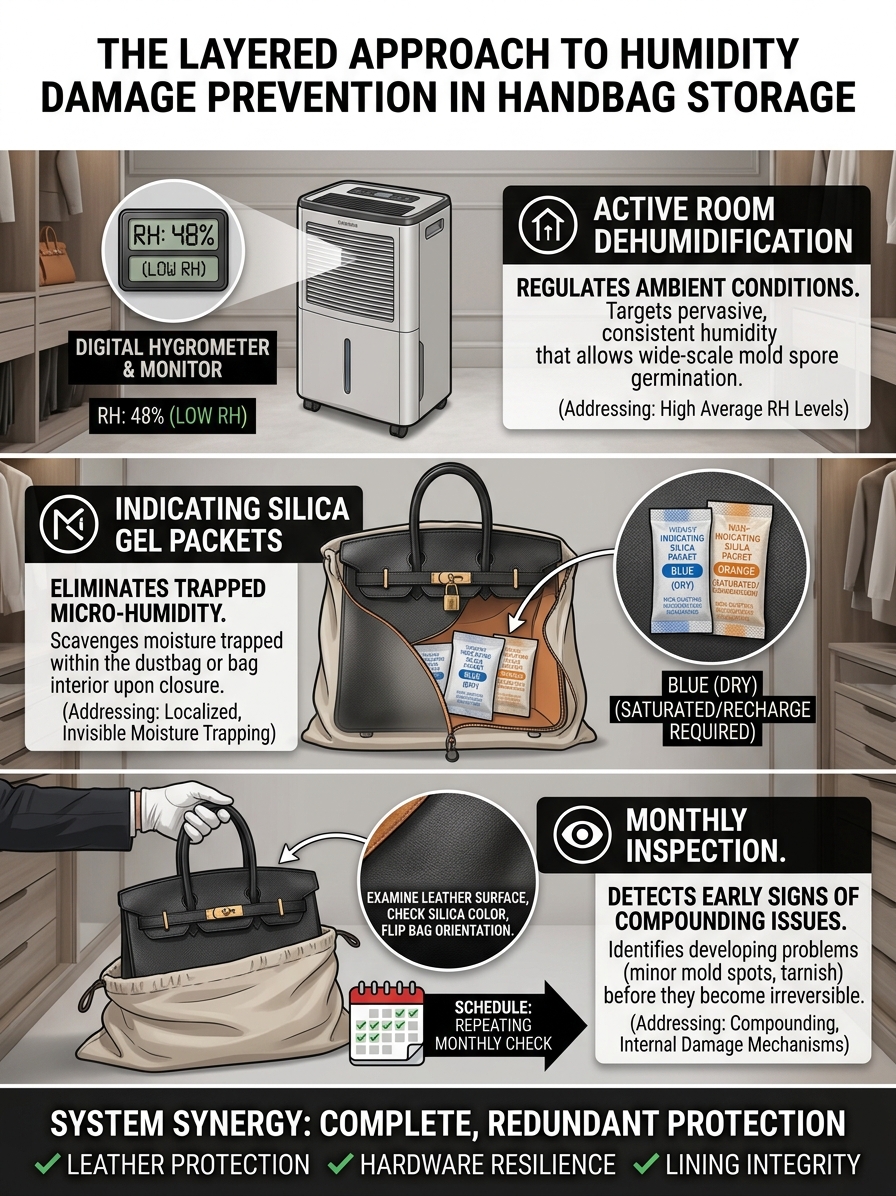
The correct high-humidity storage method operates on a layered principle: each layer of the system addresses a different aspect of the humidity risk, and the layers compound in effectiveness. No single intervention is sufficient in very high humidity environments; the complete system provides reliable protection across all humidity risk mechanisms.
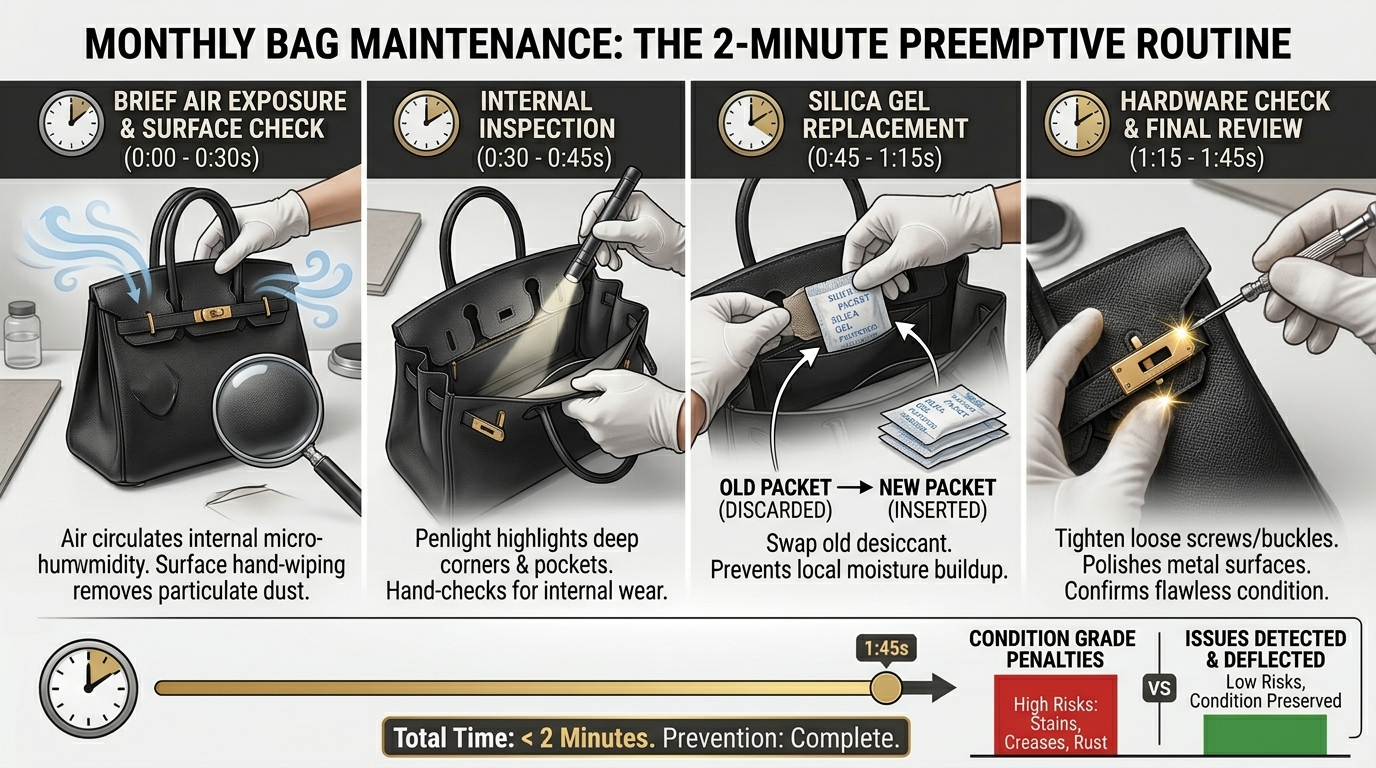
The monthly air exposure is a step that most holders skip and then regret. Leather that is sealed in a dustbag with silica gel and never inspected can still develop micro-environmental issues that the silica gel alone does not prevent — particularly if the dustbag itself has absorbed ambient moisture over time. The monthly inspection takes less than two minutes per bag and provides early detection that allows intervention before any permanent damage occurs.
For holders who travel frequently and leave bags in storage in different climate environments — a common situation for international buyers who carry pieces between home and travel destinations — the storage method must be applied at every location where the bag is stored for more than two weeks. A Birkin stored for three months in a humid Bangkok apartment while the owner is in London requires the same active humidity management as a permanent resident storage situation. Duration, not intent, determines the damage risk. Our companion article on best bag inserts for Birkin 30 structure addresses the structural dimension of storage that complements the humidity management framework in this article, and our analysis of preventing colour transfer on light Hermès leather covers the related care risk that affects light-coloured pieces during storage.
Monitoring, Maintenance, and Recovery Strategy
The humidity storage system requires ongoing monitoring and periodic maintenance to remain effective — it is not a set-and-forget installation. The monitoring infrastructure is inexpensive and the maintenance schedule is modest; the alternative is accepting preventable condition grade deterioration that costs multiples of the monitoring investment at resale.
The digital hygrometer is the essential monitoring tool. Place one in each area where Hermès pieces are stored and check it weekly. Set your dehumidifier to maintain 50% RH as a target midpoint within the safe range, with automatic activation triggered at 55% RH. In climates with significant seasonal humidity variation, adjust the dehumidifier setting seasonally — summer monsoon conditions may require continuous operation, while dry winter months may require minimal intervention or none at all.
- Digital hygrometer placement: one per storage room or wardrobe, positioned at the same height as the bag storage shelf — not at floor level where readings differ from the storage zone.
- Silica gel replacement schedule: every 30 days in environments above 65% RH; every 60–90 days in environments of 55–65% RH. Indicating silica gel changes colour (typically blue to pink or white to orange) when saturated — replace when colour change is visible across more than half the sachets.
- Dehumidifier maintenance: empty the water collection tank daily during high-humidity periods; clean the filter monthly. A dehumidifier with a blocked filter operates at reduced efficiency and may allow humidity to exceed target levels during high-moisture events.
- Seasonal deep inspection: twice per year (pre-monsoon/pre-summer and post-monsoon/post-winter), remove all pieces from storage for a 2–3 hour air exposure, wipe hardware gently with a clean microfibre cloth, apply a thin application of appropriate leather conditioner to exterior surfaces, and re-inspect for any developing issues before returning to storage.
- If early-stage bloom or surface moisture effect is detected: remove the affected piece from the dustbag immediately, allow it to breathe at room temperature in controlled humidity (45–55% RH) for 24–48 hours, then gently wipe the surface with a clean dry cloth. Do not apply conditioner until the surface is fully dry. Contact the Hermès Spa for professional assessment if the surface issue does not resolve with air exposure.
Recovery from humidity damage is the most difficult position to be in. The Hermès Spa service — covered in our detailed analysis of Hermès Spa treatment cost, wait time, and when it is worth it — can address some humidity-related surface conditions, but cannot reverse mould damage, significant oxidation, or lining staining from sustained moisture exposure. The Spa is a maintenance and light restoration tool, not a humidity damage recovery service. Prevention is the entire strategy. The full lifestyle and care context for all ownership decisions is available through the Ownership & Care category archive.
| Storage Method | Mould Prevention | Hardware Protection | Suitable Humidity Range | Verdict |
|---|---|---|---|---|
| Full system: dehumidifier + silica gel + dustbag + monthly inspection | Excellent | Excellent | All humidity levels | Only reliable method >70% RH |
| Dehumidifier (45–55% RH maintained) + dustbag only | Very Good | Very Good | Up to 80% outdoor RH | Recommended for most humid climates |
| Silica gel only (no active dehumidification) | Moderate | Moderate | Up to 65% ambient RH | Inadequate above 65% RH |
| Original dustbag only (no additional measures) | Minimal | Minimal | Up to 55% ambient RH only | Insufficient for humid climates |
| Airtight plastic bag or sealed container | Dangerous — traps moisture | High oxidation risk | Never appropriate | Avoid — accelerates damage |
| Air-conditioned room (no humidity monitoring) | Moderate (varies by system) | Moderate | Unpredictable | Supplement with hygrometer and silica gel |
| Dedicated wine cooler / climate cabinet (set to 50% RH) | Excellent | Excellent | All humidity levels | Premium option for serious collectors |
Effectiveness ratings reflect protection under sustained high-humidity conditions. Actual outcomes depend on climate specifics, leather type, dehumidifier capacity relative to room size, and maintenance schedule adherence. All storage methods should be supplemented with monthly inspection regardless of confidence in the primary method.
Active Dehumidification Is Non-Negotiable in Humid Climates
The secondary market data on humidity-damaged Hermès pieces is unambiguous: mould growth, hardware oxidation, and lining bloom from moisture exposure are permanent condition penalties that no cleaning, conditioning, or Spa service fully reverses. The condition grade loss from sustained high-humidity storage without active management can reduce a Birkin from Pristine to Good — a price difference of 25–40% on major resale platforms that represents tens of thousands of dollars on a standard quota bag configuration.
The correct storage method for any Hermès piece in a humid climate (above 60% average ambient RH) is the full layered system: active room dehumidification to maintain 45–55% RH, indicating silica gel packets inside each dustbag replaced monthly, breathable cotton dustbag storage in an upright position, hardware wrapped in acid-free tissue, and monthly inspection. Each layer addresses a different damage mechanism; all are necessary in high-humidity environments.
The investment in this system is modest and fixed: a dehumidifier, a digital hygrometer, silica gel packets, and a maintenance schedule. The condition grade it protects compounds with every day of correct storage. Holders in Singapore, Hong Kong, Bangkok, Miami, Honolulu, and any other high-humidity market who are not actively managing storage humidity are accepting preventable condition grade loss that will be visible at the point of resale regardless of how carefully they have managed carry, handling, and surface care.
Bottom Line: In any environment above 60% average relative humidity, active dehumidification of the storage space is not optional — it is the foundational intervention that makes all other storage precautions effective, and its absence makes them inadequate.
Popular Searches
Explore our most searched Hermès humidity storage and care questions
Frequently Asked Questions
The optimal storage humidity range for Hermès leather goods is 45–55% relative humidity. Below 40% RH, leather begins to dry out and can develop surface cracking over extended storage periods — particularly Box Calf and Barenia, which are most sensitive to low humidity. Above 65% RH, mould growth risk increases significantly and hardware oxidation accelerates. Above 75% RH, mould growth on leather surfaces becomes a near-certainty within weeks, and the lining is at highest risk. In high-humidity climates, active dehumidification of the storage space is the only reliable protection. See our guide on best bag inserts for Birkin 30 structure for the complementary structural care approach.
The original Hermès dustbag is cotton — a breathable material that allows some air circulation while protecting against dust. In moderate humidity environments (45–65% RH), dustbag storage is correct. In high humidity environments (above 65% RH), the dustbag alone is insufficient — it traps moisture against the leather surface rather than allowing it to dissipate, potentially accelerating mould growth. In high humidity, use silica gel packets inside the dustbag alongside the bag, replace them monthly, and ensure the storage space itself is actively dehumidified rather than relying on the dustbag for humidity management.
Minor humidity-related condition issues — surface bloom (a white haze from moisture exposure), light surface stiffness, or early-stage hardware tarnish — can often be addressed by a professional leather specialist or through the Hermès Spa service. The Hermès Spa (available at major boutiques) provides cleaning, conditioning, and minor restoration services that can improve condition grade outcomes for pieces with reversible humidity damage. Severe mould growth, permanent watermarks, or hardware oxidation beyond surface patina typically cannot be fully restored and represent permanent condition grade penalties. Prevention is significantly more cost-effective than restoration. See our analysis of Hermès Spa treatment cost, wait time, and when it is worth it for full service details.
Box Calf and Barenia are the most humidity-sensitive standard Hermès leathers — their smooth, minimally treated surfaces absorb moisture readily and are most prone to watermark formation, mould growth, and surface bloom. Clemence is also relatively sensitive due to its large open grain and soft structure. Epsom is the most humidity-resistant standard leather — its embossed, semi-treated surface repels moisture significantly better than untreated leathers. Togo sits between Clemence and Epsom in humidity resistance. Exotic leathers (crocodile, alligator) have specific humidity requirements and are most at risk from both extremes — too dry or too wet — requiring the tightest humidity range management of any Hermès leather type.