Best Bag Inserts for Birkin 30 Structure: Tested & Ranked
A resale-focused evaluation of which bag inserts most effectively preserve Birkin 30 base structure, interior condition, and the grade-A status that maximises secondary market value.
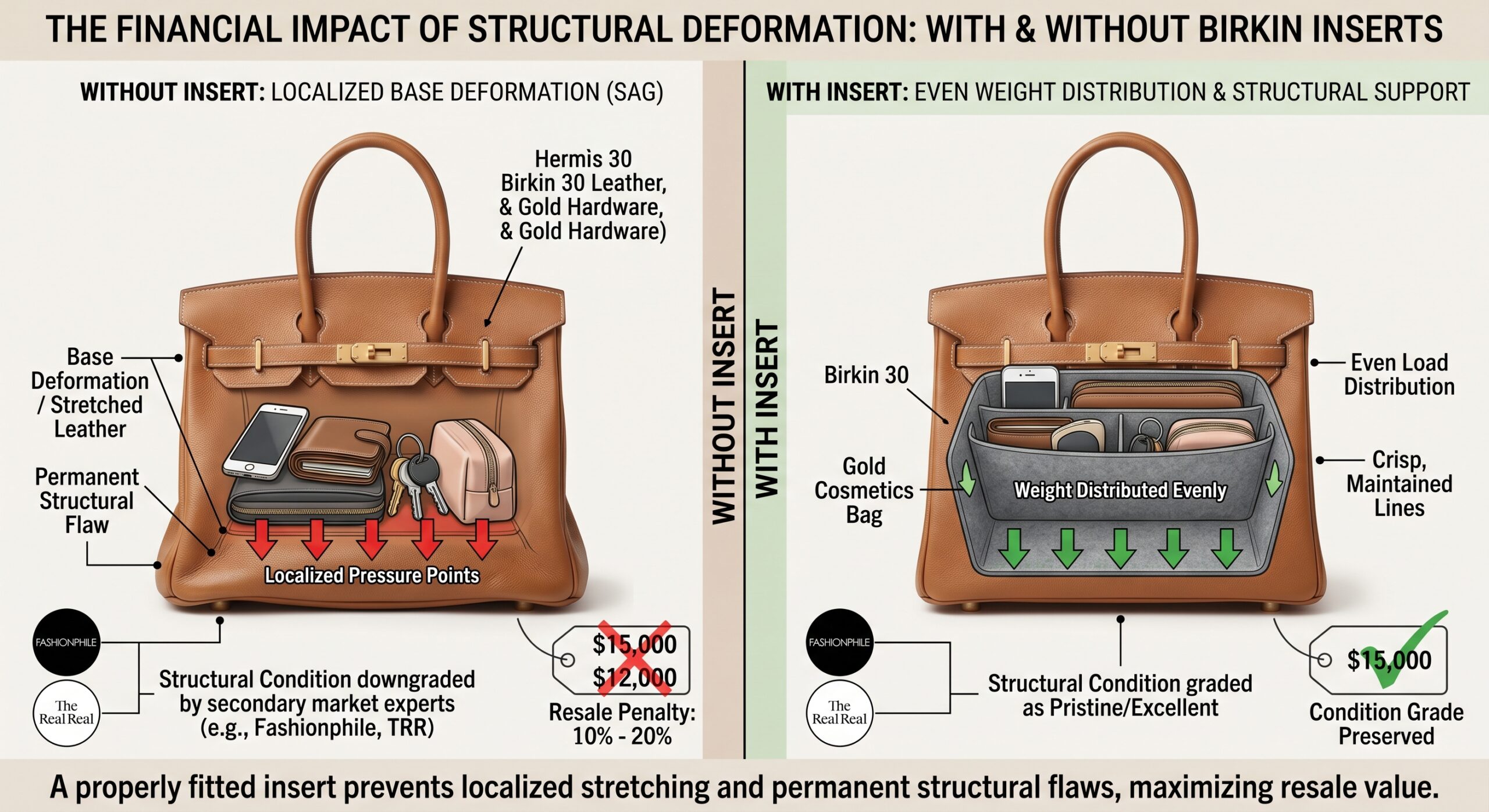
A Birkin 30 submitted to Fashionphile with base sag will not receive a Pristine grade — regardless of surface leather condition, hardware quality, or provenance completeness. Base sag is the single most common structural grading penalty applied to Birkin 30s on all four major resale platforms, and it is almost entirely preventable. The right bag insert, used consistently during daily carry and appropriately during storage, extends Grade A or Pristine condition maintenance by six to twelve months under daily use — a difference that translates directly into the 15–25% price premium that top condition commands over the next grade down.
Bag inserts for Birkin 30 structure are not an aesthetic accessory — they are a resale value preservation tool. The insert question is one of three condition grade variables that holders of daily-use quota bags can actively manage: insert use for base support, leather conditioning frequency, and storage position. The first is the most impactful for structural condition; the other two address surface and humidity-related degradation. This article focuses on the insert question specifically — which types work, which create risks, and how to implement the correct insert strategy for a Birkin 30 used daily.
Why Bag Inserts Matter for Resale Value
The Birkin 30's base structure is the most assessable structural element in the grading process at all four major resale platforms. Unlike surface leather scratches — which may be invisible in photographs and noted only upon physical inspection — base sag is visible in listing photographs, creates a negative first impression in buyer browsing, and triggers an explicit structural condition note in Fashionphile and The Real Real grading reports. A bag with visible base deformation is not Pristine regardless of any other condition variable.
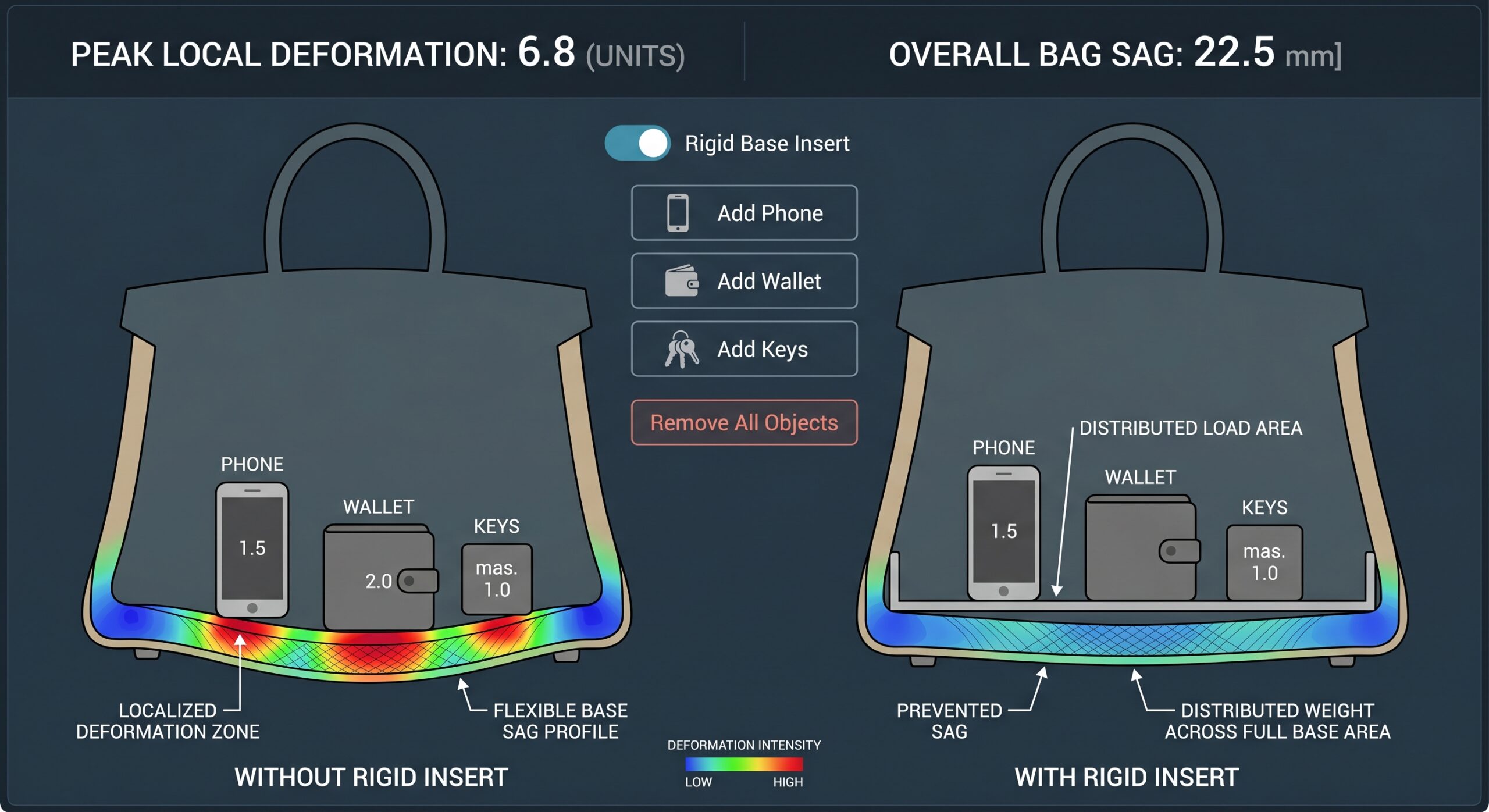
The full care and storage framework for maintaining Hermès condition grade is covered in the Hermès Care & Storage Guide, but the insert question is the single most mechanical and preventable variable in the structural condition outcome. The Birkin 30's base — approximately 30cm x 15cm of leather — spans a significant area that must support the full weight of bag contents during carry. Without internal support, that weight concentrates at the base centre and corners, creating the gradual deformation that platforms flag.
Fashionphile's grading team photographs the base of every Birkin submitted for consignment and compares it against known authentic examples of the same leather and age. A base that sits perfectly flat with sharp corner definition receives no structural deduction. A base with visible centre softening or rounded corners is noted as "light structural wear" — which typically moves the piece from Pristine to Excellent on their condition scale, with a corresponding price adjustment of approximately 8–15%.
The Real Real uses similar criteria, with "light wear to base" noted as an Excellent-level descriptor. On Vestiaire Collective, seller-described condition is verified by the authentication team, and base sag visible in submitted photographs will result in a seller condition correction before dispatch — potentially causing a buyer dispute if the declared and assessed conditions differ. The grading risk of base sag is platform-universal and grade-affecting across all four major markets.
The insert investment is therefore straightforward to justify. A purpose-made Birkin 30 organiser costs approximately $60–$150 depending on brand and material. The condition grade premium it protects — approximately $1,500–$4,000 on a standard configuration Birkin 30 depending on retail price — produces an investment return ratio that makes the insert one of the highest-ROI ownership decisions available to any quota bag holder.
The Ranked Insert Types: What Works and Why
Not all bag inserts provide equivalent base support, interior safety, or ease of use. The ranking below evaluates the most common insert types against the four variables that matter most from a resale condition perspective: base rigidity, weight distribution, leather and lining safety, and ease of removal for cleaning and storage transitions.
"A purpose-made felt organiser costs approximately $80–$120 and protects a $1,500–$4,000 condition grade premium. No other care investment produces a comparable return-to-cost ratio for a Birkin 30 holder."
The interior organisation aesthetics of each insert type — including how pocket layout and material choice affects the daily carry experience alongside the structural preservation function — is covered in the design and lifestyle team's analysis at Hermès Guidance Lounge's Birkin interior organisation guide, which provides the complementary aesthetic lens to this resale-focused structural ranking.
- Always choose a purpose-made Birkin 30 insert over a generic bag organiser — dimensional precision is the key variable for effective base support without wall pressure.
- For Togo and Clemence leathers, the rigid base board is non-negotiable — their natural softness makes them structurally vulnerable without consistent internal support during carry.
- Epsom's inherent rigidity provides some self-support — a rigid base panel is still recommended, but the urgency is lower than for softer leathers.
- For storage, remove the daily carry insert and replace with acid-free tissue stuffing — this maintains the bag's profile without the weight load of a full organiser.
Insert Risks: What Can Damage Leather and Lining
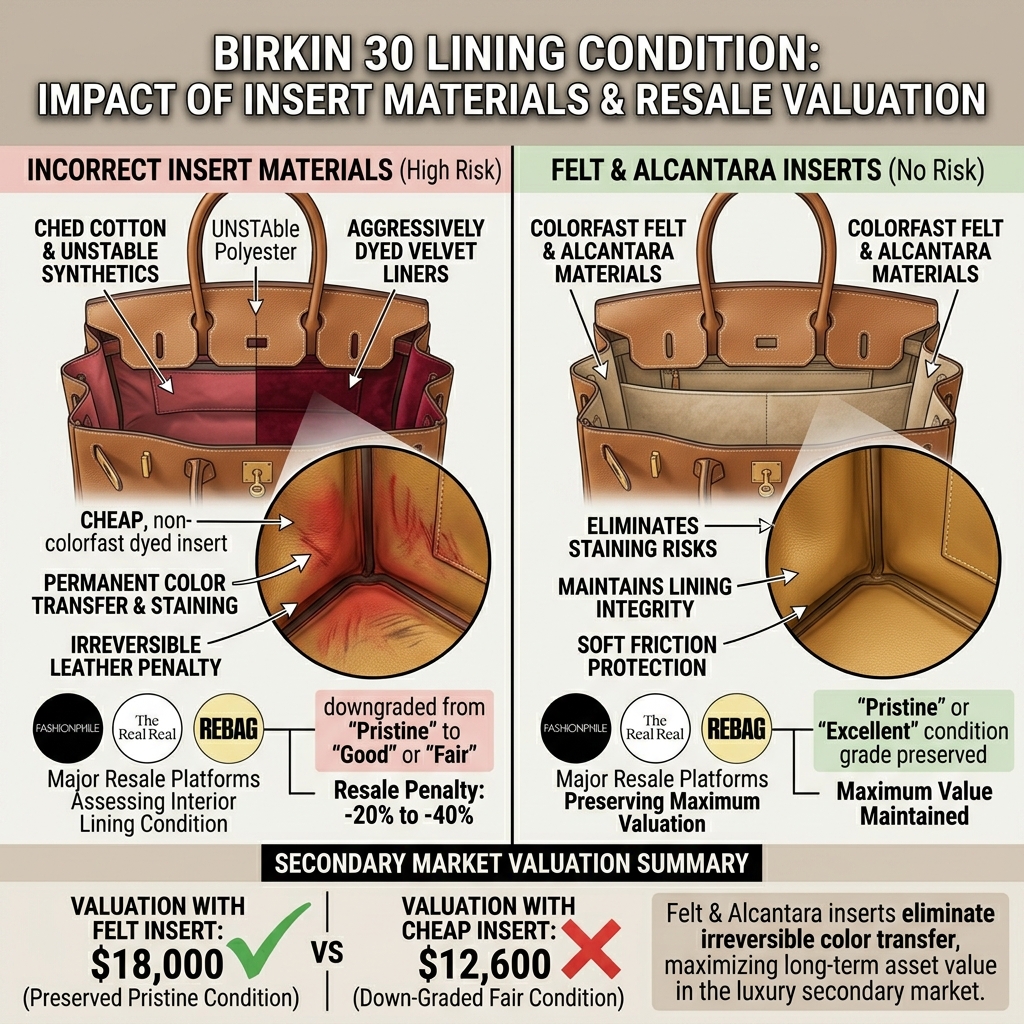
Not all bag inserts are safe for Hermès leather linings — and the risks are not always immediately visible. The Birkin 30's interior is lined in a specific leather that varies by exterior leather type and era of production. This lining is an assessed condition variable at all major resale platforms: staining, discolouration, scuffing, or dye transfer on the interior lining will affect the condition grade regardless of exterior leather quality.
Colour transfer is the most frequently overlooked insert risk. Dark-dyed fabric can transfer dye to Hermès leather lining under heat — a phenomenon most likely to occur during summer carry when internal bag temperature rises. The transfer may not be visible initially but will be apparent upon resale inspection in natural or strong artificial light. Testing any non-natural-felt insert before full use is essential: place the insert inside the bag with a white cotton cloth between the insert and the lining, leave for 48 hours in a warm room, and inspect the cloth for colour transfer before committing to use.
The broader leather care context — including how humidity affects both exterior and interior leather condition simultaneously — is covered in our companion article on storing Hermès bags in high humidity. The insert strategy works best as part of a complete care approach that addresses humidity, surface conditioning, and storage position alongside internal structural support.
One additional risk category deserves specific mention: oversized inserts that place lateral pressure on the Birkin 30's leather walls. An organiser that is dimensionally correct for the base but slightly too wide or deep will push outward against the side walls, creating stress at the stitching points and the leather-to-frame junction. Over time, this can contribute to the leather walls adopting a slightly bowed profile that is visible in listing photographs and noted by platform graders. Always verify that an insert's dimensions are equal to or marginally smaller than the interior dimensions on all three axes — never larger. Our guide on whether the Hermès raincoat damages leather over time covers related exterior leather stress from protective coverings that complements this interior care analysis.
The Complete Birkin 30 Insert and Storage Strategy
The complete condition grade preservation strategy for a Birkin 30 used daily combines the right insert during carry with a different, lighter internal support approach during storage. These two phases of the bag's daily cycle require different interventions because the structural risks are different: carry creates base weight stress; storage creates settling and shape memory effects over time.
During carry, the purpose-made felt or Alcantara organiser with rigid base board is the correct intervention. Install the insert before loading any contents, ensuring it sits flat against the base with no folding or compression. Load contents thoughtfully — distribute weight toward the centre of the base rather than concentrating heavy items at one side. The total carry weight should remain within approximately 1kg to 1.5kg for daily use; heavier loads accelerate base deformation even with insert support, particularly in Togo and Clemence leathers.
- Install the rigid base insert first, before any bag contents — inserting it after loading compresses the base and creates lateral pressure that defeats the structural purpose.
- Limit daily carry weight to approximately 1kg to 1.5kg — insert support is significantly more effective at normal carry weights than at heavier loads where structural stress exceeds the insert's distribution capacity.
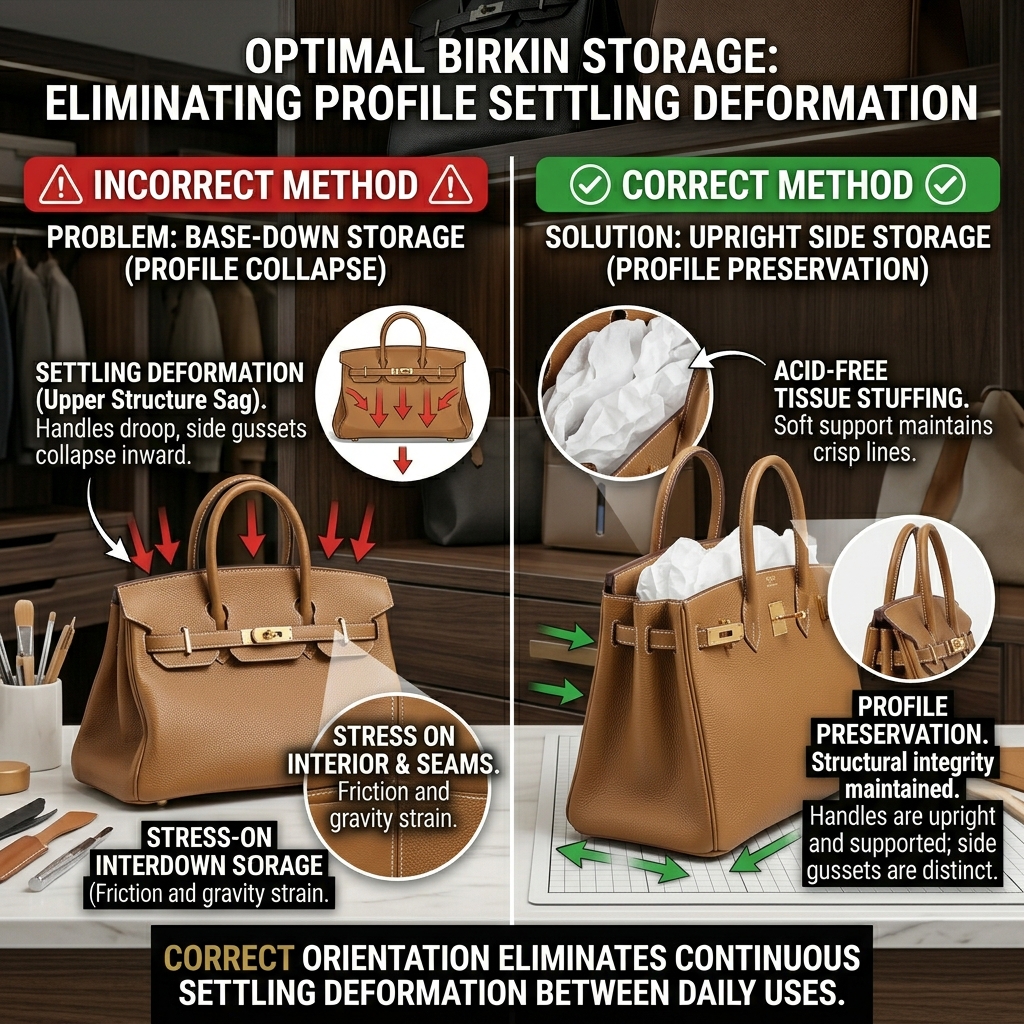
- Remove the daily carry organiser before storage — replace with a lightly stuffed acid-free tissue profile support that maintains shape without the weight of a full organiser compressing the base leather over time.
- Store the bag upright on its side, not flat on its base — base-down storage concentrates the bag's own weight on the leather base continuously, accelerating the same deformation that carry weight creates. Our broader storage guide provides the full storage position and environment framework.
- Before any resale submission, remove the insert and gently reshape the base by hand if any minor settling has occurred — this is most effective on Togo and Clemence leathers which recover readily with gentle manipulation before photography.
- If a Birkin 30 in your collection already shows early-stage base softening, a rigid insert used consistently over 4–8 weeks can partially reverse minor deformation in Togo and some Clemence pieces — the leather has memory that responds to support pressure over time.
The prevention principle applies to both carry and storage decisions. The condition grade premium that Grade A or Pristine status commands — approximately 15–25% over Grade B+ on the four major resale platforms — is the financial stake attached to every daily carry and storage decision made across the holding period. Insert use and correct storage are the two most controllable variables in that outcome. The full lifestyle and care context across all holding period variables is available through the Ownership & Care category archive.
For Birkin 25 holders: the structural principles are identical but the scale is smaller. A Birkin 25 is lighter and its base area is smaller, which reduces but does not eliminate base sag risk — particularly in Clemence leather where the structural vulnerability is independent of bag size. Purpose-made Birkin 25 organisers are available from the same specialist brands that produce Birkin 30 versions and are equally recommended for daily use holders prioritising resale condition preservation.
| Insert Type | Base Sag Prevention | Lining Safety | Leather Compatibility | Resale Verdict |
|---|---|---|---|---|
| Purpose-made felt organiser (rigid base) | Excellent | Highest — undyed felt | All leathers | Recommended #1 |
| Alcantara organiser (rigid base) | Excellent | High — colour stable | All leathers | Recommended #2 |
| Neutral canvas organiser (rigid base, colour-verified) | Good–Excellent | Moderate — test first | Standard leathers | Acceptable with testing |
| Standalone rigid base panel (felt-covered) | Good | High if covered correctly | All leathers | Good minimal option |
| Soft organiser (no rigid base) | Poor | Depends on material | Limited benefit | Not recommended alone |
| Dark-coloured fabric insert (untested) | Moderate | High risk — colour transfer | Risk to light linings | Avoid |
| Unlined hard plastic panel | Moderate | High risk — pressure marks | Risk to all leathers | Avoid |
| No insert (daily carry) | None | No risk | Grade loss accelerated | Not recommended for resale holders |
Ratings reflect resale condition grade preservation performance. Actual outcomes depend on leather type, carry weight, frequency of use, and storage conditions. Epsom leather is somewhat more tolerant of insert absence than Togo or Clemence due to its inherent structural rigidity.
The $80–$120 Insert That Protects a $2,000+ Grade Premium
The bag insert question for Birkin 30 holders has a clear answer grounded entirely in the secondary market data: a purpose-made felt or Alcantara organiser with a rigid base board is the single highest-ROI care investment available to any daily-use quota bag holder. The insert cost is negligible relative to the condition grade premium it protects — a 15–25% price difference between Grade A and Grade B+ on a Birkin 30 represents $1,500 to $4,000 or more at current secondary market pricing.
Base sag is the most preventable structural condition penalty in the entire resale grading framework. Unlike surface scratches that accumulate from contact and are difficult to control, or hardware wear that results from daily use friction, base sag is almost entirely a function of whether the base is supported during carry. An insert eliminates the risk. No insert means the risk compounds with every carry, accelerating grade degradation in direct proportion to carry frequency and load weight.
The material safety question matters as much as the structural support question. Undyed felt and Alcantara are the only insert materials that can be used inside a Birkin without any colour transfer or abrasion risk. Every other material — canvas, fabric, plastic — requires testing and carries conditional risks that felt and Alcantara eliminate entirely. Start with the safest material and the correct structural function; everything else is a compromise.
Bottom Line: Use a purpose-made felt or Alcantara organiser with a rigid base board for every daily carry session — this is the single most effective and cost-efficient action available to a Birkin 30 holder committed to maintaining Grade A condition through the resale holding period.
Popular Searches
Explore our most searched Hermès bag care and condition grade questions
Frequently Asked Questions
Yes — significantly. The Birkin 30's base structure is the primary grading variable that platforms assess for structural condition, and base sag from unsupported daily carry is the most common structural grading penalty applied by Fashionphile and The Real Real. A correctly fitted base insert distributes the weight of bag contents across the base evenly, preventing the localised deformation that creates visible sagging. For Togo leather — the most common Birkin 30 leather — a base support insert can extend Grade A condition maintenance by 6–12 months under daily use conditions. For the full leather durability context, see our guide on which Hermès leathers are most durable for daily use.
The Birkin 30's interior dimensions are approximately 30cm wide x 22cm tall x 15cm deep — though exact measurements vary slightly by leather type due to thickness variation. Purpose-made Birkin 30 organisers from specialist brands are designed to these dimensions and include structured base panels and side walls. Generic bag organisers should be measured against these dimensions before purchase — an organiser that is too large will place outward pressure on the leather walls and potentially cause deformation; one that is too small provides insufficient base support. Always choose a purpose-made Birkin 30 insert over a generic alternative.
Yes — if the wrong material is used. Inserts with dyed fabric, rough textures, or materials that transfer colour under pressure or heat can damage the Birkin's leather lining, which is an assessable condition factor at all major resale platforms. The safest insert materials are natural felt (undyed), cotton canvas in neutral tones, and Alcantara. Avoid inserts with hard plastic panels that create pressure points on the leather base, brightly coloured fabrics that may transfer dye, and any material with metallic elements that could scratch the interior hardware or lining. See our guide on storing Hermès bags in high humidity for complementary storage advice that protects both interior and exterior condition.
For storage, remove the daily carry organiser and replace with a lightly stuffed acid-free tissue profile support — this maintains the bag's shape without the weight load of a full organiser compressing the base leather over extended storage periods. The ideal storage configuration is the bag on its dustbag, sitting upright on its side (not resting on its base), with tissue stuffing maintaining the profile. The structured insert can be removed for storage and replaced with lighter tissue to maintain shape without the weight load. Storing the bag upright rather than flat on its base eliminates the continuous weight stress that base-down storage applies to the leather over time.