Resale Value of Hermès Special Order (HSS) Bags Explained
When does an HSS commission outperform a standard quota bag at resale — and when does it deliver nothing beyond its retail price? Full provenance, platform, and configuration analysis for 2026.
An HSS Birkin 25 in a two-tone Epsom combination — say, Bleu Saphir body with Craie flap — listed on 1stDibs with original commission receipt and full delivery documentation will attract a different class of buyer than any standard retail configuration. That buyer is a collector seeking something genuinely irreproducible: a combination that exists because one person commissioned it and can never be replicated through standard boutique purchase. The premium they pay for that uniqueness is real — typically 15–30% above a comparable retail-issue piece — but it is entirely contingent on provenance.
Hermès Special Service, known as HSS, is the brand's custom order programme that allows established clients with strong boutique relationships to commission quota bags in bespoke leather, color, and hardware combinations not available through standard retail. The resale value of HSS bags is one of the most misunderstood topics in the secondary market — some configurations genuinely outperform retail quota bags; others achieve nothing beyond a standard listing price. The difference between the two outcomes is largely determined by configuration distinctiveness and provenance documentation, not by the HSS status itself.
This article provides the complete investment picture: which HSS configurations command genuine secondary market premiums, how provenance documentation determines whether that premium is achievable, and how to evaluate an HSS commission decision against the alternative of a standard quota bag acquisition.
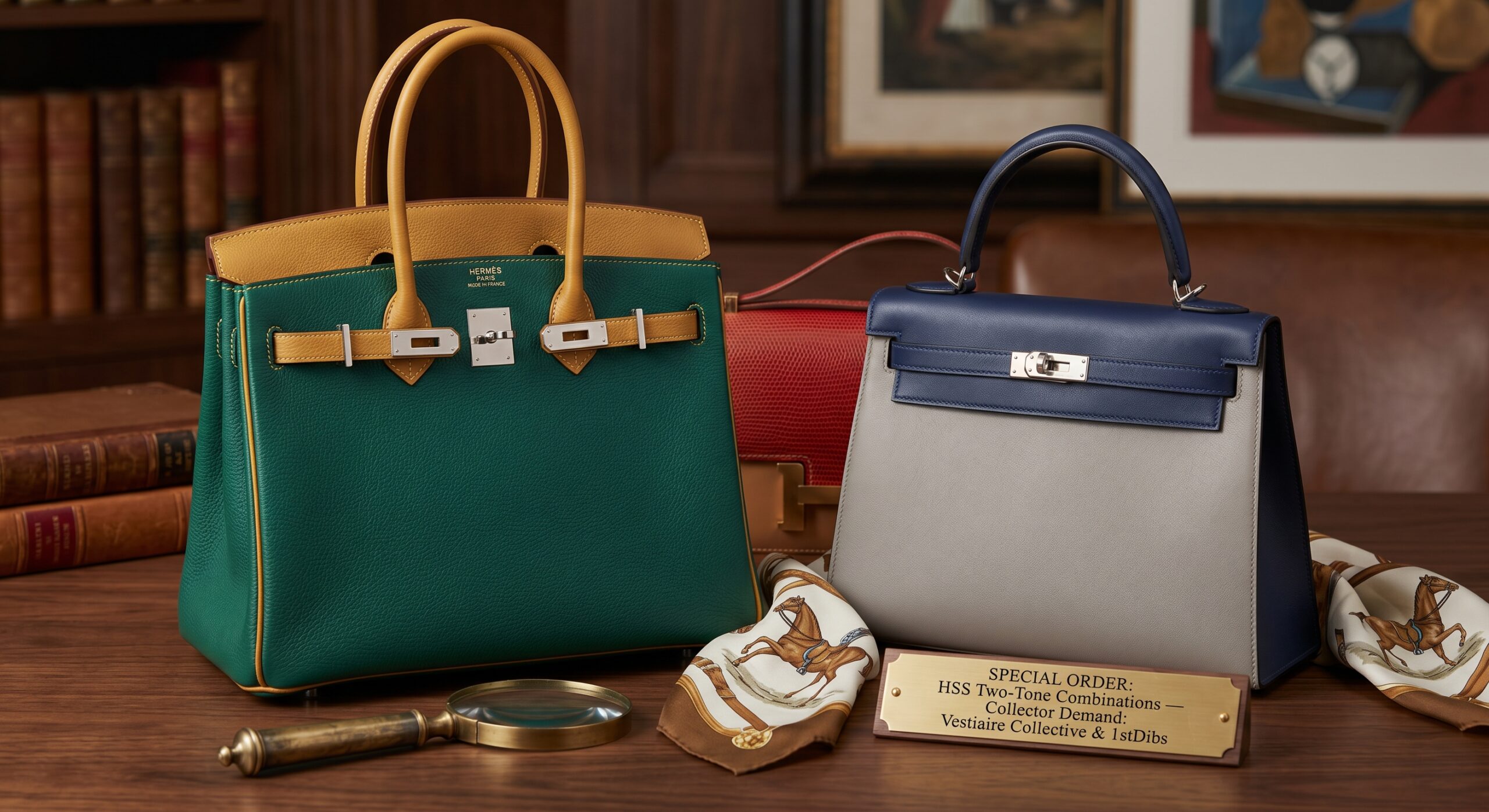
What HSS Is and How the Secondary Market Values It
HSS — Hermès Special Service — is the custom order programme that allows clients with established boutique relationships to commission a quota bag in a specification that goes beyond what is available through standard retail allocation. The full context of HSS access within the quota bag ecosystem is covered in the Hermès Iconic Collections hub, but the investment framework requires understanding a fundamental point: HSS is not a separate product category. It is a customisation layer applied to the same quota bag styles — Birkin, Kelly, Constance — that the secondary market already prices and trades.
The secondary market's response to HSS pieces depends on two variables operating simultaneously. The first is whether the commissioned configuration is genuinely distinct from anything currently or recently available at retail. The second is whether the buyer can verify that distinction through documentation. A two-tone leather combination that has never appeared in retail production is inherently distinct — but without the original commission paperwork to prove it was an HSS piece rather than a standard bag with an unusual appearance, that distinction is invisible to a platform buyer.
Vestiaire Collective, The Real Real, Fashionphile, and 1stDibs all handle HSS pieces differently. The Real Real and Fashionphile assess HSS pieces against their standard condition grading criteria — HSS status is noted in the listing description if present in documentation, but does not independently trigger a pricing uplift in their authentication process. The premium must be set by the seller and justified to buyers through the listing description and provenance documentation.
Vestiaire Collective and 1stDibs are the most HSS-aware platforms. Collector buyers on these platforms actively search for custom combinations and are prepared to pay the verified uniqueness premium. On these platforms, a well-described HSS listing with documentation images included attracts buyers who understand what they are purchasing and will negotiate less aggressively on price. These are the correct platforms for any HSS sale where the goal is maximum price achievement.
The HSS access mechanism itself is worth noting for investment context. HSS commissions are only available to clients who have already received and accepted a standard quota bag allocation — typically at least one, and in many boutiques, two or more. This means that by the time an HSS commission is possible, a client has already established the boutique relationship and spend ratio that our Hermès quota bag spending ratio strategy for 2026 covers in detail. HSS is a second-tier opportunity for established clients, not an entry point for new ones.
Provenance: The Make-or-Break Variable
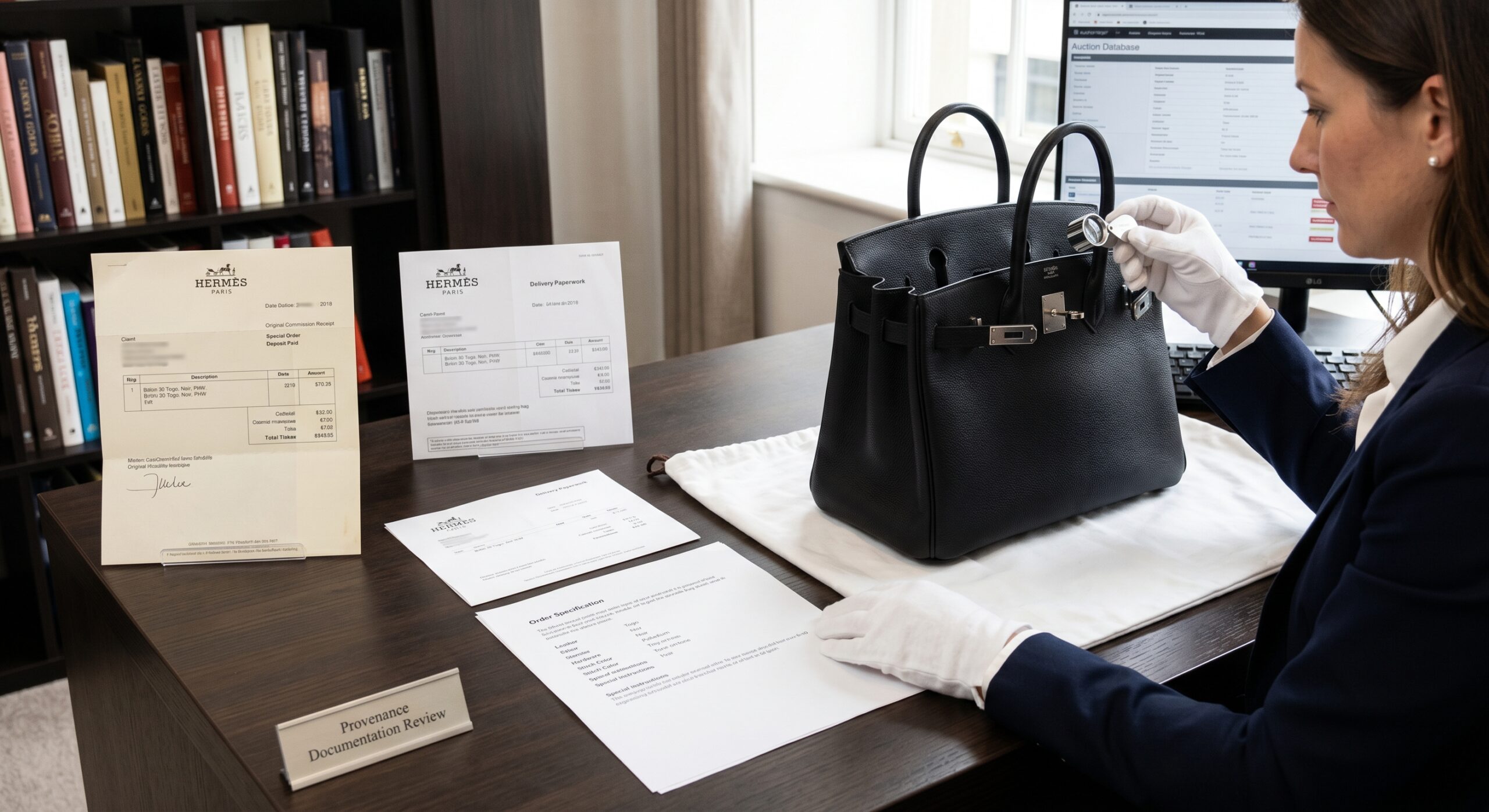
No other category of Hermès bag is as provenance-dependent as HSS at resale. The uniqueness that drives the HSS premium is invisible without documentation — a two-tone leather combination looks distinctive in photographs, but a platform buyer cannot confirm its HSS origin from appearance alone. Without the paper trail that establishes commission origin, the premium collapses toward the standard listing price for any unusual-looking bag.
The commission receipt is the most critical single document in the HSS provenance chain. It specifies the exact leather, color, hardware, and any additional customisation details that were ordered — and it bears the Hermès boutique stamp and date. A buyer on 1stDibs who can see a commission receipt matching the bag's specification has their verification question answered. Without it, they are being asked to pay a premium for a claim they cannot independently confirm.
Most HSS clients receive their commission receipt at the point of order, with a follow-up confirmation when the bag enters production. These documents are easily lost over an 18-month to 3-year wait period — filed carelessly, discarded as clutter, or simply forgotten. The financial cost of losing these documents is substantial: the difference between a fully documented HSS premium and an undocumented listing can represent thousands of dollars on a collector-tier piece.
The correct approach is to photograph all HSS documentation at the point of receipt and store digital copies securely alongside the physical originals. When the bag is delivered, photograph the documentation together with the bag, dustbag, and box. This creates a timestamped visual provenance record that supplements the physical documents and provides backup if originals are ever lost or damaged.
For sellers listing an HSS piece without commission documentation, the correct platform approach is Fashionphile or The Real Real — where the authentication team can verify the bag's physical characteristics and list it accurately as a custom configuration, without requiring the paper trail that collector-oriented platforms expect. The achievable price will be lower, but the sell-through will be more reliable than listing a premium HSS price on Vestiaire without the documentation to support it.
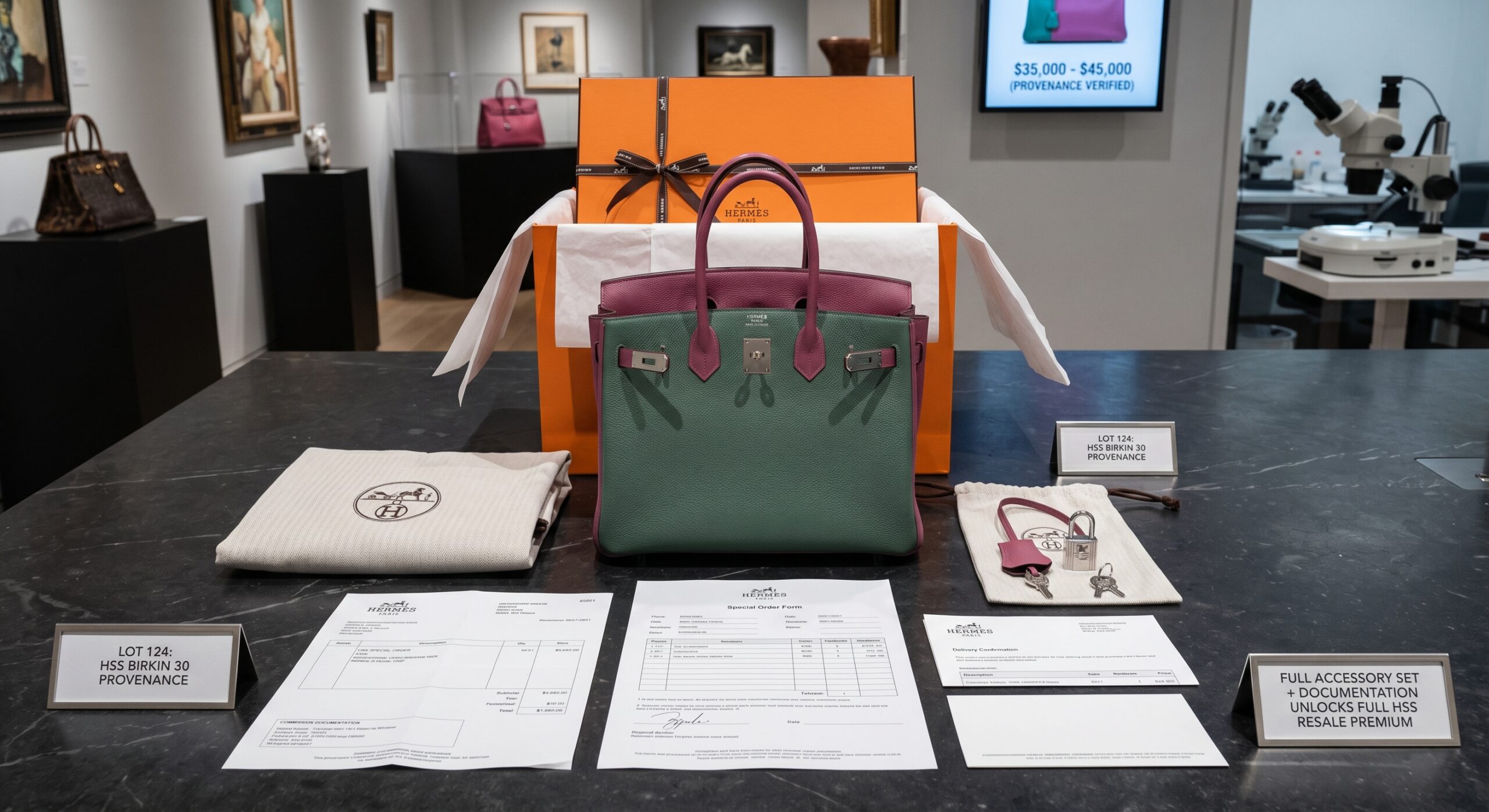
The interaction between HSS provenance and platform selection is the most tactical element of HSS resale management. Vestiaire Collective's seller verification process allows documentation images to be included in the listing — upload photographs of the commission receipt and delivery paperwork directly to the listing, making them visible to prospective buyers before enquiry. On 1stDibs, dealer listings for HSS pieces typically include provenance narrative in the description alongside documentation images. This approach converts the provenance documentation from a private verification tool into a public confidence signal that justifies the asking price before buyer contact.
HSS as an Investment: The Framework Decision
The investment case for HSS is more complex than for standard quota bag acquisition. The extended wait time, the provenance dependency of the premium, and the narrower buyer pool on the collector platforms all introduce variables that standard quota bag investment does not carry. Before commissioning an HSS piece with resale return as a primary or secondary motivation, the decision framework requires honest assessment of three questions.
First: is the planned configuration genuinely distinct from anything currently or recently available at retail? If the answer is no — if the commissioned configuration is a color-leather combination that Hermès has recently produced in standard allocation — the HSS premium will not materialise at resale. The secondary market prices HSS bags as standard pieces when the configuration does not read as custom, regardless of the paper trail.
Second: can you maintain complete provenance documentation for the entire wait period and beyond? If commission paperwork is likely to be lost or damaged over a 2–3 year period, the premium that provenance enables disappears with it. Documentation storage and management is a genuine commitment, not an afterthought.
- Commission HSS only if your planned configuration is verifiably distinct — two-tone leathers, exotic skins in non-standard colors, or genuinely discontinued shade specifications.
- Photograph and digitally archive all commission documentation at the point of receipt — do not wait until delivery to establish your provenance record.
- Plan your resale platform selection before the bag arrives — 1stDibs for exotic or maximum-premium configurations, Vestiaire Collective for two-tone standard leather pieces, Fashionphile or TRR for undocumented or near-retail-spec HSS pieces.
- Factor the HSS wait time into your investment timeline — retail price increases during the wait period affect your eventual price-to-resale ratio, as our Hermès price increase history analysis covers in detail.
- Compare the HSS investment case to the alternative of acquiring a rare color quota bag at retail — a Rose Shocking or Bleu Electrique Birkin obtained through standard allocation requires no wait surcharge and delivers a proven secondary market premium without provenance complexity.
Third: is HSS the most efficient route to your target resale outcome, or would a standard quota bag in a rare color or exotic leather deliver comparable returns with less friction? For most buyers at the early-established stage of their boutique relationship, the answer is that standard rare-color quota bags — analysed in detail in our Hermès fine jewellery vs bag investment return comparison — offer better risk-adjusted investment profiles than HSS commissions. HSS becomes the correct choice when the buyer has already optimised their standard quota bag strategy and is looking for the next tier of secondary market positioning.
The full secondary market context for understanding where HSS fits within the broader Hermès investment ecosystem is available through the All Topics archive — HSS strategy works most effectively when viewed alongside the standard quota bag acquisition framework rather than as a standalone investment decision.
| HSS Configuration | Provenance | Resale Premium | Liquidity | Best Platform |
|---|---|---|---|---|
| Two-tone leather — Birkin/Kelly | Full documentation | +20–35% vs retail | Moderate (collector) | 1stDibs · Vestiaire |
| Two-tone leather — Birkin/Kelly | No documentation | +5–10% vs retail | Moderate | Vestiaire · Fashionphile |
| Exotic + rare HSS color | Full documentation | +25–40%+ vs retail | Low (specialist) | 1stDibs |
| Discontinued color + Epsom/Togo | Full documentation | +10–20% vs retail | Moderate | Vestiaire · 1stDibs |
| Standard color + standard leather (near-retail spec) | Full documentation | +0–8% vs retail | Higher | Fashionphile · TRR |
| Standard color + standard leather | No documentation | Standard retail pricing | High (same as retail) | Fashionphile · TRR |
| Any HSS — condition grade B or below | Any | Premium eliminated | Low | TRR (condition discount applies) |
Premium figures reflect observed secondary market ranges vs comparable retail configurations in excellent condition. Exotic leather configurations and full provenance can significantly exceed ranges shown. All data approximate.
HSS Premium Is Real — But Provenance and Configuration Are Everything
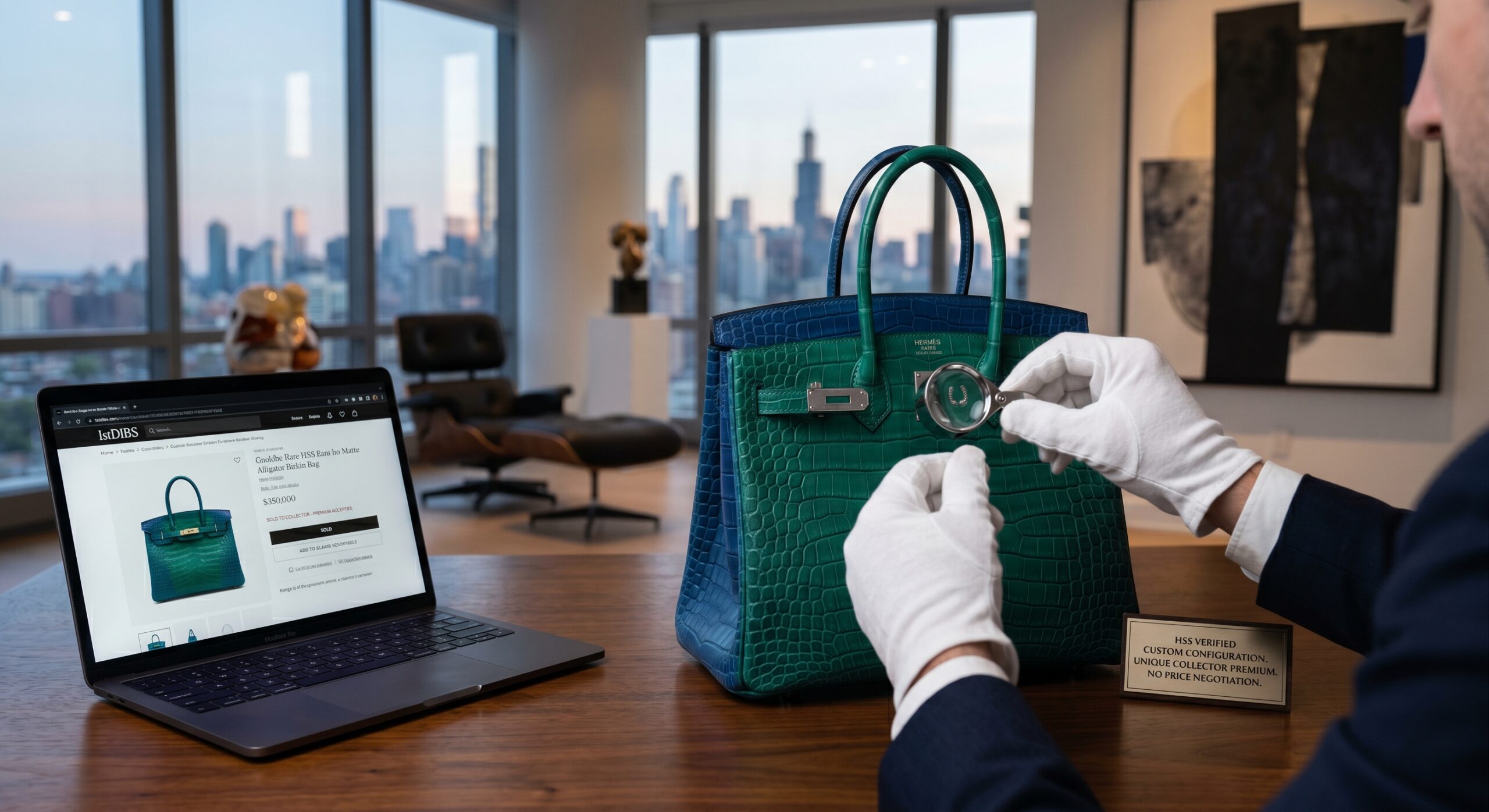
The secondary market data for 2026 confirms that HSS bags command genuine premiums — but only under two simultaneous conditions: the configuration is verifiably distinct from anything available at standard retail, and the full provenance chain from commission to delivery is intact and documentable. Meet both conditions and a two-tone or exotic HSS piece on 1stDibs or Vestiaire Collective can achieve 20–40% above comparable retail configurations. Miss either condition and the premium collapses toward zero.
The most important investment insight about HSS is that it is not a category — it is a layer. A two-tone Birkin in a proven leather combination with full documentation is a genuinely premium secondary market asset. A standard-color HSS piece in a near-retail specification without paperwork is simply a Birkin with a story that cannot be verified. The market prices each accordingly.
For buyers who have already established their standard quota bag strategy and are considering HSS as the next tier, the configuration decision is the entire game. Commission pieces that are unreplicable — two-tone leathers, exotic skins in non-standard colors — and document everything from day one. For buyers who are still building their boutique relationship toward a first standard quota bag offer, HSS is a premature consideration. Master the standard allocation mechanism first.
Bottom Line: Commission HSS only in configurations that are verifiably distinct from retail production; document every step from commission to delivery; and target 1stDibs or Vestiaire Collective for resale — these are the three conditions that determine whether HSS outperforms standard quota bag acquisition at the secondary market level.
Popular Searches
Explore our most searched Hermès HSS and special order investment questions
Frequently Asked Questions
HSS bags with full provenance documentation — original commission receipt, delivery paperwork, dustbag, box, and clochette — can command premiums of 15–30% above comparable retail-issue configurations on Vestiaire Collective and 1stDibs. The premium is driven by verified uniqueness: a buyer who can confirm the HSS origin via documentation is paying for a genuinely one-of-a-kind piece. Without provenance, that premium shrinks to 5–10% or disappears entirely, as buyers on resale platforms have no way to verify the custom origin and price accordingly. See our Hermès quota bag spending ratio strategy for 2026 for context on how HSS access relates to the spend ratio system.
The strongest HSS resale premiums come from three configuration types: two-tone leather combinations in proven color pairings, rare or discontinued colors in durable leathers like Epsom or Togo, and exotic leather commissions with unusual color specifications. Two-tone HSS pieces are particularly sought after on Vestiaire Collective and 1stDibs because they cannot be replicated through standard boutique purchase — the combination exists only because someone commissioned it. Single-color HSS pieces in standard leathers that closely resemble retail-available configurations command little or no premium over standard retail listings.
HSS wait times vary significantly by boutique, leather type, and current production capacity. Observed timelines typically range from 18 months to 3 years from commission to delivery. Standard leather HSS commissions (Togo, Epsom, Clemence) tend toward the shorter end; exotic leather commissions (Porosus Crocodile, Alligator) can reach or exceed three years. The wait time itself adds to the provenance narrative at resale — a documented long-wait HSS commission is understood by serious collectors as a genuine custom piece, not a reseller acquisition. See our Hermès price increase history analysis for how retail price increases during the HSS wait period affect your eventual price-to-resale ratio.
HSS is not a reliable primary investment vehicle for resale purposes. The combination of extended wait time (18 months to 3 years), the requirement for an established boutique relationship that has already produced standard quota bag offers, the 30% retail surcharge on exotic leather HSS commissions, and the provenance-dependency of the resale premium creates a high-friction, high-risk investment profile. HSS makes the most investment sense when the commissioned configuration is genuinely distinct from anything available at retail — two-tone leathers, exotic skins in unusual colors, or discontinued color specifications — and when full provenance is maintained throughout the holding period.