Sellier vs Retourne: Which Kelly Construction Holds Its Shape Best?
A resale-focused breakdown of how Kelly construction affects shape retention, condition grade under daily use, and secondary market price delta — with platform-by-platform data.
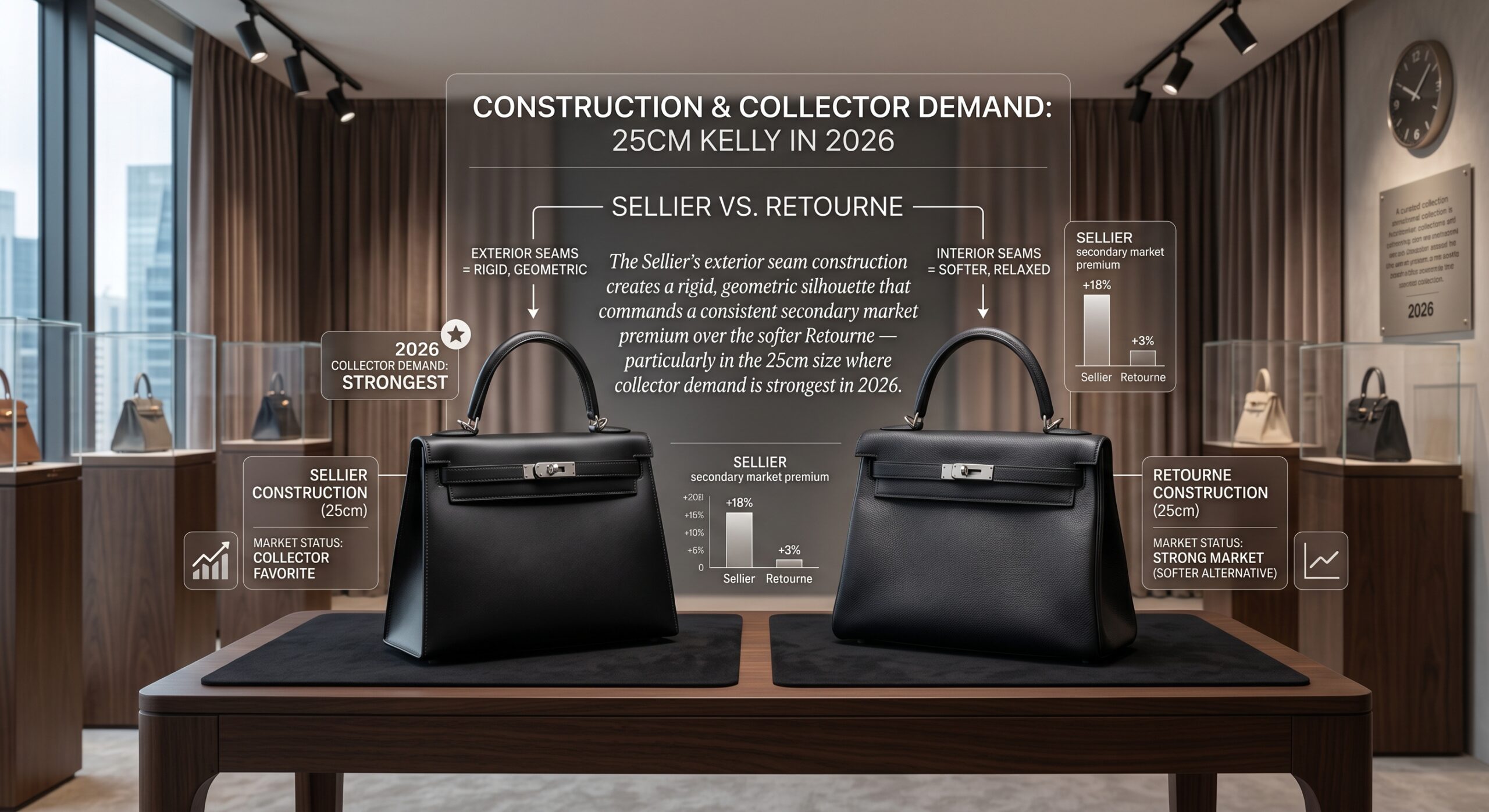
On Vestiaire Collective in 2026, a Kelly 25 Sellier in Noir Epsom with palladium hardware consistently lists — and sells — at a 10–18% premium over an equivalent Kelly 25 Retourne in the same leather and hardware. That price delta is not an anomaly. It is a structural feature of the secondary market, driven by the Sellier's production scarcity, its rigidly formal silhouette, and the collector demand that has built around the smaller structured format over the past three years.
The Sellier versus Retourne question is the most consequential construction decision a Kelly buyer makes — and most buyers make it based on aesthetic preference alone. The secondary market has a clearer view: Sellier construction commands a consistent premium across platforms, holds its geometric shape more reliably under daily use, and retains condition grade more predictably at the point of resale grading. None of that means the Retourne is a poor choice — it means the two constructions serve different buyers, different use patterns, and different resale strategies.
This article gives you the full investment picture: what drives the Sellier premium, where the Retourne holds its own, and how to make the construction decision as part of a coherent quota bag acquisition strategy in 2026.
Construction and the Secondary Market: Why It Matters
The Kelly is the only quota bag Hermès offers in two distinct structural constructions — and that choice creates a measurable secondary market split. The full context on construction methodology and silhouette is covered in the Hermès Structure: Sellier vs Retourne Hub, but the investment framework centres on three variables: shape retention under use, condition grade at resale submission, and the price delta between constructions on the four major platforms.
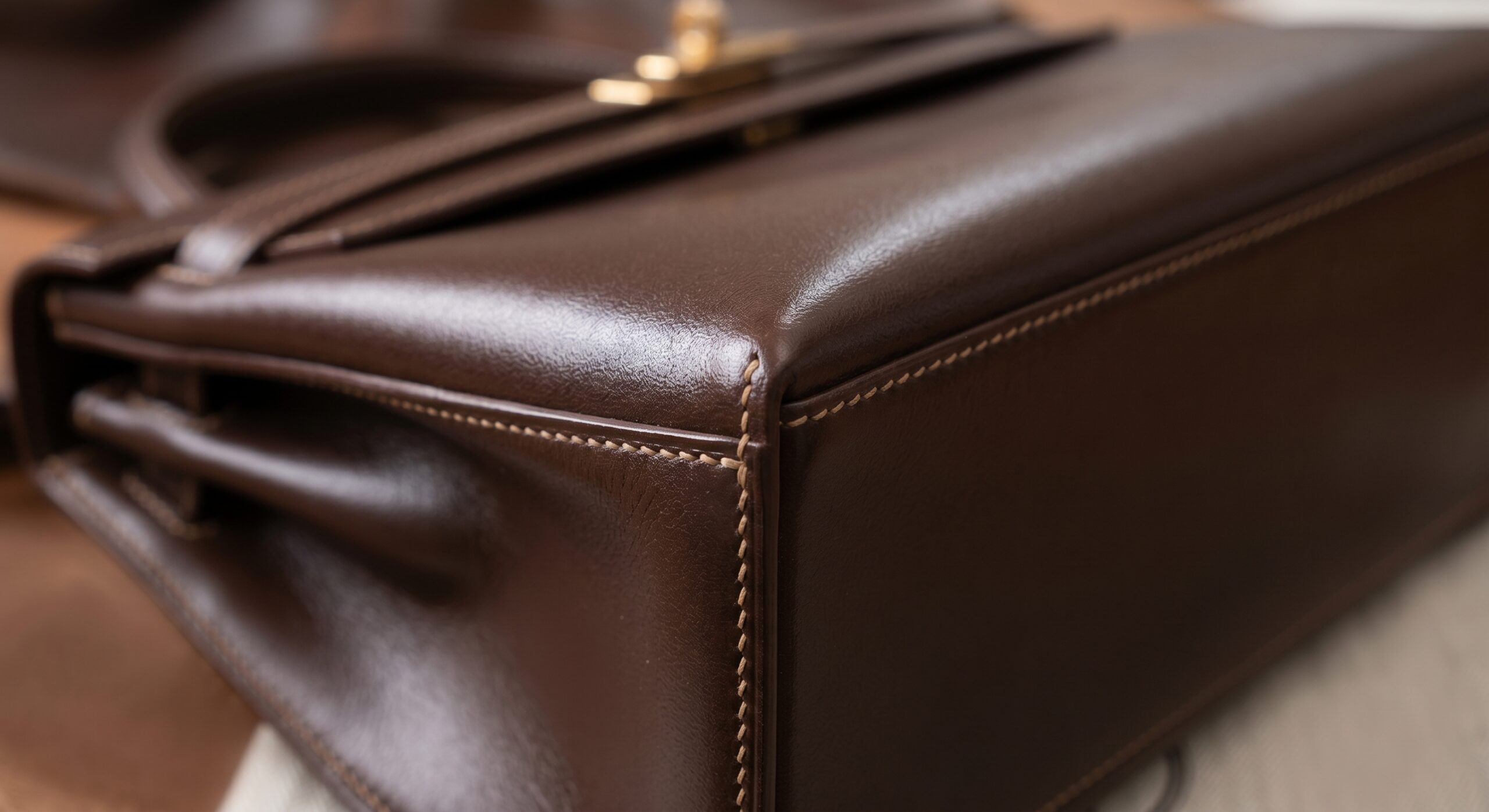
The Sellier is constructed with its seams on the exterior — the leather is stitched outward, creating a rigid trapezoidal silhouette with sharp edges and flat faces. This outward construction creates a bag that is structurally self-supporting: it holds its shape without content, sits flat on a surface, and does not deform under moderate load. The Retourne is the inverse — seams turned inward, creating a softer, slightly slouched silhouette that relaxes around its contents. Its edges are rounded rather than sharp; its faces curve gently rather than lying flat.
These structural differences translate directly into condition grade outcomes. Graders at Fashionphile and The Real Real assess a Kelly's structural condition as part of the overall grade — not just leather surface and hardware, but whether the base sits flat, whether the corners hold their shape, and whether the closure mechanism operates cleanly. The Sellier's rigid construction makes it harder to deform through use; the Retourne's softer construction is more forgiving to carry but more vulnerable to the gradual shape changes that graders flag as condition factors.
Fashionphile's grading team notes structural deformation explicitly for Kelly pieces — a Retourne that has lost its base definition or shows corner rounding beyond normal for the construction will be graded at Excellent rather than Pristine, even with clean leather and hardware. The Real Real uses similar criteria, noting "light wear to structure" as a Excellent-level descriptor.
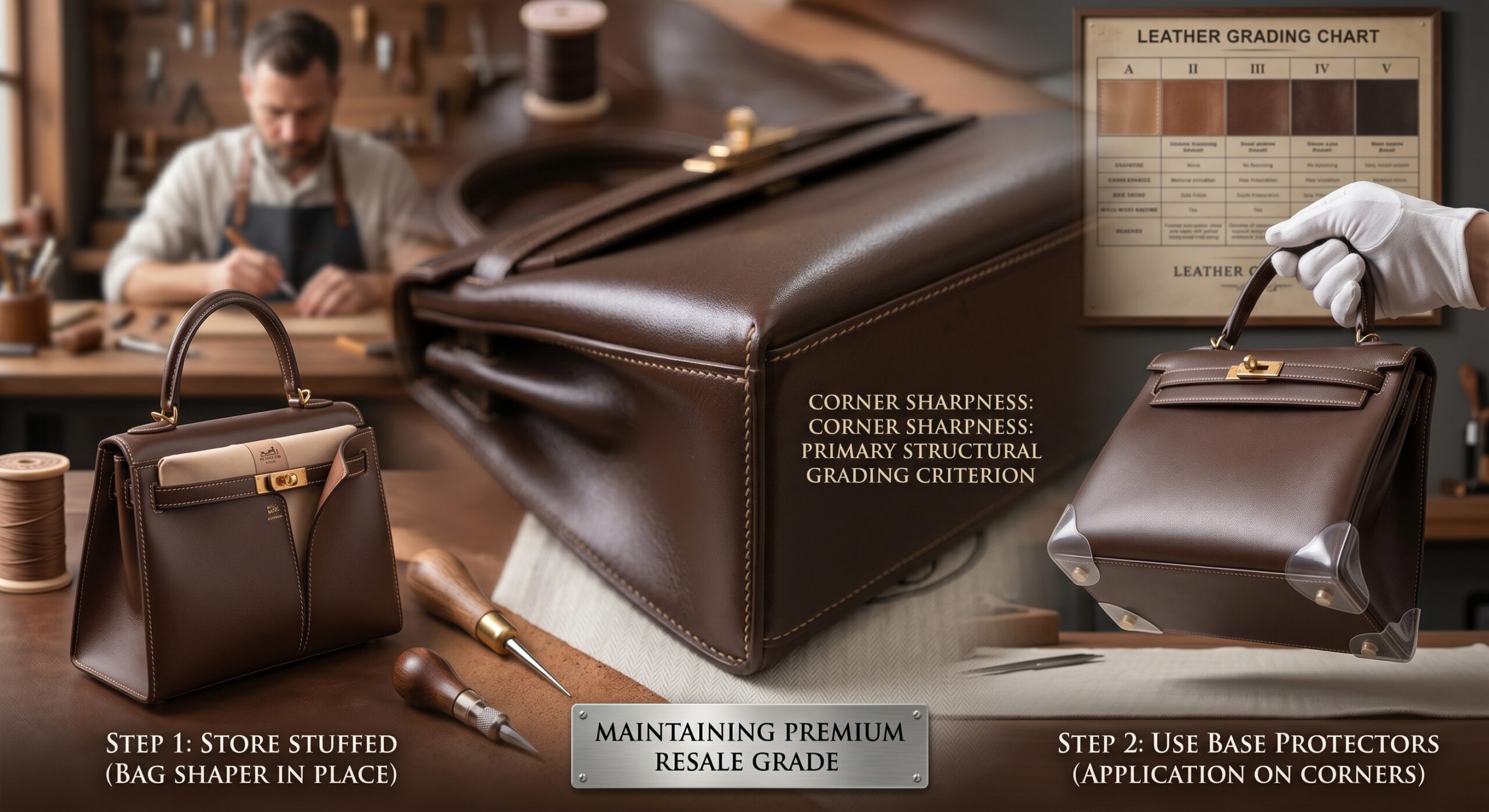
For Sellier pieces, the grading risk is different: corner sharpness at the four base corners is the primary structural assessment point. A daily-use Sellier that shows corner rounding — typically from surface contact during carry — will be graded accordingly. The exterior seam stitching is also inspected; any loosening or pulling at the saddle stitch points affects grade. Both constructions have specific structural grading risks — knowing them helps you maintain condition through the holding period.
The price delta between constructions reflects both the scarcity dynamic and the structural condition advantage. Fewer Sellier pieces are produced in any given leather run — the more complex exterior-seam construction requires additional artisan time, and boutiques receive smaller allocations of Sellier Kellys. Secondary market supply is therefore structurally tighter for Sellier, which supports premium pricing even when multiple Retourne examples of the same configuration are available simultaneously on the same platform.
The Sellier Case: Structure, Scarcity, and Premium
The Kelly Sellier is, by secondary market consensus, the stronger investment construction in 2026. Its price premium over the Retourne is consistent across platforms, persistent across sizes, and resistant to broader market corrections. In the 2024–2026 secondary market softening that affected many Hermès configurations, Sellier premiums held more firmly than Retourne premiums — a pattern that suggests collector demand for the construction is durable rather than trend-driven.
The Sellier premium is strongest in the Kelly 25 size. Collector demand for the compact, rigid silhouette has intensified over the past two years — the 25cm Sellier reads as maximally rare and maximally structured, appealing to buyers who want the most concentrated version of the Kelly's formal heritage. On Vestiaire Collective and 1stDibs, Kelly 25 Sellier listings in neutral leathers with PHW attract bidding activity within days of listing in most standard color configurations.
"The Kelly 25 Sellier in Noir or Etain Epsom with PHW is the single most consistently premium Kelly configuration on Vestiaire Collective in 2026 — its collector demand is deep enough to sustain high prices even in a softened broader market."
The Sellier's shape retention advantage is also meaningful at the point of resale grading. Its self-supporting structure means that a Sellier carried daily — even without the interior support of bag contents — does not deform in the way a lightly loaded Retourne might. The exterior seam acts as a structural spine, preventing the gradual base and corner deformation that triggers grade reductions on softer constructions. The primary structural risk for Sellier is corner sharpness at the four base points — daily surface contact can gradually round these, which graders note. Carrying the bag by the top handle rather than over the shoulder reduces this risk significantly.
- Specify Sellier construction whenever your SA offers a Kelly — the 10–18% premium over Retourne is consistent enough to justify the preference on investment grounds alone.
- The Kelly 25 Sellier is the priority size for maximum resale premium — if your boutique relationship produces a 25 Sellier offer, it is one of the strongest quota bag positions available in 2026.
- Protect the four base corners of a Sellier during carry — corner sharpness is the primary structural grading criterion; a small leather protector under the base significantly reduces corner contact wear.
- For resale, list Sellier pieces on Vestiaire Collective or 1stDibs first — collector buyers on these platforms understand and pay for the construction premium; Fashionphile and TRR buyers are more mixed in their construction awareness.
For the deeper context on why the Sellier has built such strong collector positioning — including how its design language relates to the Kelly's visual identity — the design team at Hermès Guidance Lounge explores the Sellier's design heritage in detail, providing useful context on the aesthetic factors that sustain collector demand beyond pure investment metrics.
The Retourne Case: Softness, Versatility, and Liquidity
The Kelly Retourne is not the lesser construction — it is a different construction with its own buyer profile, use case, and resale dynamic. Understanding where the Retourne outperforms the Sellier is essential for buyers whose use pattern or aesthetic preference genuinely favours the softer format.
On Fashionphile and The Real Real — the platforms with the highest transaction volume for standard Kelly configurations — the Retourne achieves comparable sell-through speed to the Sellier, despite its lower price point. The volume of Retourne listings is higher, which means buyers looking for a specific color-leather-hardware combination are more likely to find it in Retourne than Sellier. For sellers, this broader supply creates competition but also means the buyer pool is larger and less specialised — a correctly priced Retourne in a popular configuration sells reliably without requiring the patient, collector-oriented buyer that Sellier benefits from.
The Kelly 32 Retourne is the configuration where the soft construction is most at home on the secondary market. In the larger format, the Retourne's relaxed silhouette reads as intentional rather than as a structural compromise — buyers seeking a daily-use Kelly that opens wide and carries comfortably specifically seek the 32 Retourne, and the platform demand for this configuration is genuine.
The Kelly 28 Retourne in Togo or Clemence is the highest-volume Kelly configuration across all four platforms — the combination of practical size, familiar leather, and accessible construction means there is always a buyer pool. The premium over Sellier that buyers miss is real, but for buyers whose priority is a reliable, lower-drama exit, the 28 Retourne is a defensible position.
The Retourne's shape retention under daily use is genuinely leather-dependent in a way that the Sellier's is not. A Kelly 28 Retourne in Epsom holds its shape considerably better than the same size in Clemence, because Epsom's rigidity compensates for the construction's natural softness. A Clemence Retourne under daily use with moderate loads will develop base deformation within 12–18 months — a grading risk that Epsom or Togo Retournes avoid for significantly longer. For buyers who receive a Retourne offer, specifying Epsom or Togo mitigates the construction's primary structural vulnerability.
Our analysis of which Hermès leathers are most durable for daily use provides the leather context that makes the Retourne's construction work — pairing a durable leather with the softer construction is the correct strategy for buyers who prefer the Retourne's silhouette but need condition grade retention. And for the broader Kelly versus Birkin investment context, our Birkin vs Kelly five-year value retention analysis covers how the Kelly's overall performance compares to the primary quota bag benchmark.
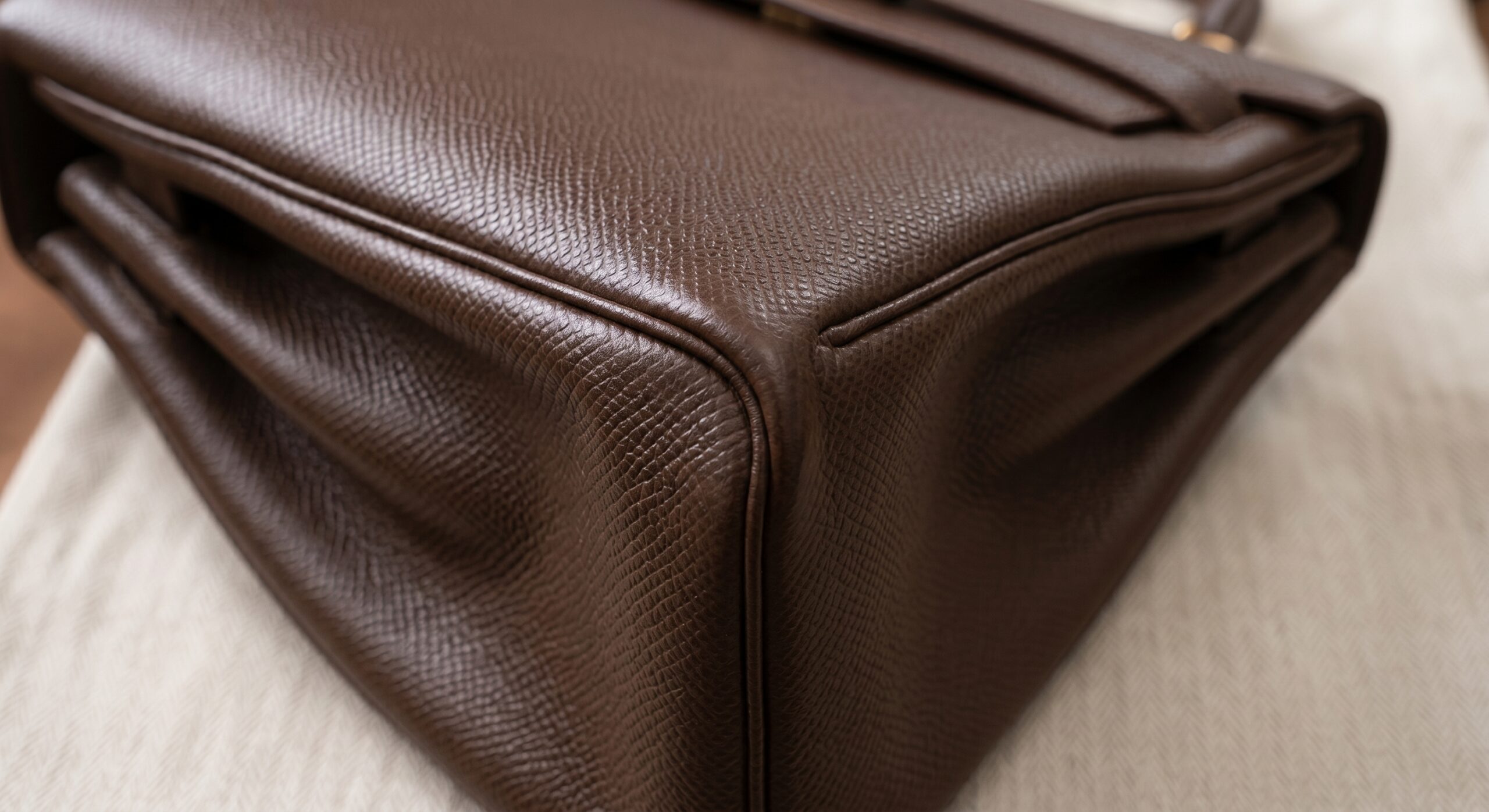
The Retourne is also the more forgiving construction for buyers whose carry habits are heavier. Because the silhouette is designed to relax around contents, the visual impact of normal use-related softening is less dramatic than it would be on a Sellier — where any corner rounding or base flattening reads as structural degradation against the bag's defined geometric ideal. A Retourne that develops a gentle base sag is following its natural character; a Sellier with a softened corner is losing its defining feature.
Which Construction to Pursue: The Acquisition Decision
The construction decision for a Kelly acquisition should be made in sequence: first determine your use pattern and holding timeline, then determine the construction that maximises your resale outcome within those constraints. The Sellier is the stronger investment specification in most scenarios — but the Retourne is not a poor choice, and for some buyers it is the correct one.
If your SA presents a Kelly offer and you have the ability to specify construction, the investment case for Sellier is clear: the 10–18% premium over Retourne is consistent, the production scarcity that drives it is structural rather than trend-dependent, and the condition grade advantage under daily use is real if you manage corner contact carefully. In the Kelly 25 and 28 sizes, Sellier is the specification that maximises your price-to-resale ratio.
- Always specify Sellier when your SA offers a construction choice — the resale premium is consistent enough to justify the preference without needing to assess the specific configuration.
- If offered a Retourne and Sellier is not available in your requested leather-color combination, accept the Retourne — a quota bag in hand in any construction outperforms waiting indefinitely for Sellier.
- For Retourne pieces, specify Epsom or Togo — the leather's rigidity compensates for the construction's softness and significantly extends condition grade A retention under daily use.
- If your holding timeline is under 12 months, Retourne in a popular configuration on Fashionphile is a viable exit — the buyer pool is broad and sell-through is reliable at correct pricing.
- For Sellier pieces, use a base protector during daily carry and store the bag stuffed to maintain corner sharpness — the grading premium depends on structural preservation throughout the hold.
- When listing a Sellier, lead with construction in your platform description — buyers specifically seeking Sellier filter by this and are prepared to pay the premium without negotiation.
The construction question also intersects with the broader Kelly versus Birkin acquisition decision. For buyers who are earlier in their boutique relationship and have not yet established the spend ratio needed for a Birkin offer, a Kelly Sellier in a strong leather-color configuration is a defensible alternative — it delivers genuine secondary market premium and builds the relationship history that supports future quota bag offers. Our Chevre vs Epsom durability and resale analysis provides additional leather selection context for buyers finalising their Kelly specification.
| Configuration | Construction | Resale Premium | Liquidity | Best Platform |
|---|---|---|---|---|
| Kelly 25 — Epsom/Togo — PHW | Sellier | +15–18% vs Retourne | High (collector-driven) | Vestiaire · 1stDibs |
| Kelly 25 — Epsom/Togo — PHW | Retourne | Strong vs retail | High (broad buyer pool) | Fashionphile · TRR |
| Kelly 28 — Epsom/Togo — PHW or GHW | Sellier | +10–15% vs Retourne | High | Vestiaire · Fashionphile |
| Kelly 28 — Togo/Clemence — any HW | Retourne | Moderate vs retail | Very High (highest volume) | Fashionphile · TRR |
| Kelly 32 — any leather — any HW | Sellier | +8–12% vs Retourne | Moderate | Vestiaire Collective |
| Kelly 32 — Togo/Epsom — GHW | Retourne | Moderate vs retail | Moderate | The Real Real |
| Kelly 25 — exotic leather — GHW | Sellier | Significant premium | Moderate (collector only) | 1stDibs · Vestiaire |
| Kelly 28 — Clemence — any HW | Retourne | Grade risk under daily use | Moderate | Fashionphile |
Premium figures are approximate and reflect observed secondary market ranges vs retail price in good to excellent condition. Exotic leathers, rare colors, and full provenance documentation can significantly exceed these ranges.
Sellier Wins on Investment; Retourne Wins on Volume
The secondary market data for 2026 is clear: Kelly Sellier construction delivers a consistent 10–18% premium over equivalent Retourne configurations, driven by genuine production scarcity, superior shape retention under daily use, and deep collector demand — particularly in the Kelly 25 size. If your goal is to maximise the price-to-resale ratio of your Kelly allocation, Sellier is the correct specification in every size where it is available.
The Retourne is not a poor investment — it is a different one. It delivers higher transaction volume, faster average sell-through on Fashionphile and The Real Real, and a more forgiving condition grade trajectory for buyers who carry heavily. In the Kelly 28 and 32 sizes, the Retourne is the dominant configuration at resale by volume, and correctly priced pieces sell reliably. Pairing Retourne construction with a durable leather — Epsom or Togo — significantly mitigates the construction's primary shape retention risk.
The construction decision should always be made in the context of your specific holding timeline and exit platform. Sellier for patient sellers targeting collector buyers on Vestiaire and 1stDibs. Retourne for buyers who need reliable, faster liquidity at a strong-but-not-maximum premium on the volume platforms.
Bottom Line: Always specify Sellier when your SA offers a construction choice — the 10–18% resale premium is consistent, production scarcity is structural, and shape retention under daily use reduces the grading risk that erodes that premium over the holding period.
Popular Searches
Explore our most searched Kelly construction investment and acquisition questions
Frequently Asked Questions
Sellier construction delivers a consistent resale premium of approximately 10–18% over the equivalent Retourne Kelly in comparable leather, color, and hardware configurations on Vestiaire Collective and The Real Real. The structured exterior seam, rigidity, and perceived formal rarity of the Sellier drive this premium. In the Kelly 25 size specifically, the Sellier premium can reach the upper end of that range — collector demand for the smaller Sellier is exceptionally strong in 2026. For a full style-level resale comparison, see our analysis of which Hermès bag styles hold their resale value best in 2026.
Sellier holds its geometric shape more consistently than Retourne because its seams are on the exterior and the structure is built outward, not inward. The Retourne's inward-turned seams create a softer silhouette that is intentional — but under daily use with heavier loads, the Retourne can lose some of its defined base edge and corner sharpness faster than the Sellier. This structural difference is visible to graders at Fashionphile and The Real Real and factors into condition assessment on heavily used pieces.
Yes — in most boutiques, Sellier construction is produced in smaller runs than Retourne for any given leather, as the more complex exterior-seam construction requires additional artisan time. SA allocations of Sellier pieces are therefore more limited, and the wait list dynamic for buyers who specifically request Sellier is longer. This production scarcity directly contributes to the Sellier's secondary market premium — supply genuinely is more constrained at retail. See our Birkin vs Kelly five-year value retention analysis for the broader Kelly versus Birkin investment comparison.
In 2026, the Kelly 25 Sellier commands the strongest premiums of any Kelly configuration on all four major resale platforms. Collector demand for the smaller format has intensified, driven by the international buyer pool on Vestiaire Collective and 1stDibs seeking a compact, structured quota bag that reads as maximally rare. The Kelly 28 Sellier performs well but with slightly broader supply and a more moderate premium. The Kelly 32 Sellier has a dedicated buyer pool but lower overall demand than the 25 or 28.