How Hermès Hardware Type Affects Resale Price: Full Data Analysis
A platform-by-platform breakdown of the palladium vs gold hardware price delta — and why hardware condition is a direct resale value variable that most buyers underestimate.
In a side-by-side comparison on Fashionphile, two Birkin 30s in Noir Togo — identical in every respect except hardware — will list at a measurable price delta. The palladium hardware version moves faster; the gold hardware version often achieves a slightly higher final price in the right buyer context. That gap is real, consistent, and worth understanding before you specify hardware at your next boutique appointment or evaluate a quota bag offer from your SA.
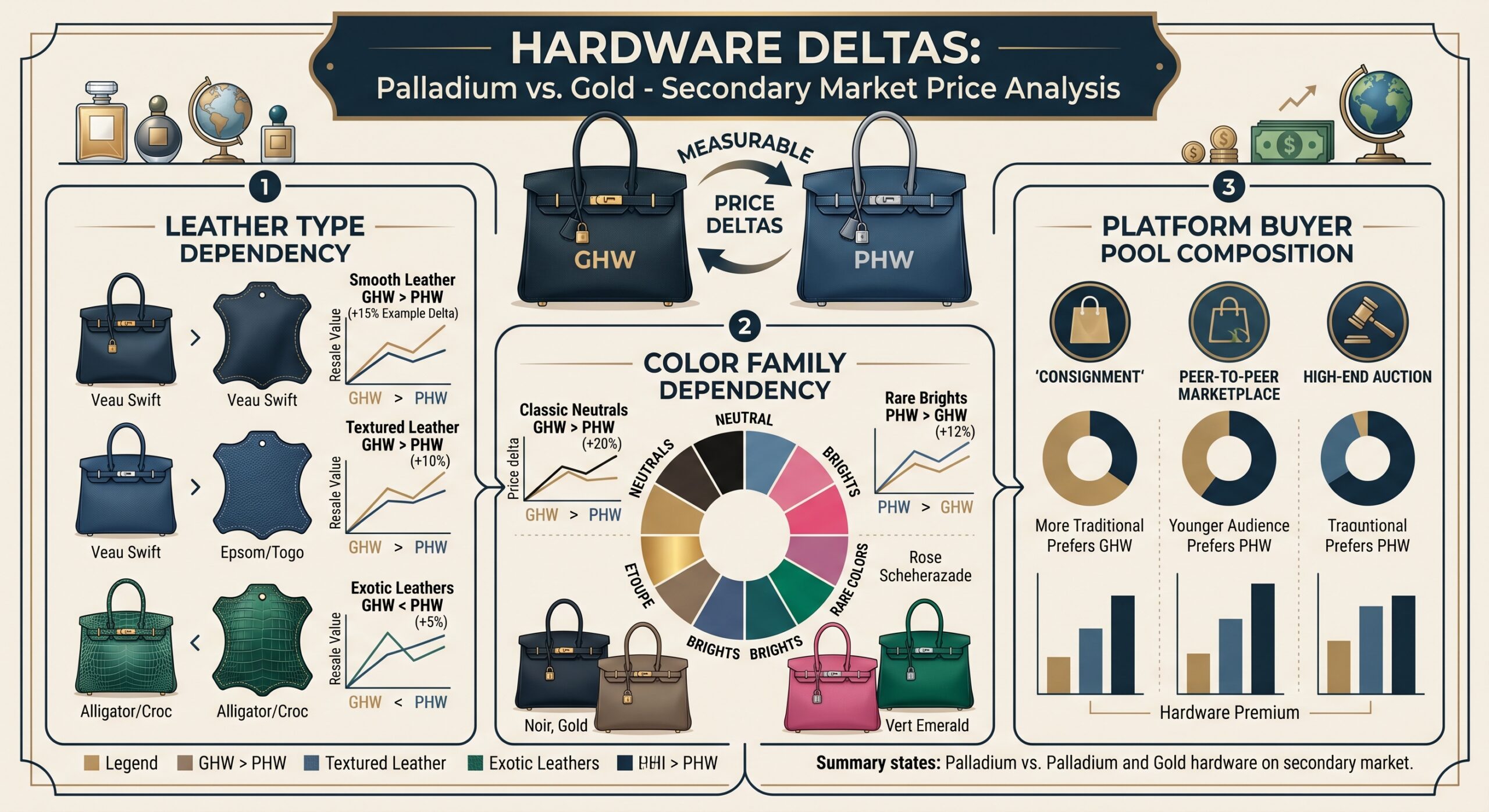
Hermès hardware type is the most frequently underestimated resale variable among buyers who have correctly identified leather and color as their primary investment levers. The price delta between palladium hardware (PHW) and gold hardware (GHW) in standard configurations is typically 3–8% — modest in isolation, but meaningful when compounded with the right color and leather combination. On exotic leathers and rare colors, that dynamic inverts entirely: GHW commands collector premiums that PHW cannot match on Vestiaire Collective and 1stDibs.
This article provides the full picture: where each hardware type outperforms across the four major resale platforms, how hardware condition affects grading independent of leather, and how to factor hardware choice into a coherent quota bag acquisition strategy in 2026.
Hardware and the Secondary Market: The Framework
Hermès offers four primary hardware finishes across its quota bag range: palladium (PHW), gold (GHW), brushed gold (BGHW), and ruthenium. Each finish attracts a distinct buyer profile on the secondary market, and each interacts differently with leather and color to produce a combined resale outcome. The full craftsmanship detail behind each finish is covered in the Hermès Hardware & Craftsmanship Guide, but the investment framework requires understanding three things: which hardware finish the broadest buyer pool prefers, which finish collector buyers specifically seek, and how hardware condition is assessed independently of leather condition at the point of grading.
On Fashionphile and The Real Real — the two platforms with the largest US buyer pools — palladium hardware is the slightly preferred finish for standard leather configurations. This preference reflects the contemporary aesthetic that has dominated the American luxury market over the past decade: cool-toned, minimalist, versatile. PHW Birkins and Kellys in neutral leathers move fractionally faster on these platforms and attract a broader range of first-time quota bag buyers who may not yet have strong hardware preferences.
On Vestiaire Collective and 1stDibs — which serve more international and collector-oriented buyer pools — gold hardware maintains stronger positioning, particularly for rare colors, exotic leathers, and Kelly configurations where the warm finish reads as more classically Hermès. The price delta between PHW and GHW on these platforms in exotic configurations is not 3–8%; it can reach 12–20% in favour of GHW among collectors who understand the heritage significance of the original hardware finish.
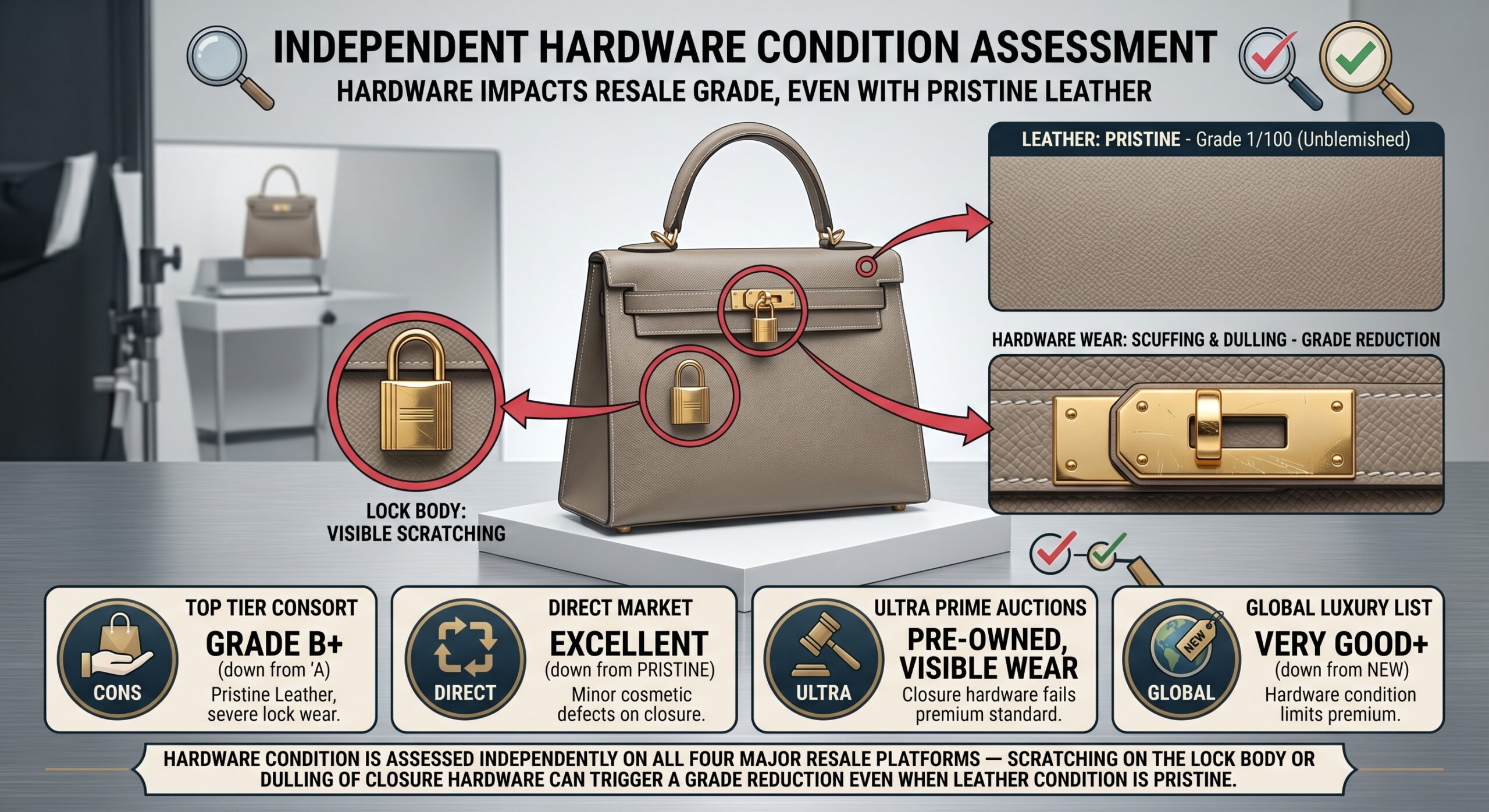
All four major resale platforms assess hardware condition separately from leather condition. This matters because hardware degradation — scratching on the lock body, dulling of the turn-key closure, oxidation on the clochette ring — can trigger a condition downgrade on a bag whose leather is otherwise pristine. Fashionphile's condition descriptions explicitly note hardware scratching. The Real Real factors closure mechanism smoothness into its Excellent vs Good determination.
This means hardware maintenance is a direct resale value preservation activity. Palladium hardware scratches more visibly than gold hardware under equivalent daily use. A PHW Birkin used daily without hardware protection — carrying keys against the lock, for example — will show hardware degradation faster than the equivalent GHW piece, all else equal. Factor this into your daily use planning if you intend to sell within 24 months.
Understanding these platform-specific dynamics is the foundation of hardware-informed acquisition. Choosing between PHW and GHW is not a matter of personal taste alone — it is a question of which buyer pool you want to access at the point of resale, and how your leather and color choices interact with each finish to produce the strongest combined price-to-resale ratio.
PHW vs GHW: Where Each Hardware Wins
The palladium versus gold hardware question does not have a single correct answer — it has a context-dependent answer that changes with leather type, color family, and target resale platform. Here is the market data broken down by configuration type.
For standard leather Birkins in neutral colors — the core of the secondary market by volume — the PHW advantage on Fashionphile and The Real Real is real but modest. Observed price differentials of 3–8% in favour of PHW reflect the wider buyer pool's aesthetic preference, but the margin is not large enough to override other configuration decisions. A Birkin 30 Togo PHW Noir sells marginally faster than the equivalent GHW piece; the GHW version typically achieves a comparable or very slightly lower final price from a buyer who knows exactly what they want.
"The PHW advantage on standard configurations is real but narrow — 3–8% on Fashionphile. The GHW advantage on exotic leathers and rare colors is much wider — and on 1stDibs, it can be decisive for collector buyers."
The dynamic shifts sharply on exotic leathers. Porosus Crocodile, Niloticus Crocodile, and Alligator configurations with GHW command meaningfully higher prices on Vestiaire Collective and 1stDibs than their PHW equivalents. The collector community for exotic Hermès pieces has historically associated gold hardware with the classic presentation — the original Birkin specifications, the Kelly's heritage closure — and this association maintains a genuine price premium. An exotic Birkin 25 GHW on 1stDibs will routinely outperform the PHW equivalent by 12–20% among motivated collector buyers.
- For standard leather quota bags in neutral colors targeting Fashionphile or The Real Real, PHW is the marginally stronger resale specification — broader buyer pool, faster liquidity.
- For exotic leathers or rare color configurations targeting Vestiaire Collective or 1stDibs, GHW is the correct specification — collector premium is consistent and significant.
- For Kelly bags specifically, GHW has stronger heritage association and performs well across platforms in both standard and exotic leather — the Kelly's design is historically linked to gold hardware more strongly than the Birkin.
- If your SA offers a hardware choice, always check the secondary market for that specific leather-color combination before deciding — the market data will tell you which finish commands premium in that exact configuration.
The interaction between hardware and color is analysed in detail in our article on Hermès rare colors that outperform on the resale market — reading that analysis alongside this hardware breakdown gives you the full configuration picture. For the broader price trend context, our Hermès price increase history analysis covers how retail price movements affect the secondary market premium across hardware types over time.
Hardware Condition, BGHW, and Ruthenium: The Full Picture
Beyond the PHW versus GHW core comparison, two additional hardware types — brushed gold (BGHW) and ruthenium — appear in the Hermès range with sufficient frequency to warrant dedicated resale analysis. And hardware condition, independent of finish type, is a variable that affects every quota bag at the point of platform grading.
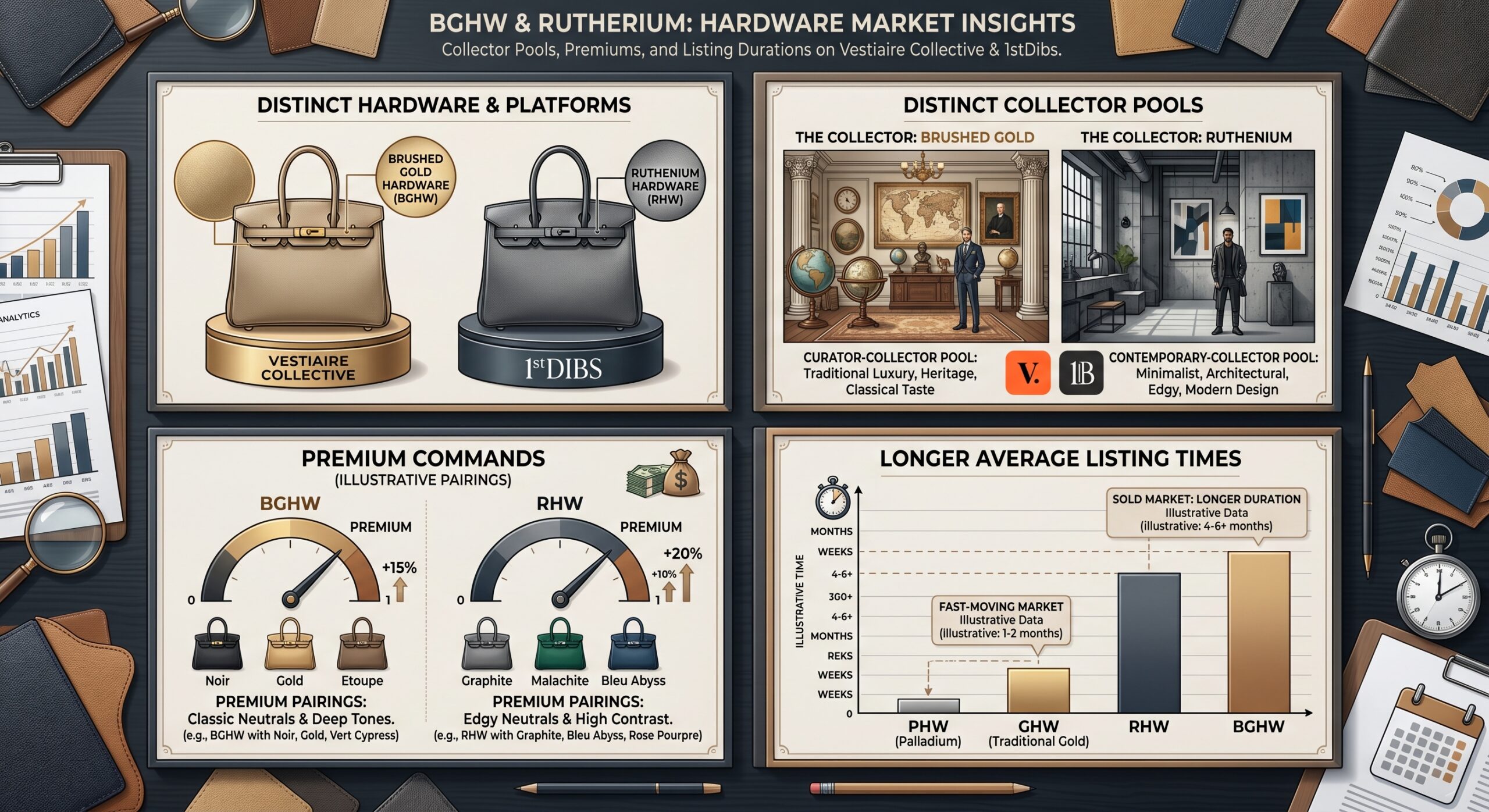
Brushed gold hardware occupies a genuine middle position in the secondary market. Its matte, textured finish reads as more understated than polished GHW and has attracted a loyal buyer subset — particularly among Kelly buyers who prefer a contemporary aesthetic without the coolness of PHW. On Vestiaire Collective, BGHW Kellys in neutral leathers can achieve a 5–10% premium over equivalent polished GHW pieces among buyers who specifically seek the finish. However, the narrower buyer pool means longer average listing times — the premium is real, but patience is required to achieve it.
Ruthenium hardware — a dark, gunmetal finish offered periodically across the quota bag range — commands a distinct collector premium when it appears on resale platforms. Its relative rarity means that a Birkin or Kelly in ruthenium hardware with a complementary dark leather (Noir, Graphite, Ébène) can achieve premiums of 10–18% over the equivalent PHW or GHW piece on Vestiaire and 1stDibs.
The key variable is colour pairing. Ruthenium on a dark leather creates a cohesive, high-collector-interest combination. Ruthenium on a light or mid-tone leather can read as mismatched to some buyers and slow the sale considerably. If you receive a ruthenium hardware offer from your SA, evaluate the leather-color combination carefully — the right pairing is a premium asset; the wrong pairing is a liquidity risk.
Hardware condition deserves specific attention because it degrades independently of leather and creates resale risk that many owners do not anticipate. Palladium hardware scratches visibly under daily carry — the lock body accumulates fine scratches from key contact, and the turn-key closure can develop wear at the pivot point. Gold hardware develops a warm patina that reads positively on most platforms — buyers understand and often welcome the natural aging of gold plating. Brushed gold shows wear differently: the brushed texture can become polished in high-contact areas, creating an uneven appearance that graders flag.
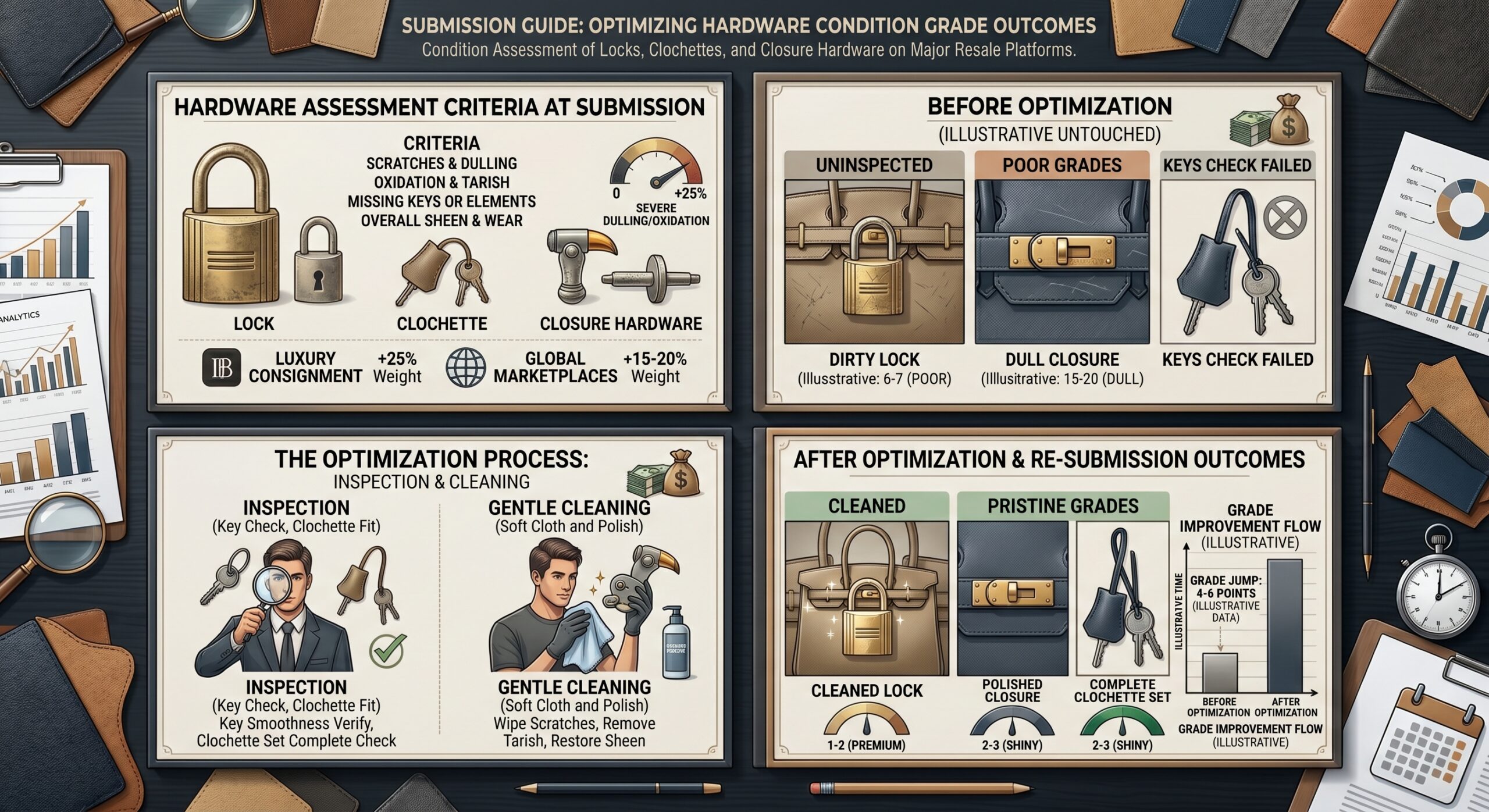
The practical implication for sellers: before listing any quota bag, inspect hardware thoroughly under good light. Fine polishing of palladium hardware with a microfibre cloth before photography and submission can improve the grade outcome meaningfully. Understanding how leather durability interacts with hardware wear patterns is covered in our broader leather analysis — for the specific chemistry behind these processes, the leather science team at Hermès Insights Hub covers the hardware-leather interaction in technical detail, providing useful context on why certain pairings age more gracefully than others.
For buyers who have received a non-standard hardware offer — BGHW, ruthenium, or a discontinued finish — the approach is the same as with rare colors: check secondary market listings before deciding. A quick search on Vestiaire Collective filtered by hardware type will show you active listings and recent sold prices for that specific finish. The resale market will give you a more reliable answer in two minutes than any general guidance can in two paragraphs.
Hardware Strategy in Your Acquisition Decisions
Hardware choice should be the final layer of your quota bag specification — applied after you have determined the style, size, leather, and color that deliver your target resale outcome. It is a meaningful variable, but a secondary one. Getting the leather and color right first, then optimising hardware for the specific configuration, is the correct sequencing.
When specifying a quota bag with your SA, the hardware question has a clear framework. For a standard leather Birkin targeting the broadest possible buyer pool and fastest exit: specify PHW. For a Kelly in any leather targeting collector buyers on Vestiaire or 1stDibs: GHW is the stronger choice, given its heritage association with the style. For exotic leather configurations: always GHW — the collector premium is consistent and the resale data supports it unambiguously.
- Birkin, standard leather, neutral color, targeting Fashionphile or TRR → PHW for maximum liquidity speed.
- Birkin, standard leather, rare color → check secondary market for that color — rare colors perform differently with each hardware type.
- Birkin or Kelly, exotic leather → GHW — collector premium is consistent across Vestiaire and 1stDibs.
- Kelly, any leather → GHW is generally the stronger specification; heritage association drives collector demand.
- HSS commission → align hardware with the leather-color combination's natural aesthetic, then verify secondary market positioning for that exact combination before finalising the specification.
- Hardware maintenance → clean hardware with a soft cloth before any resale listing; PHW in particular benefits from careful preparation before photography.
The resale market context for hardware is evolving. Our Hermès reseller market price drop analysis covering 2024 to 2026 shows that hardware-related price gaps have remained relatively stable even as the broader market corrected — suggesting that hardware preference is a durable buyer behaviour rather than a trend-driven variable. This stability makes hardware strategy a reliable component of long-term acquisition planning.
| Hardware | Standard Leather Delta | Exotic Leather Delta | Liquidity | Best Platform |
|---|---|---|---|---|
| PHW (Palladium) | +3–8% vs GHW | −12–20% vs GHW | Highest (US buyer pool) | Fashionphile · TRR |
| GHW (Gold) | Slight lag vs PHW | +12–20% vs PHW | High (collector + global) | Vestiaire · 1stDibs |
| BGHW (Brushed Gold) | +5–10% vs GHW (Kelly) | Comparable to GHW | Moderate (niche buyers) | Vestiaire Collective |
| Ruthenium (dark leather) | +10–18% vs PHW | +10–18% vs PHW | Moderate (collector-driven) | Vestiaire · 1stDibs |
| Ruthenium (light leather) | Neutral or slight discount | Neutral or slight discount | Low (pairing mismatch risk) | Vestiaire Collective |
| PHW — worn/scratched | Grade penalty applies | Grade penalty applies | Reduced | Any (post-clean recommended) |
| GHW — patinated | Neutral or slight premium | Premium (vintage) | Moderate–High | 1stDibs · Vestiaire |
Price delta figures are approximate and reflect observed secondary market ranges. Outcomes vary by specific color, leather, size, and condition grade. All data approximate based on observed platform patterns.
PHW for Speed, GHW for Premium — Know Your Exit Before You Specify
The secondary market data on Hermès hardware is consistent and actionable. Palladium hardware delivers marginally stronger liquidity on the US-focused platforms — Fashionphile and The Real Real — because the broader buyer pool slightly prefers the cooler finish in standard leather configurations. Gold hardware commands meaningful collector premiums on exotic leathers and rare colors, and dominates the international buyer platforms where heritage aesthetic matters more than contemporary preference.
The hardware condition variable is the most underestimated resale risk in this analysis. A Birkin with scratched palladium hardware and pristine leather will not achieve a Pristine or Grade A condition outcome on any major platform — and the grade reduction it receives can exceed the original PHW premium advantage. Maintaining hardware condition through the holding period is a direct investment in your exit price.
Ruthenium and brushed gold are premium-capable finishes in the right configurations — but their narrower buyer pools mean longer listing times. Accept these finishes when offered in the right pairing; plan for a patient resale process rather than a fast exit.
Bottom Line: Specify PHW for standard leather quota bags targeting fast US-platform exit; specify GHW for exotic leather and rare color configurations targeting collector buyers on Vestiaire and 1stDibs — and maintain hardware condition throughout the hold period as a direct resale value activity.
Popular Searches
Explore our most searched Hermès hardware investment and acquisition questions
Frequently Asked Questions
In standard leathers and neutral colors, palladium hardware (PHW) delivers marginally stronger resale liquidity on Fashionphile and The Real Real — the broader buyer pool slightly favours the cooler, more modern finish. However, gold hardware (GHW) consistently outperforms on exotic leathers and rare colors, where the classic combination commands collector premiums on Vestiaire Collective and 1stDibs. The price delta between PHW and GHW in the same standard-leather configuration is typically 3–8% — meaningful but not decisive. For color-specific hardware interaction data, see our analysis of Hermès rare colors that outperform on the resale market.
Yes — hardware condition is assessed separately from leather condition on all four major resale platforms, and degraded hardware can trigger a grade reduction even when leather is pristine. Palladium hardware is prone to scratching and dulling under daily use; gold hardware develops a warm patina that is often viewed positively by buyers. On Fashionphile, hardware scratching on a Birkin lock or turn-key closure is noted explicitly in the condition description and affects pricing. Maintaining hardware condition — particularly lock and closure mechanisms — is a direct resale value preservation activity.
Brushed gold hardware commands a modest premium in specific configurations — particularly Kelly bags where the matte finish reads as more contemporary and understated. On Vestiaire Collective, BGHW Kellys in neutral leathers can achieve a 5–10% premium over equivalent GHW pieces among buyers who specifically seek the finish. However, BGHW pieces take slightly longer to sell because the buyer pool seeking that specific finish is narrower. For most standard configurations, polished GHW remains the stronger choice for both liquidity and price. See the Hermès Hardware & Craftsmanship Guide for the full hardware reference.
For HSS (Hermès Special Service) commissions, hardware choice interacts with leather and color to create the combined premium. An HSS piece in a rare color with GHW on an exotic leather represents the ceiling of the secondary market — but only with full provenance documentation. Without the original order receipt and delivery paperwork, buyers on 1stDibs and Vestiaire cannot verify the HSS origin, and the hardware premium is absorbed into general uncertainty. Maintain all HSS documentation from commission through to any eventual resale.