Hermès Wish List Strategy for New Clients: The Insider Approach
How to communicate quota bag preferences to your SA without triggering the relationship dynamics that delay — or permanently close — allocation access in 2026.
The Hermès wish list is not a system — it is a conversation. And how that conversation is structured, timed, and worded determines whether it accelerates your quota bag allocation or flags you as a client whose intentions outrun their relationship capital. In the boutique environment, the difference between a client who receives an offer within 14 months and one who waits 30 months with comparable spend history often comes down to a single interaction: the moment they first expressed their quota bag interest, and whether they expressed it in a way that invited the SA into a long-term client relationship or simply demanded access to inventory.
The spend ratio strategy covered in our quota bag spending ratio guide establishes the financial dimension of boutique relationship building. This article covers the relational dimension: the specific mechanics of how new clients communicate quota bag preferences in 2026, what wording signals genuine collector intent versus transactional access-seeking, and how to navigate the SA relationship across the full pre-offer timeline without triggering the dynamics that delay allocation.
The market context for this strategy is direct — a quota bag acquired at retail through a functioning boutique relationship yields a price-to-resale ratio of 120–145% on the secondary market. A quota bag acquired on the secondary market to bypass the relationship process costs 20–40% above retail. The wish list strategy is worth getting right.
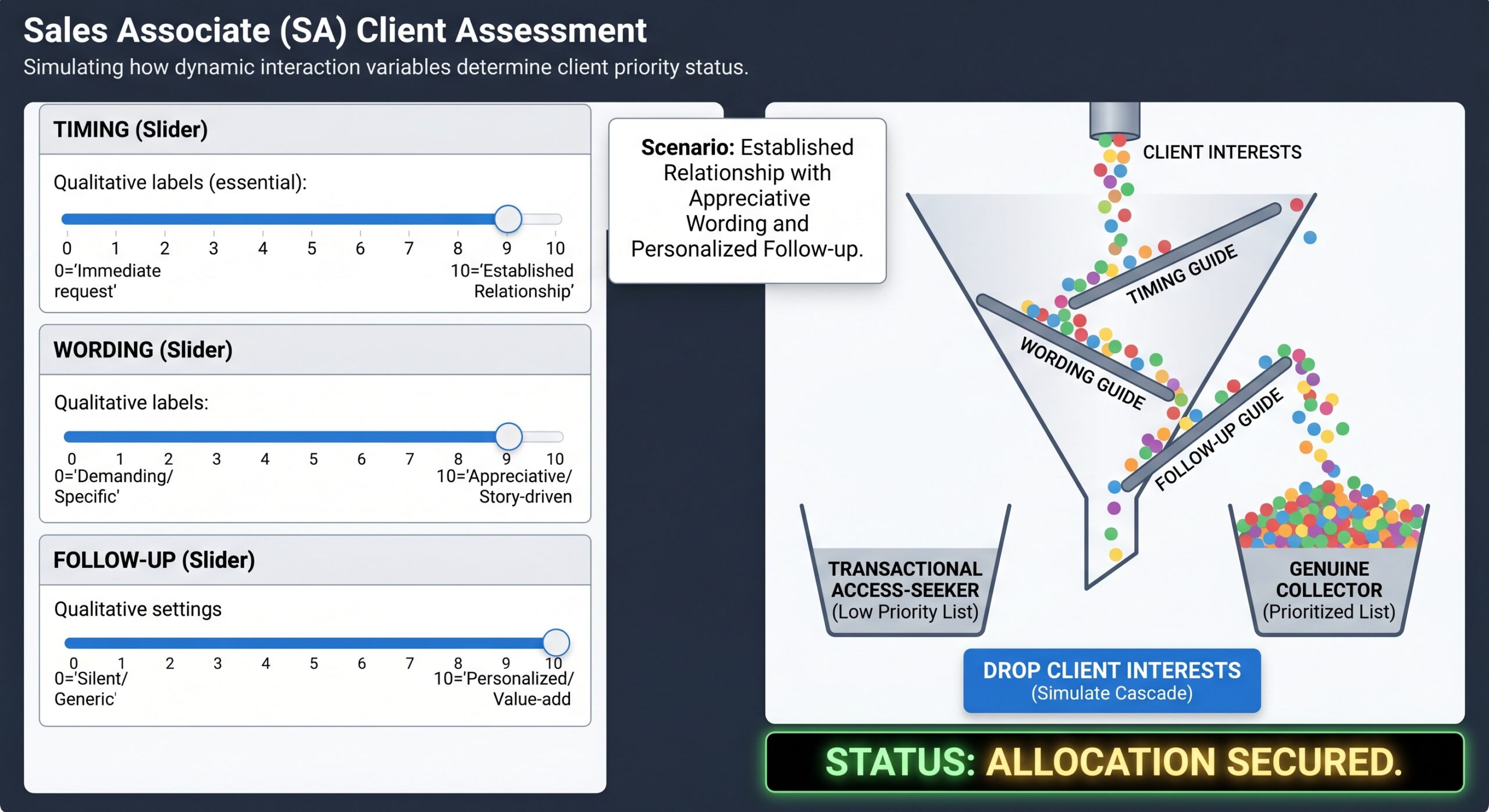
The Wish List Myth: What the System Actually Is
The first thing every new Hermès client must understand is that there is no official wish list. Hermès does not operate a registration system, a numbered queue, or any centralised mechanism for expressing quota bag interest. What clients call a "wish list" is in reality the SA's memory — supplemented by notes in their client management system — of which clients have expressed preferences for specific pieces, and when.
The full context of how quota bag allocation actually works is covered in the Buying Hermès Without the Wait hub, but the wish list mechanism requires understanding one thing above all: it is managed entirely by human beings whose professional incentives, personal relationships, and boutique management dynamics shape every allocation decision. An SA who advocates internally for a client does so because they trust the client will handle the offer well, value the relationship, and reflect positively on the SA's judgment. A client who has created friction, expressed impatience, or signalled that their interest is purely transactional will not receive that internal advocacy — regardless of their spend history.
When an SA has a quota bag available to offer, they run through a mental shortlist of clients. That shortlist is not organised by spend history alone — it is organised by relationship quality, expressed preference specificity, responsiveness history, and trust. A client who stated a clear preference six months ago, has continued visiting and purchasing without pressure, and responded promptly to previous SA communications is near the top of that shortlist. A client who mentioned a Birkin on their first visit, has called three times asking about availability, and sent a follow-up email last week is near the bottom — regardless of what they have spent.
The wish list strategy is therefore not about registering your name in any system. It is about positioning yourself in the SA's mental shortlist through the quality of your relationship and the clarity of your expressed preference — stated once, at the right moment, in the right way.
The boutique presentation and style dimension of this relationship — how you present yourself in the boutique environment and the signals your appearance and behaviour send to an SA who is assessing client credibility — is covered by the design and lifestyle team at Hermès Guidance Lounge's boutique client presentation guide, which provides useful context on the non-verbal dimension of the SA interaction that complements the verbal strategy in this article.
How and When to Express Your Quota Bag Preference
Timing and wording are the two variables that determine whether a quota bag preference expression advances or damages a new client's allocation standing. Both are entirely controllable — and both are frequently mishandled by buyers who understand the financial strategy but not the relational one.
Timing follows a clear principle: express your preference after you have established enough purchase history to be credible as a collector, but early enough that the SA has time to factor it into their allocation thinking before your spend ratio matures. Visits three through five — after making two or more genuine purchases and after the SA has begun to recognise you as a consistent client — is the right window. Expressing interest on the first visit signals that access is your only reason for being there. Waiting until visit ten or twelve means you have been in the relationship without giving the SA the information they need to consider you.
Specificity is the most undervalued element of preference communication. An SA who is told "I want a Birkin 30 in Togo with palladium hardware — neutral colour preferred, Noir or Etain would be ideal — but I'm open to other neutrals" has enough information to match you to an available piece with confidence. An SA told "any Birkin" has no information they can act on. Vague preferences are not remembered; specific preferences are logged — mentally and in client notes — and actioned when inventory matches.
"The most effective wish list conversation is the one where the SA leaves knowing exactly what you want, knowing you are patient enough to wait, and knowing you will respond immediately when they call."
- State your full preference specification in a single conversation: style, size, leather, hardware, colour range — not a single element, and not every possible option.
- Express genuine patience explicitly — "no rush at all" or "whenever the timing is right" signals that you will not create pressure, which makes the SA more willing to associate your name with future offers.
- Make the preference statement feel like a natural continuation of a product conversation, not a separate agenda item — the most effective moments are during discussions about leather choices, bag styles, or collections you are already admiring.
- Never follow up the preference conversation with a progress check at the next visit — let the SA hold the information and act on it in their own time.
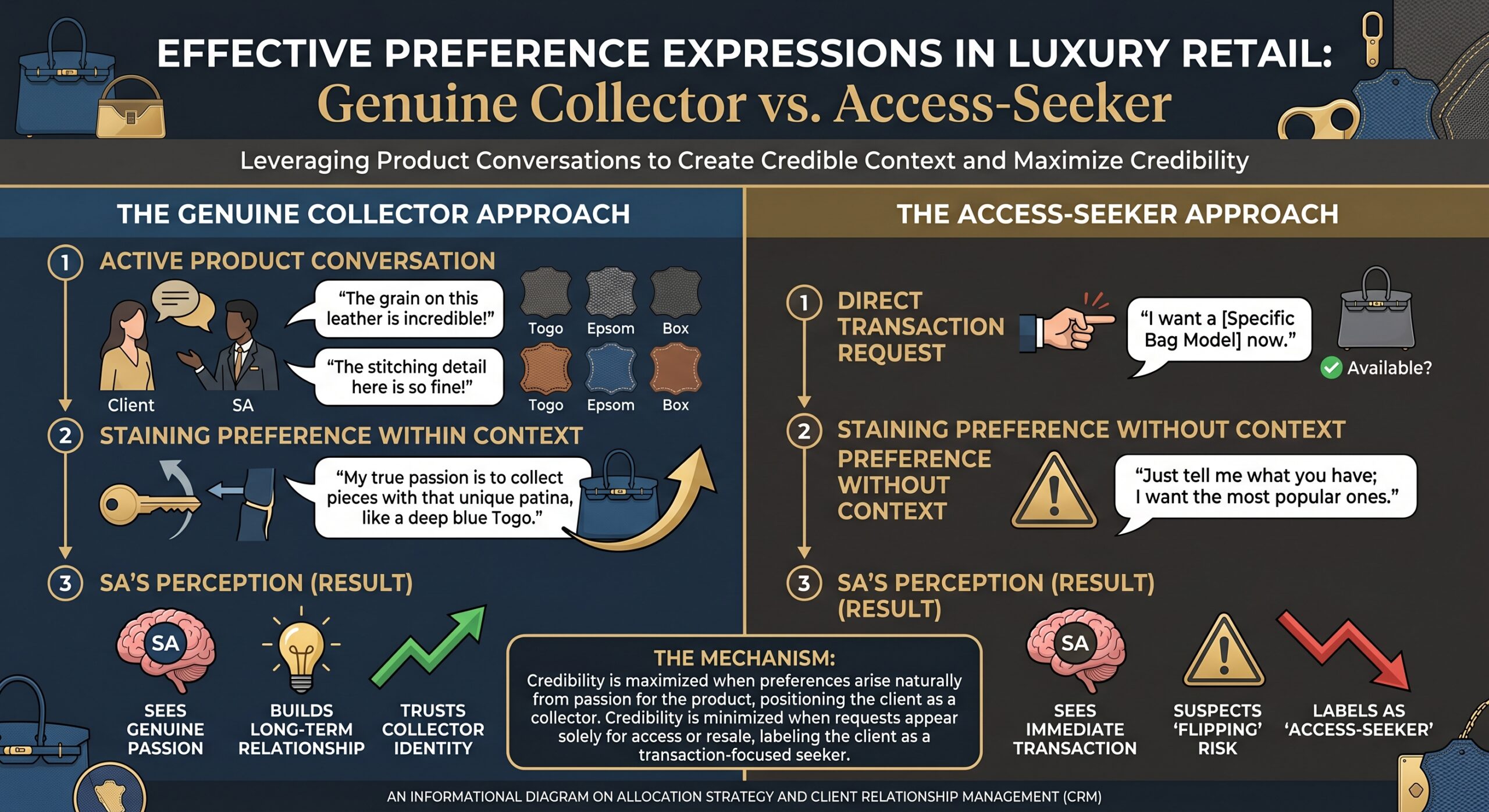
SA Relationship Dynamics: What Helps and What Damages
Beyond the initial preference conversation, the ongoing SA relationship management across the pre-offer period is where most new clients either build or erode their allocation standing. The behaviours that help are largely intuitive; the behaviours that damage are less so — because they often feel justified from the client's perspective while reading very differently from the SA's.
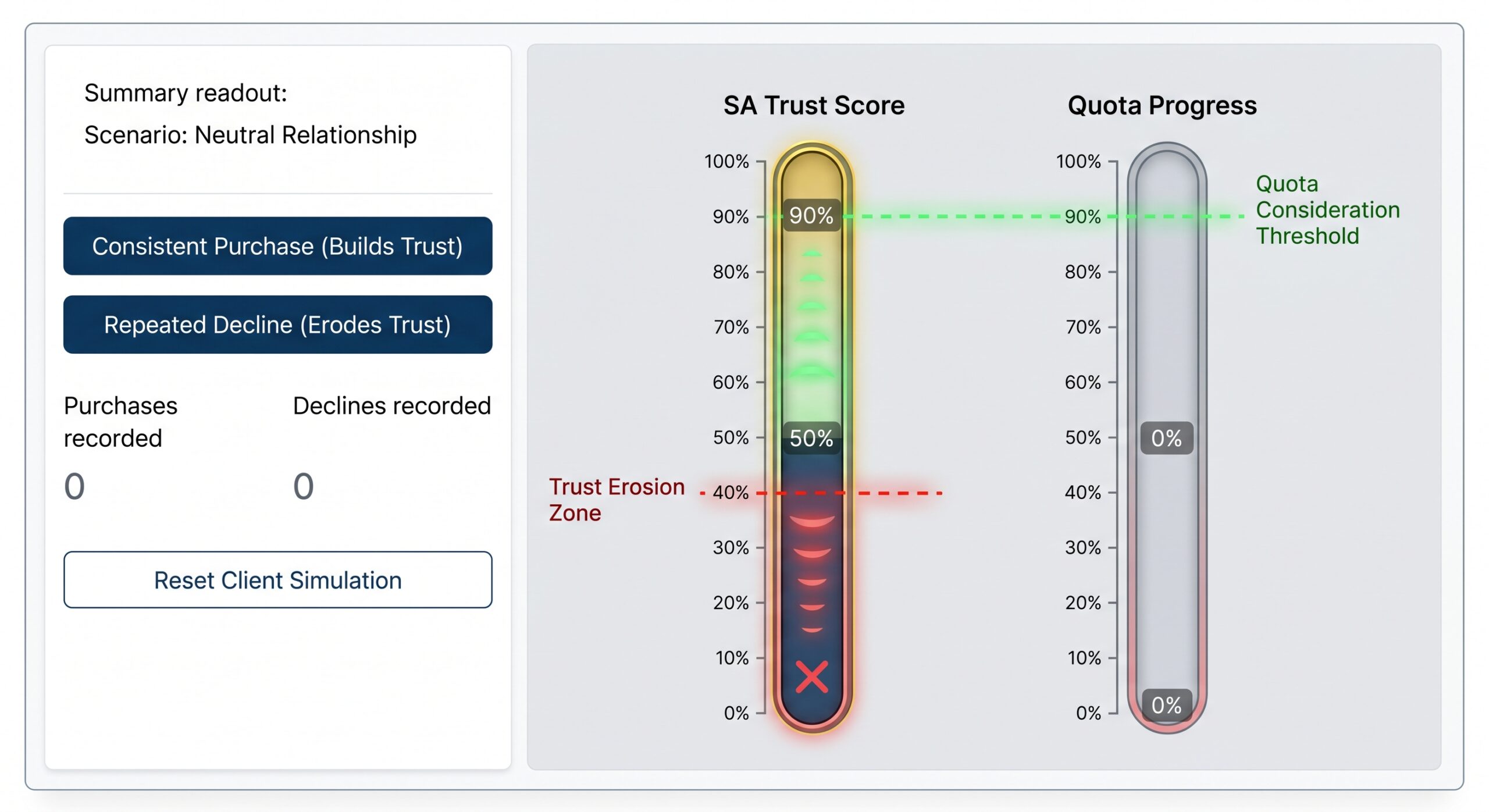
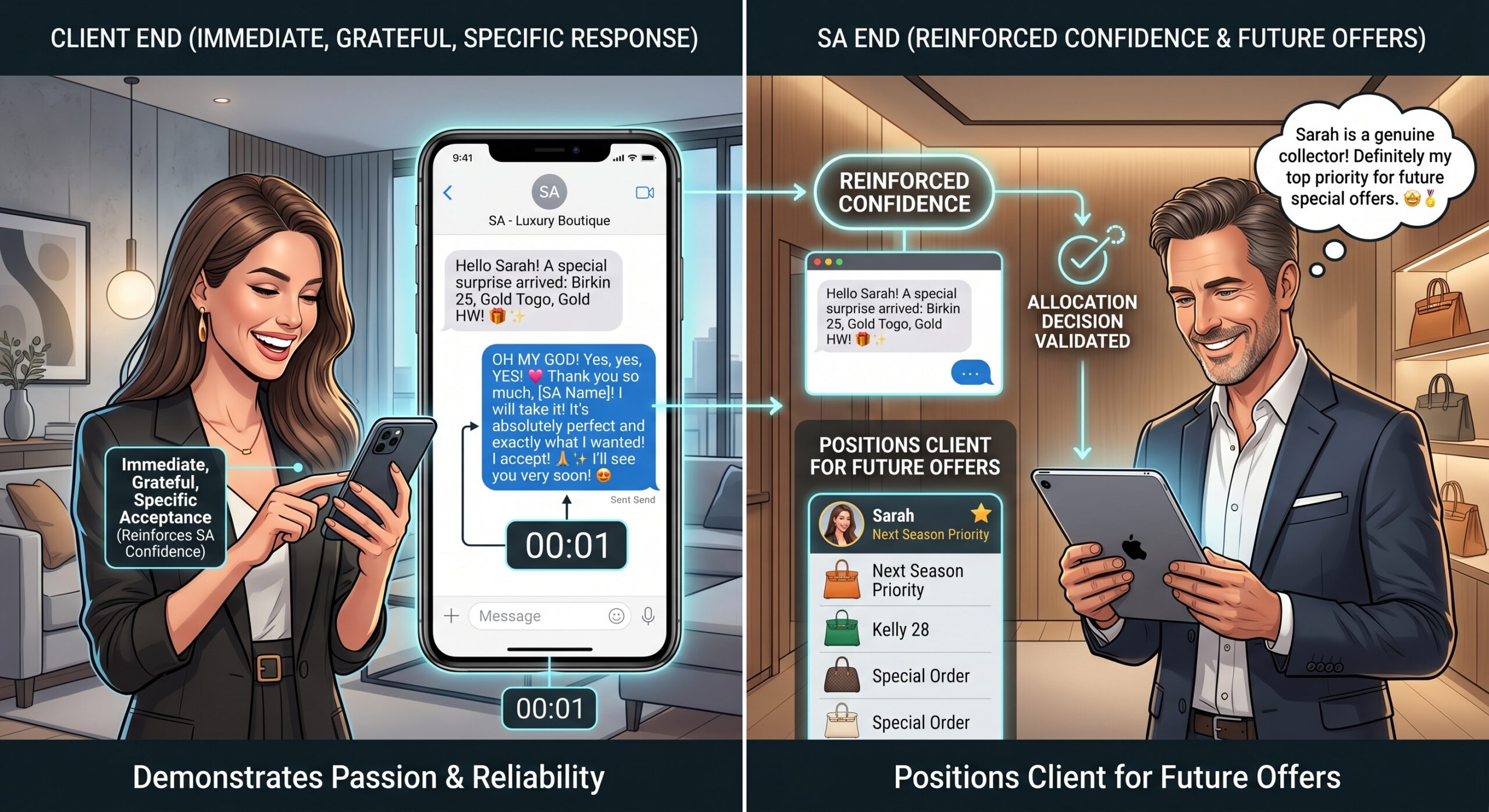
When an SA contacts you — whether about a new product arrival, an invitation to an event, or a follow-up on a previous conversation — respond within 24 hours. Slow responses to SA contact signal that you are not genuinely invested in the relationship. When a quota bag offer eventually comes, the SA expects an immediate response; that expectation is built through your responsiveness history across all prior contact.
Maintain your visit cadence — approximately every four to six weeks — without increasing frequency around anticipated allocation periods or after expressing your preference. A client who suddenly starts visiting weekly after mentioning a Birkin interest reads as pressure-driven. Consistent, unhurried visits read as genuine engagement.
If you ask to see a piece, consider it seriously. If an SA recommends something and holds it for you, either purchase it or decline promptly and respectfully. Clients who regularly browse without purchasing, or who hold pieces and fail to follow through, signal unreliability — which directly affects whether an SA will risk offering a quota bag to them.
If your SA offers a quota bag in a configuration you had not requested — wrong colour, wrong leather, wrong size — the correct response is to take 24 hours to evaluate the secondary market position, then either accept with genuine appreciation or decline respectfully and specifically: "I love that you thought of me — this isn't quite the configuration I'm building toward, but I'd love to be considered for a 30 in Togo when one comes through." Never decline rudely or with visible disappointment.
If your SA leaves the boutique or transfers, introduce yourself to a replacement SA within the first two visits and make a purchase. Reference the previous relationship briefly and positively: "I had a wonderful relationship with [name] here and I'm hoping to continue building my collection with your guidance." Your purchase history transfers; the relationship capital does not — it must be rebuilt deliberately.
The boutique relationship context that informs these dynamics — including how SA incentives and boutique management culture vary by location — is relevant to buyers choosing where to focus their relationship-building. Our guide on best Hermès boutique locations for walk-in Birkins in 2026 covers the location dynamics that affect how quickly SA recognition builds and how competitive the allocation environment is by boutique type.
The wish list conversation interacts directly with the Paris Leather Appointment lottery — the international visitor route to a Paris flagship quota bag. Buyers who are pursuing both the local boutique relationship and the Paris lottery should be aware that a successful Paris purchase, while adding to your global spend history, does not substitute for a local boutique relationship. The two routes are complementary but distinct. Our dedicated guide on Hermès Leather Appointment Paris Lottery tips covers the lottery-specific mechanics in detail.
The 2026 New Client Wish List Action Plan
The complete wish list strategy for a new client entering the Hermès boutique ecosystem in 2026 follows a phased approach — each phase building the relationship capital and expressed preference clarity that combine to produce an allocation offer at the earliest achievable timeline.
- Phase 1 (Visits 1–2): Introduce yourself, make a genuine first purchase, and register your client profile. Do not mention quota bags. Focus entirely on establishing a pleasant, memorable first impression with your SA.
- Phase 2 (Visits 3–5): Continue purchasing across categories. Begin engaging in product conversations about bags, leathers, and collections as a natural extension of your interest. By visit four or five, express your quota bag preference once — clearly, specifically, and with explicit patience language.
- Phase 3 (Months 6–12): Maintain visit cadence. Continue purchasing. Do not reference the preference conversation. Respond promptly to all SA contact. Attend any boutique events your SA invites you to — these are relationship investment opportunities, not social obligations.
- Phase 4 (Month 12+): If no offer has arrived, it is appropriate to gently restate your preference once during a purchase interaction — not as pressure, but as a natural reminder. Do not ask about timelines. Continue the relationship pattern through the offer window.
- When the offer arrives: Respond within 24 hours. Accept or decline specifically and appreciatively. Never negotiate on price. If accepting, complete the transaction promptly and with visible genuine appreciation — this interaction shapes the SA's willingness to offer again.
The spend ratio that underpins each phase of this plan is covered in the full detail of our Hermès quota bag spending ratio strategy for 2026. The wish list strategy and spend ratio strategy work together — the financial history creates the grounds for an offer, and the relational strategy creates the SA advocacy that converts that history into an actual allocation. Neither is sufficient without the other. Together they represent the most reliable path to a quota bag offer available to any new client in 2026.
| Client Behaviour | SA Perception | Allocation Impact | Typical Outcome |
|---|---|---|---|
| Specific preference stated once, patient follow-through, consistent visits | Genuine collector | Strongly positive | Offer within 12–18 months |
| Preference stated, consistent purchases, responsive to SA contact | Reliable client | Positive | Offer within 14–20 months |
| Preference stated, good spend, occasional follow-up questions | Interested but slightly impatient | Neutral–Slightly Negative | Offer delayed vs patient clients |
| Preference stated on visit 1, referenced at every subsequent visit | Transactional access-seeker | Negative | Extended wait or passed over |
| Vague preference ("any Birkin in any colour") | Unclear collector intent | Neutral | Lower allocation priority |
| Pressure tactics, entitlement framing, competitive references | Problematic client | Strongly Negative | Allocation standing damaged |
| Declined non-preferred offer rudely or with disappointment | Unreliable / demanding | Very Negative | Future offers withheld |
| Accepted non-preferred offer graciously, resold discreetly | Trustworthy collector | Strongly Positive | Preferred future allocation |
Timeline estimates are approximate. Individual boutique dynamics, SA relationships, and inventory availability significantly affect outcomes. Client behaviour is the most controllable variable in the allocation timeline.
One Clear Statement, Patient Follow-Through, and Immediate Responsiveness
The Hermès wish list strategy for new clients in 2026 reduces to three principles that, applied together, represent the most reliable path to a quota bag offer available: state your preference once, with full specification and explicit patience; maintain consistent, unhurried visit and purchase patterns without referencing the preference; and respond immediately and gratefully to all SA contact, including the offer itself when it arrives.
The behaviours that damage allocation standing are equally clear: stating preferences on the first visit, repeating them at every subsequent visit, using entitlement framing, referencing wait lists or other boutiques, and declining offers poorly. Each of these signals converts a client from a relationship investment to a management challenge in the SA's mental model — and clients who become management challenges do not advance on the allocation shortlist regardless of their spend history.
The relational dimension of the wish list strategy is the variable most buyers underestimate and the one most within their control. Financial history builds the grounds for an offer; relationship quality produces the SA advocacy that converts that history into an allocation. Both are necessary; the relational dimension is where most new clients have the most room to improve and the most to gain.
Bottom Line: State your quota bag preference once — specifically, patiently, and at the right moment in the relationship — then let the SA hold it without pressure or follow-up until the offer arrives.
Popular Searches
Explore our most searched Hermès wish list and new client acquisition questions
Frequently Asked Questions
The most effective approach is to express a clear, specific, single preference — once — after making at least one purchase at the boutique, and then not repeat it at every subsequent visit. The preferred framing is conversational and forward-looking rather than demanding: something like "I'm building my collection and a Birkin 30 in a neutral leather is something I'd love to add when the time is right" lands very differently than "I want to be put on the list for a Birkin." Specificity matters — stating your preferred style, size, leather, and hardware gives the SA information they can act on. Vague requests are forgotten; specific preferences are remembered. For the full spend ratio context that supports this conversation, see our Hermès quota bag spending ratio strategy for 2026.
No. Hermès does not operate an official wish list, waitlist, or registration system for quota bags. What buyers call a "wish list" is in reality the SA's informal memory of which clients have expressed specific preferences, combined with the boutique manager's knowledge of the client roster. There is no form to fill out, no number to be assigned, and no guaranteed timeline. The allocation decision is entirely at the discretion of the SA and boutique management, informed by the client's purchase history, relationship quality, and expressed preferences. See our guide on best Hermès boutique locations for walk-in Birkins for how boutique location affects the odds of being remembered and offered.
Very specific — but flexible in practice. The ideal preference statement covers style (Birkin or Kelly), size (25 or 30 for Birkin; 25 or 28 for Kelly), leather (Togo or Epsom as first choices), hardware (PHW or GHW), and colour range (neutral or a specific colour if you have strong preferences). Stating "any Birkin in any size and colour" signals you are not a genuine collector with preferences — it signals you are an opportunity-seeker. SAs prefer clients who know what they want because it makes the allocation match easier. However, expressed openness to "something close to this" gives the SA more flexibility to offer a related configuration when inventory is available.
After 12 months of consistent engagement with no offer, it is appropriate to gently restate your preference once — not as pressure, but as a refresher. A natural moment for this is when making a meaningful purchase: "I just wanted to remind you that I'm still very interested in a Birkin 30 in Togo when something becomes available." Do not ask about timelines, express frustration, or reference the wait list. If after 18 months there is still no movement, consider supplementing your primary relationship with visits to a secondary market boutique — as covered in our guide on best Hermès boutique locations for walk-in Birkins in 2026 — where the allocation environment may be more accessible.