Selling Hermès Without the Original Receipt: What Buyers Accept
Platform-by-platform provenance requirements, the exact price impact of missing documentation, and what experienced buyers actually accept versus what they penalise in 2026.
Every major Hermès resale platform — Vestiaire Collective, The Real Real, Fashionphile, and 1stDibs — will authenticate and sell a Hermès quota bag without an original purchase receipt. Authentication at all four platforms is performed on the physical piece: leather composition, hardware stamping, saddle stitch count, date stamp placement, and construction details that counterfeit pieces consistently fail to replicate convincingly. The receipt is not an authentication document. It is a provenance document — and its presence or absence affects buyer confidence and achievable price, not whether the sale can proceed.
The market data on the price impact of missing provenance is nuanced and configuration-dependent. For a standard leather Birkin 30 in Noir Togo with PHW in excellent condition, selling without a receipt costs approximately 5–10% of achievable price in buyer confidence premium. For a Rose Shocking Birkin with HSS documentation or a vintage piece with ambiguous dating, the same absence can cost 15–20% or more — because these are the configurations where the receipt does meaningful verification work that physical authentication alone cannot fully substitute.
This article gives you the complete picture: how authentication differs from provenance, which documents affect price most significantly by platform, and how to maximise your resale outcome when your documentation is incomplete.
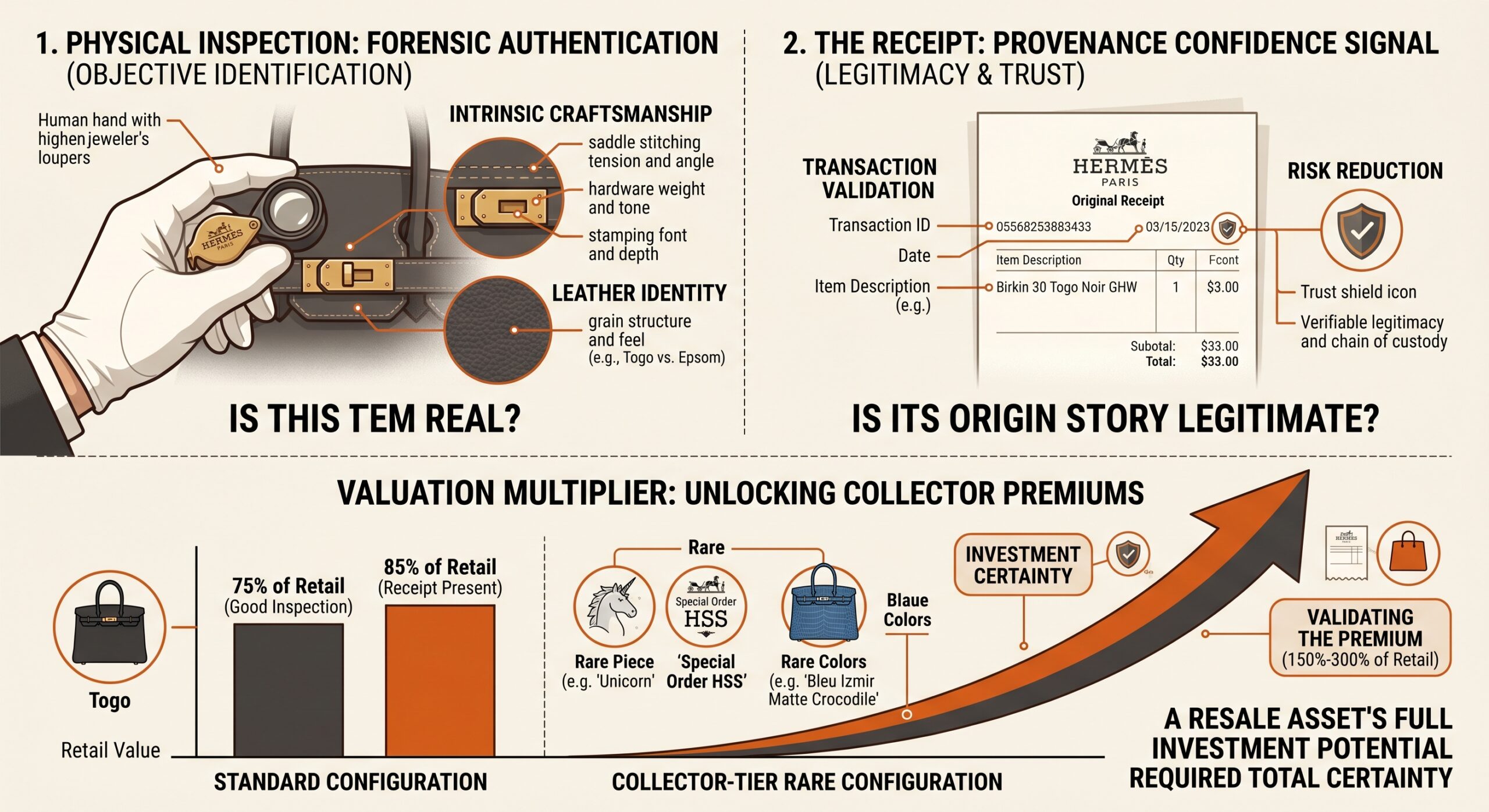
Authentication vs Provenance: The Critical Distinction
The single most important concept for any Hermès seller without a full documentation set is the distinction between authentication and provenance. These two things are frequently conflated — by sellers who fear they cannot sell without a receipt, and by buyers who conflate documentation with authenticity. Understanding the distinction allows sellers to approach the platforms with realistic expectations and buyers to make informed confidence assessments.
Authentication answers the question: is this piece genuinely made by Hermès? The answer comes from physical inspection of the piece — leather texture and composition, hardware stamps and finishes, saddle stitch count and thread quality, date stamp placement and font, interior stamp alignment, and structural construction details. The full authentication methodology behind these physical checks is documented in the Hermès Authentication Hub, and every major resale platform employs trained specialists who assess these markers. A genuine Hermès piece authenticates definitively on physical grounds alone; a receipt does not make a fake genuine, and the absence of a receipt does not make a genuine piece questionable to a trained authenticator.
Provenance answers a different question: can the ownership and purchase history of this piece be independently verified? A receipt answers yes — it establishes the retail transaction, the date of purchase, and typically the configuration purchased. A dustbag, box, and clochette support provenance by indicating that the complete original retail package was received and maintained. These documents do not prove authenticity; they establish a chain of custody that gives buyers additional confidence in the piece's history beyond what physical inspection can verify.
The leather science and construction analysis that underpins physical authentication is more sophisticated than most sellers realise. Hermès leathers have specific grain patterns, weight, and surface characteristics that vary by type and era of production. Hardware stamps have changed format and depth across production periods. Saddle stitch counts are model-specific and consistent within genuine pieces. Date stamp positioning follows known placement conventions that counterfeiters consistently get wrong.
The physical evidence base for authenticating a genuine Hermès piece is extensive and reliable — which is why all four major platforms authenticate without receipt dependency. The technical depth behind these authentication markers — including how leather composition analysis supports or disputes authenticity claims — is covered by the authentication team at Hermès Insights Hub's guide to physical authentication markers, providing useful context for sellers who want to understand what authenticators are actually assessing.
The practical implication is this: if you have a genuine Hermès piece in good condition, you can sell it on all four major platforms regardless of your documentation status. The documentation question is about how much you achieve, not whether you can sell at all.
Which Documents Matter and by How Much
Not all provenance documents affect resale price equally. The impact of each missing item varies by platform, by configuration, and by the type of buyer the listing is targeting. Understanding the hierarchy allows sellers to triage their documentation situation and make strategic decisions about which platform to target and how to price.
The clochette, lock, and key set occupies a unique position in the provenance hierarchy — unlike the receipt and box, which are confidence documents, the clochette and lock are functional components of the bag. Their absence is assessed not just as a provenance gap but as a completeness issue that affects the condition grade assigned by Fashionphile and The Real Real. A Birkin submitted to Fashionphile without its lock and key set will be noted as incomplete in the listing description, which both affects the condition grade and reduces buyer pool to buyers who accept incomplete sets — a smaller and less motivated pool than the full-set market.
"The dustbag and clochette set matter more than the receipt for mainstream platform sales — their absence directly affects condition grade and buyer pool size in ways the receipt alone does not."
The receipt's impact is most significant at the collector-tier platforms (1stDibs, Vestiaire Collective) and for configurations where its verification function is most needed — rare colors, HSS commissions, exotic leathers, and vintage pieces where dating matters. For a standard Birkin 30 in Noir Togo at Fashionphile, the receipt absence costs approximately 5–8% of achievable price. For a Rose Shocking Birkin 25 on 1stDibs, the same absence could cost 15% or more, because collector buyers at that tier are using the receipt to verify both the retail purchase and the colour specification.
- Prioritise locating the clochette, lock, and key set before listing anywhere — their absence affects condition grade independently of provenance, with a price impact that exceeds the receipt's absence for most standard configurations.
- The dustbag is the single most expected item in any Hermès secondary market sale — its absence signals incomplete care to buyers across all platforms and buyer tiers.
- If you have the receipt but have lost the dustbag, the receipt adds less value than replacing the dustbag would — platform-appropriate replacement dustbags are available and their absence is more universally noted.
- For HSS, rare color, and exotic pieces: the receipt is disproportionately important — make every effort to locate it before listing, including checking email records for any digital communication from the boutique at time of purchase.
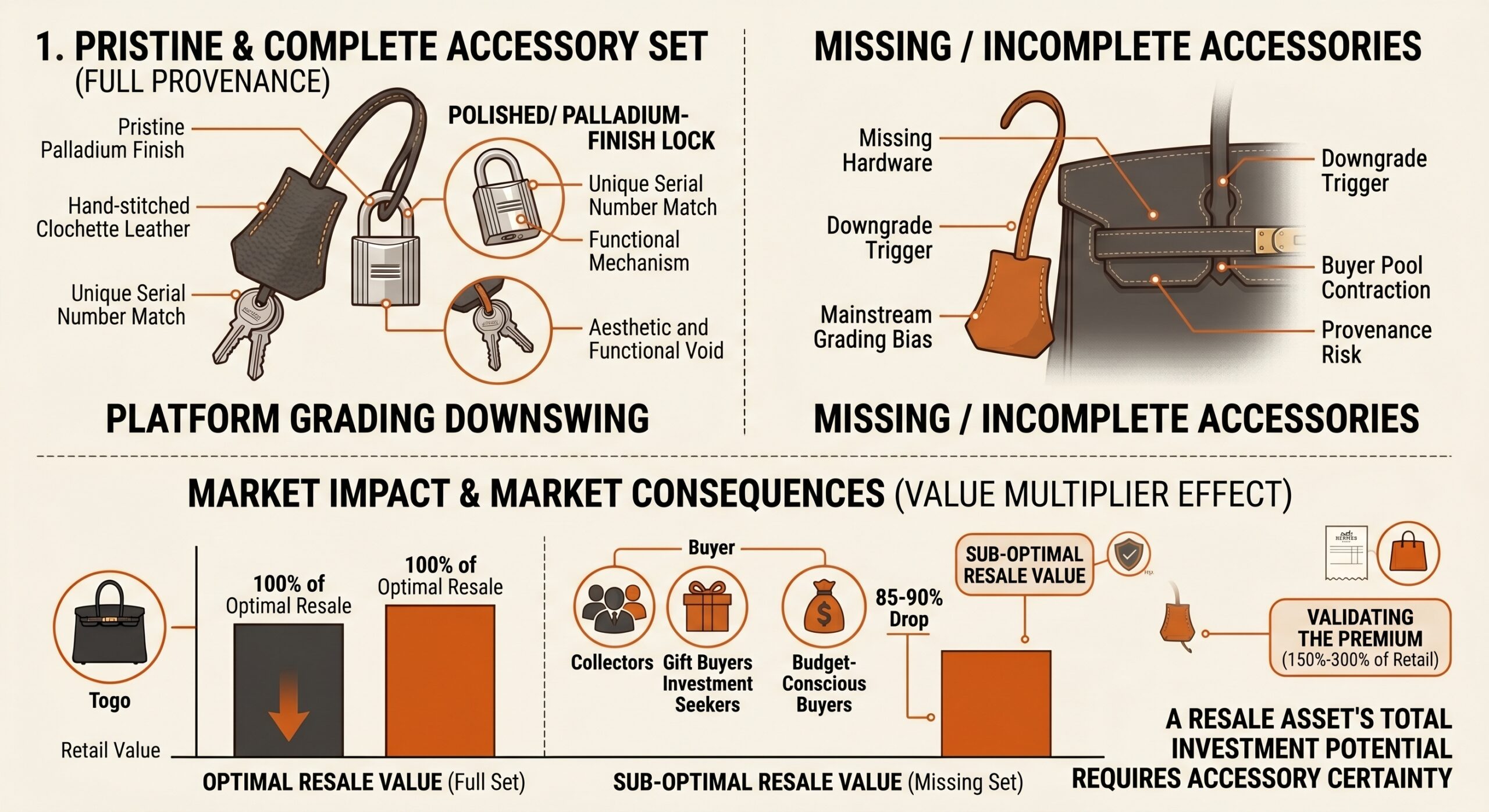
Platform-by-Platform: Acceptance and Price Impact
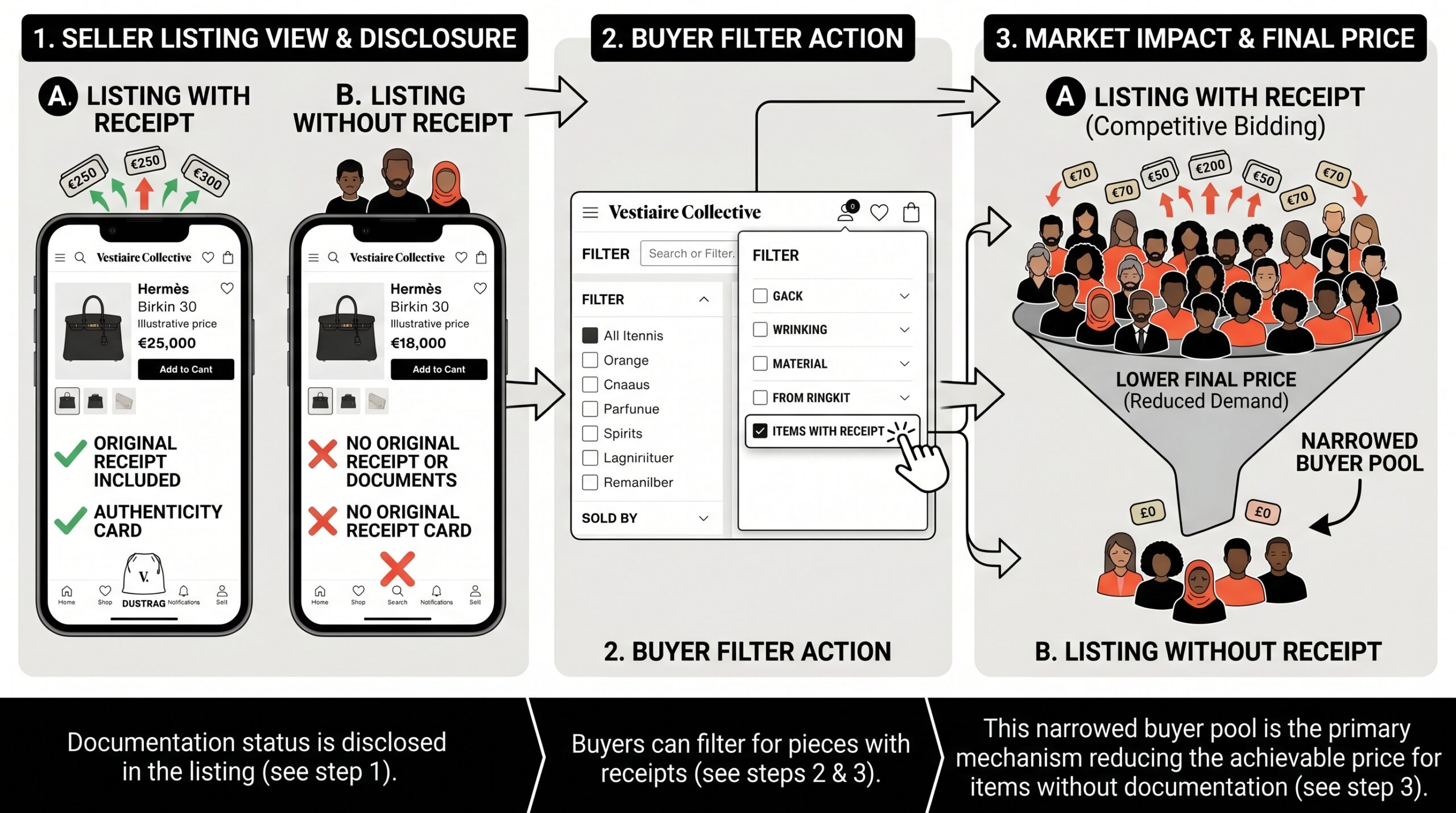
Each of the four major resale platforms handles missing documentation differently — reflecting their distinct buyer pools, authentication models, and pricing philosophies. Matching your specific documentation situation to the right platform is the most actionable step a seller without full provenance can take.
The practical platform selection logic for sellers without a full documentation set is straightforward. For standard leather Birkins and Kellys in good to excellent condition without receipts: Fashionphile is the most efficient exit — fast consignment, physical authentication standard, and minimal pricing penalty for absent documentation. For rare color pieces or pieces with partial documentation (receipt present but box missing, or dustbag present but receipt missing): Vestiaire Collective offers the broadest international collector reach with seller-set pricing that can absorb the documentation gap more flexibly. For pieces where the receipt is present but other documentation is missing: 1stDibs may still be viable — the receipt is the document that collector buyers value most, and its presence can compensate for the absence of box and dustbag in the listing narrative.
The broader context of how condition grade and provenance interact at the secondary market level — and how Birkin versus Kelly documentation requirements differ in practice — is covered in our companion analysis of Birkin vs Kelly value retention over five years, which includes provenance's role in long-term secondary market positioning. For sellers navigating the broader resale market environment in 2026, our Hermès reseller market price drop analysis provides the current market context that informs realistic pricing expectations.
Maximising Your Sale Without Full Documentation
Sellers without a full provenance set have several concrete actions available to maximise the achievable price before listing and during the listing process itself. The goal is to minimise the buyer confidence gap that missing documentation creates — not by misrepresenting the provenance, but by providing the maximum legitimate information available and selecting the platform and approach that minimises the documentation penalty.
Before listing, conduct a thorough documentation search. Original receipts are sometimes digitally archived in email records from boutique SA correspondence at the time of purchase. Hermès boutiques in some markets can provide a purchase confirmation letter for verified clients — contact your originating boutique directly, with your client profile details, and enquire about their documentation re-issue policy. This varies significantly by boutique and market, but is worth pursuing for high-value pieces before accepting a documentation discount at resale.
- Search email archives thoroughly before listing — boutique SA correspondence at time of purchase often includes purchase confirmation, leather specification, or payment confirmation that can serve as supporting provenance documentation even without the physical receipt.
- Contact your originating Hermès boutique with your client profile details — some boutiques will provide a purchase confirmation letter for registered clients, which carries meaningful weight with Vestiaire Collective and 1stDibs buyers even if not equivalent to the original receipt.
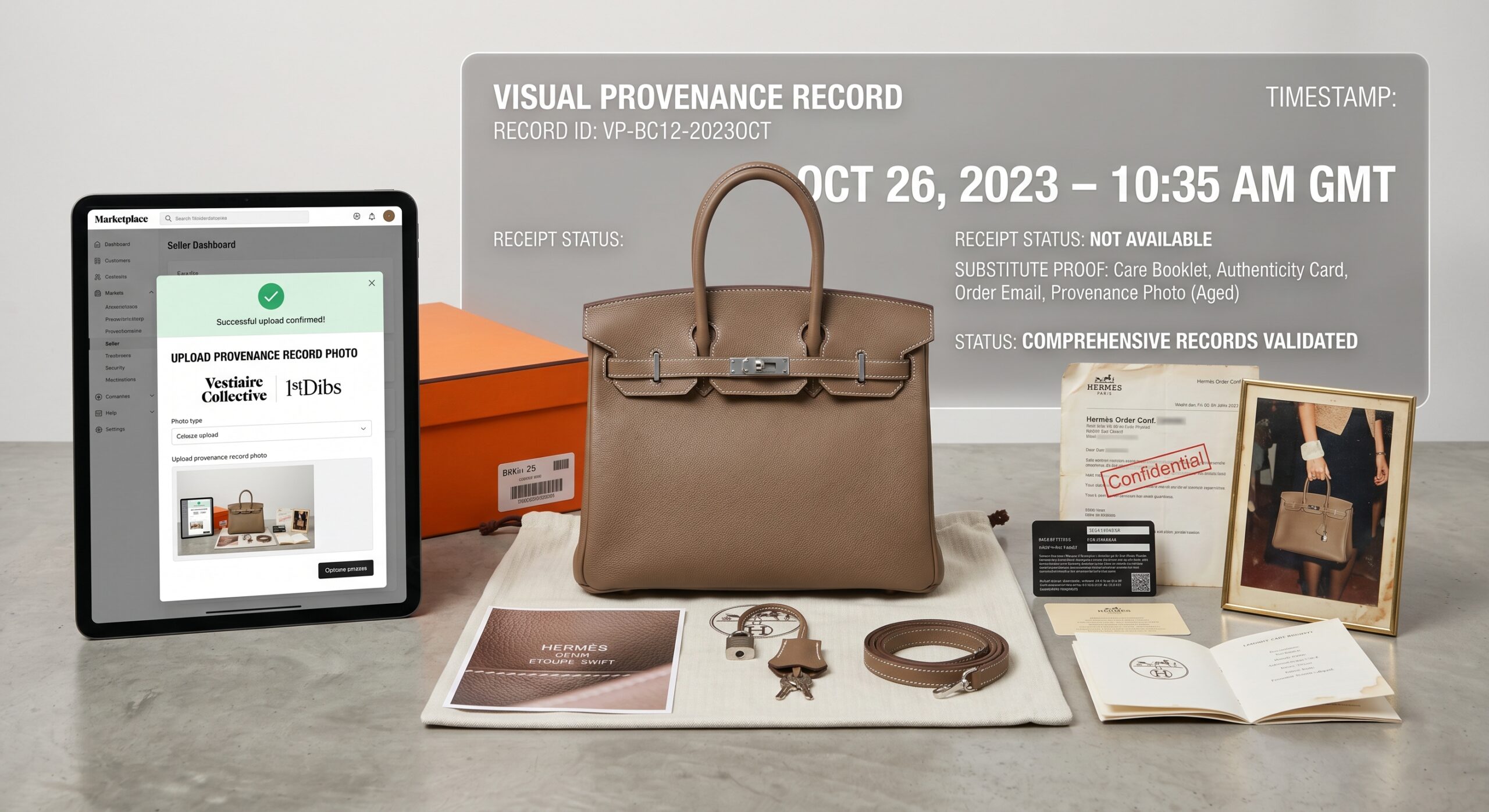
- Photograph all available documentation together with the bag, dustbag, and hardware set before listing — a comprehensive photographic provenance record created at listing time creates a timestamped visual history that supports buyer confidence independently of paper documentation.
- Disclose documentation status accurately and completely in listing descriptions — buyers who discover undisclosed missing items after purchase create returns, disputes, and platform penalties that cost more than honest upfront disclosure.
- For pieces missing the clochette/lock/key set: price the adjustment into your ask price explicitly rather than hoping buyers will not notice — experienced buyers on all platforms check this immediately and a disclosed price adjustment is more credible than a negotiation post-enquiry.
- For standard pieces without receipts targeting Fashionphile: emphasise condition in your description and photography — condition grade carries more weight than documentation at this platform, and excellent condition with honest documentation disclosure is a strong listing position.
The investment in documentation management begins at the point of purchase, not at the point of sale. The glossary of Hermès market and investment terms — including the specific meanings of provenance terms across platforms — is covered in our Hermès Market & Investment Glossary, which provides the full reference framework for buyers and sellers navigating the secondary market. For context on how the all-topics community of Hermès buyers approaches documentation and authentication, the All Topics archive provides additional market intelligence across the full range of buyer decisions.
| Configuration / Situation | Receipt Impact | Best Platform (No Receipt) | Approx. Price Penalty |
|---|---|---|---|
| Standard Birkin 30 — Togo/Epsom — Grade A — No receipt | Moderate | Fashionphile | −5–8% vs documented |
| Standard Kelly 28 — any leather — Grade A — No receipt | Moderate | Fashionphile · TRR | −5–8% vs documented |
| Rare color Birkin (Rose Shocking, Bleu Electrique) — No receipt | High | Vestiaire Collective | −12–18% vs documented |
| HSS special order — No commission receipt | Very High | Vestiaire (seller desc only) | −15–25% vs documented HSS |
| Exotic leather — No receipt | High | Vestiaire · Fashionphile | −12–20% vs documented |
| Standard piece — No dustbag | Moderate (grade) | Fashionphile · TRR | −3–8% vs complete set |
| Standard piece — Missing clochette/lock/key | High (completeness) | Fashionphile (noted) | −8–15% vs complete hardware |
| Full provenance — Receipt, box, dustbag, hardware | Maximum confidence | 1stDibs · Vestiaire | Reference price (no penalty) |
Price penalty figures are approximate and reflect observed secondary market ranges. Actual outcomes depend on specific platform, buyer pool at time of listing, configuration, and condition grade. All figures based on observed market patterns.
You Can Sell Without a Receipt — But Know the Cost by Configuration
The Hermès secondary market is fully navigable without an original receipt. All four major platforms authenticate from the physical piece and will list, authenticate, and sell genuine Hermès quota bags regardless of documentation status. The receipt is not an authentication requirement — it is a buyer confidence premium, and its absence costs approximately 5–12% for standard configurations and significantly more for rare, exotic, and HSS pieces where its verification function is most valuable.
The clochette, lock, and key set matters more than the receipt for mainstream platform sales. Its absence affects condition grade — not just buyer confidence — and the price impact at Fashionphile and The Real Real is often larger than the receipt's absence for standard configurations. Prioritise locating missing hardware accessories before listing; they are the most consequential missing items for grade-based platform pricing.
Platform selection is the most actionable lever for sellers without full documentation. Fashionphile for standard pieces in good condition without receipt — fastest, most documentation-forgiving. Vestiaire Collective for rare or collector-tier pieces with partial documentation — broadest international reach, seller-set pricing flexibility. Avoid 1stDibs as a primary platform for no-receipt pieces; its collector buyer pool is the most documentation-sensitive of any major market.
Bottom Line: A genuine Hermès bag sells without a receipt on every major platform — the question is how much the missing documentation costs, which varies from 5% for standard pieces to 20%+ for rare configurations, and which platform minimises that cost for your specific situation.
Popular Searches
Explore our most searched Hermès authentication and provenance questions
Frequently Asked Questions
Yes — all four major resale platforms (Vestiaire Collective, The Real Real, Fashionphile, and 1stDibs) will accept and authenticate Hermès bags without an original purchase receipt. Authentication is performed on the physical piece itself — leather, hardware, stitching, date stamps, and construction details — not on documentation. However, the absence of a receipt typically reduces the achievable resale price by approximately 5–12% on most platforms, as buyers use documentation to calibrate buyer confidence. On 1stDibs and Vestiaire Collective, full provenance including receipt can add a meaningful premium for rare configurations. See our analysis of Birkin vs Kelly value retention over five years for how provenance affects long-term value retention across the two major quota bag styles.
In order of impact on achievable resale price: (1) original dustbag — most buyers expect this and its absence signals incomplete set; (2) clochette, lock, and keys — absence noted by platforms and affects condition grade assessment; (3) original receipt — adds 5–12% in buyer confidence premium, critical for HSS and rare configurations; (4) original box — significant for 1stDibs and collector-tier Vestiaire buyers; (5) authenticity card / care booklet — low independent value but completes the provenance set. The dustbag and original hardware accessories are the most impactful missing items for mainstream platform sales; the receipt matters most for collector-tier and HSS pieces.
Yes — both Fashionphile and The Real Real authenticate Hermès bags based entirely on physical inspection of the piece itself, not on documentation. Their authentication teams are trained to assess leather, hardware, stitching, date stamps, and construction details against known authentic examples. A receipt is neither required nor does its absence prevent authentication or listing. The price offered by Fashionphile for consignment may be slightly lower without documentation, as their pricing models factor in buyer confidence signals — but the difference is typically modest for standard configurations in good condition.
Yes — significantly. For standard leather Birkins and Kellys in neutral colors, the absence of a receipt costs approximately 5–10% of achievable price in buyer confidence premium — meaningful but not decisive. For rare color configurations, HSS special orders, exotic leathers, and vintage pieces, the receipt's absence costs proportionally more — sometimes 12–20% — because these are the configurations where buyers most want independent verification of origin and authenticity. A Rose Shocking Birkin with receipt on 1stDibs commands a materially stronger price than the same bag without one. See our Hermès Market & Investment Glossary for the full terminology reference on provenance and authentication terms.