Hermès Fine Jewelry vs Bag Investment Return: Which Wins?
A direct secondary market comparison of price-to-resale ratio, liquidity, and long-term appreciation — with the definitive answer on where Hermès investment capital belongs in 2026.
Hermès fine jewelry serves two entirely different investment functions — and confusing them is one of the most expensive mistakes a serious Hermès buyer can make. On the secondary market, a Birkin 30 in Togo with palladium hardware in excellent condition trades at approximately 120–140% of its retail price. A Chaîne d'Ancre bracelet in yellow gold in the same condition trades at approximately 60–80% of retail. The jewelry achieves less than retail; the quota bag achieves well above it. That price delta is the entire investment case, stated plainly.
Where fine jewelry does outperform quota bags is in spend ratio efficiency — and this is where the confusion arises. A €6,000 jewellery purchase builds boutique relationship capital faster and more signally than six €1,000 scarf purchases, making it the most efficient single spend ratio tool in the Hermès range. But spend ratio efficiency and investment return are different metrics, and buyers who purchase Hermès jewelry believing they are making an investment equivalent to a quota bag allocation are making a category error that becomes visible the moment they attempt to sell.
This article settles the comparison with secondary market data: which Hermès asset class delivers stronger price-to-resale ratios, which offers better liquidity, and how to structure a Hermès portfolio strategy that uses both asset classes correctly.
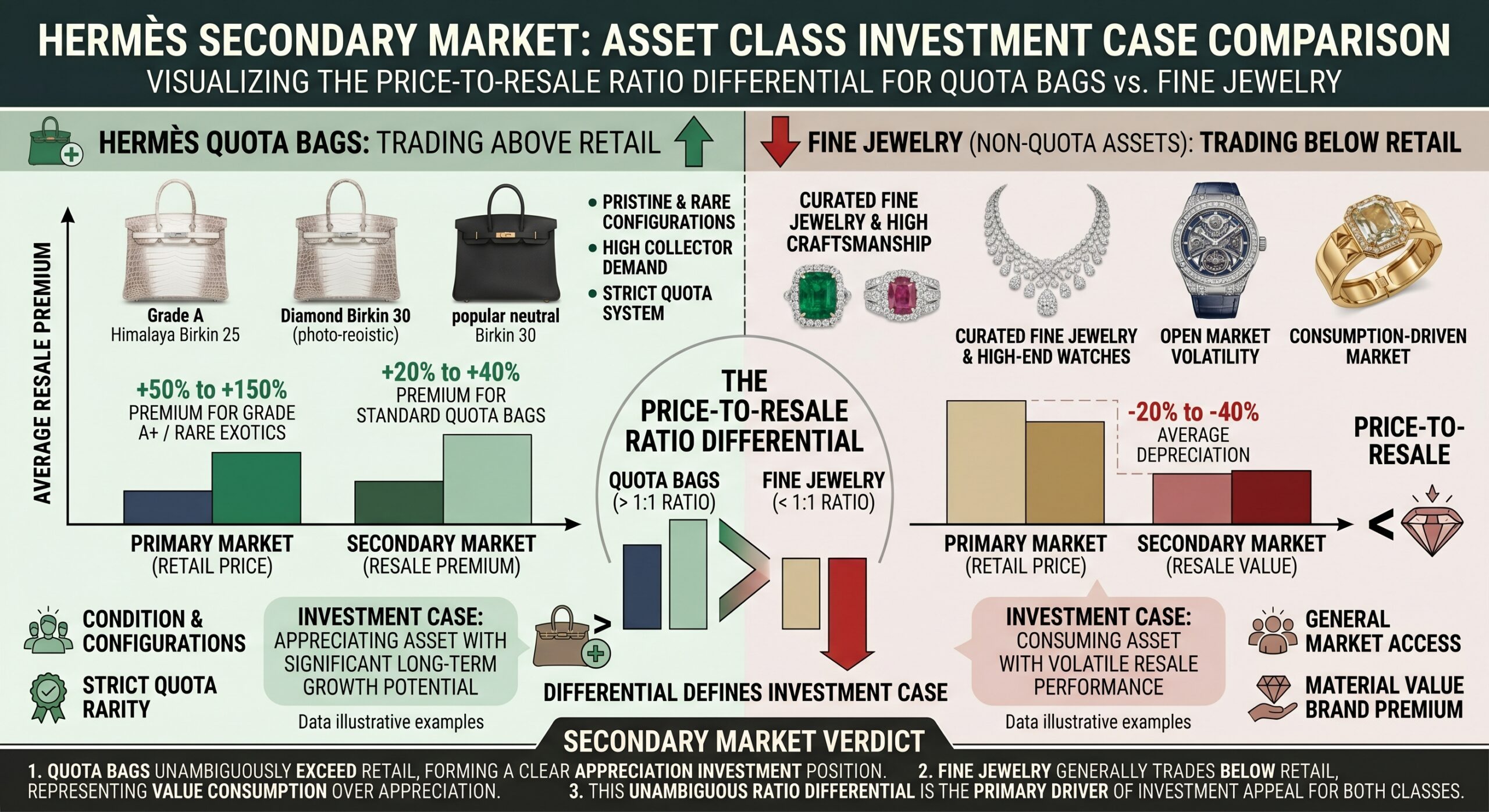
The Investment Framework: Why This Comparison Matters
Every serious Hermès buyer faces the same capital allocation question at multiple points in their boutique relationship: when a significant purchase is needed to build spend ratio, which category serves both the relationship goal and the investment objective most efficiently? The full investment framework is detailed in the Hermès Investment Guide, but the jewelry versus quota bag comparison requires a specific analytical lens — one that separates the spend ratio function from the investment return function and evaluates each asset class against both metrics.
The spend ratio function is about relationship building: which purchases signal genuine, high-value client engagement to an SA and boutique manager, accelerating the timeline to a quota bag offer. Fine jewelry performs exceptionally well here — a single jewellery purchase demonstrates category breadth, high per-item spend, and engagement with a product range that most transactional buyers never approach.
The investment return function is about secondary market performance: which purchases can be resold above retail, how quickly, and with what liquidity characteristics. Quota bags perform decisively better here — and fine jewelry, with the narrow exception of a few iconic pieces, performs poorly.
The confusion between spend ratio function and investment function is most acute for buyers who have read that Hermès jewelry "holds its value" — a claim that is true relative to fashion jewelry but misleading relative to quota bags. A Collier de Chien that retains 80% of retail value does hold its value well compared to a standard fashion brand's jewelry. It does not hold its value well compared to a Birkin that retains 130% of retail value.
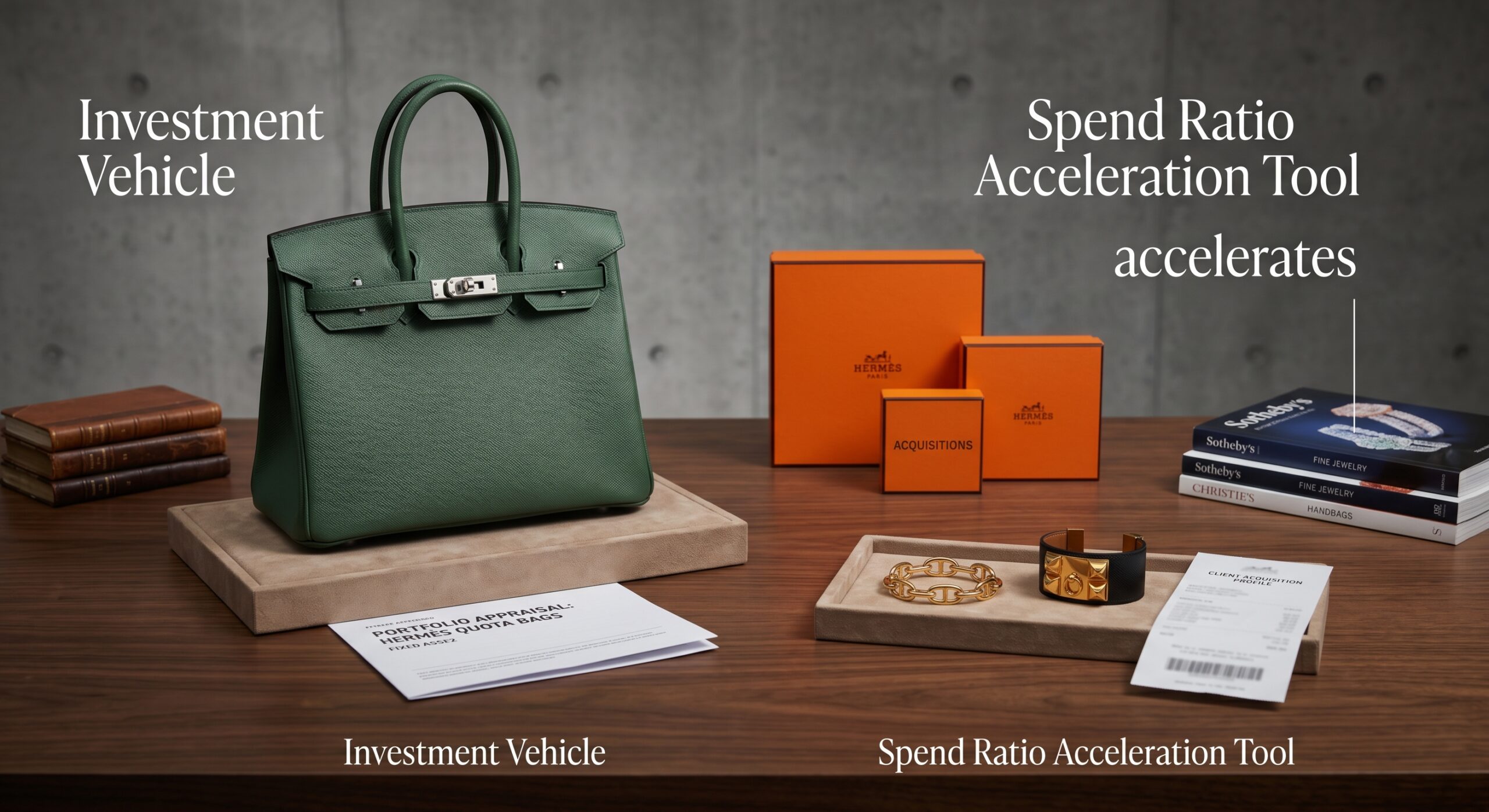
The correct framework is: use jewelry as a spend ratio acceleration tool, understanding that you are accepting a 10–40% below-retail resale position in exchange for boutique relationship capital. Use quota bags as the investment vehicle, understanding that you are accepting the access challenge of boutique relationship building in exchange for an above-retail resale position. Each plays its role; neither substitutes for the other.
The materials and craftsmanship context that informs Hermès jewelry pricing — including why certain pieces hold secondary market value better than others due to precious metal content and construction method — is covered by the craftsmanship team at Hermès Insights Hub's analysis of Hermès jewelry materials and craftsmanship, providing the technical foundation beneath the investment data in this article.
Quota Bags: The Investment Case in Full
The quota bag investment case rests on three compounding mechanisms that no other Hermès product category replicates: above-retail secondary market pricing driven by supply constraint, passive return from ongoing retail price increases, and condition grade as an actively manageable value variable. Together these produce the strongest risk-adjusted investment return profile available within the Hermès product range.
The quota bag's above-retail secondary market position is the defining investment characteristic. On Vestiaire Collective and Fashionphile, a Birkin 30 in Togo with PHW in Grade A condition consistently achieves 120–140% of current retail. The Kelly 25 Sellier achieves comparable or higher premiums in the same condition. These premiums have persisted through market corrections, retail price increases, and broader luxury resale market fluctuations — they are structural features of supply-constrained allocation, not cyclical price phenomena.
"The quota bag is the only Hermès product that consistently trades above its retail price across all major secondary market platforms — a structural advantage no other category in the range replicates."
The passive retail price increase benefit compounds the investment case. As documented in our Hermès price increase history analysis, annual retail price increases of approximately 7–12% raise the floor price for existing holders each year without any active decision required. A holder who maintains Grade A condition through three annual price increase cycles benefits from both the ongoing premium above retail and the rising retail reference point — a dual compounding mechanism that no other luxury asset class within Hermès replicates.
- Grade A or Pristine condition is the investment-grade threshold for quota bags — below this level, condition discounts begin to erode the above-retail premium that defines the investment case.
- The Birkin 25 and 30 in Togo or Epsom with PHW are the highest-liquidity investment configurations — fastest sell-through, broadest buyer pool, and most consistent premium across platforms.
- Rare color quota bags in excellent condition represent the strongest risk-adjusted position — their premium is higher than standard neutrals, and their correction resilience (demonstrated in 2024–2026) is superior.
- Do not conflate investment return with spend ratio efficiency — quota bags are the investment vehicle; other categories including jewelry are the relationship-building mechanism.
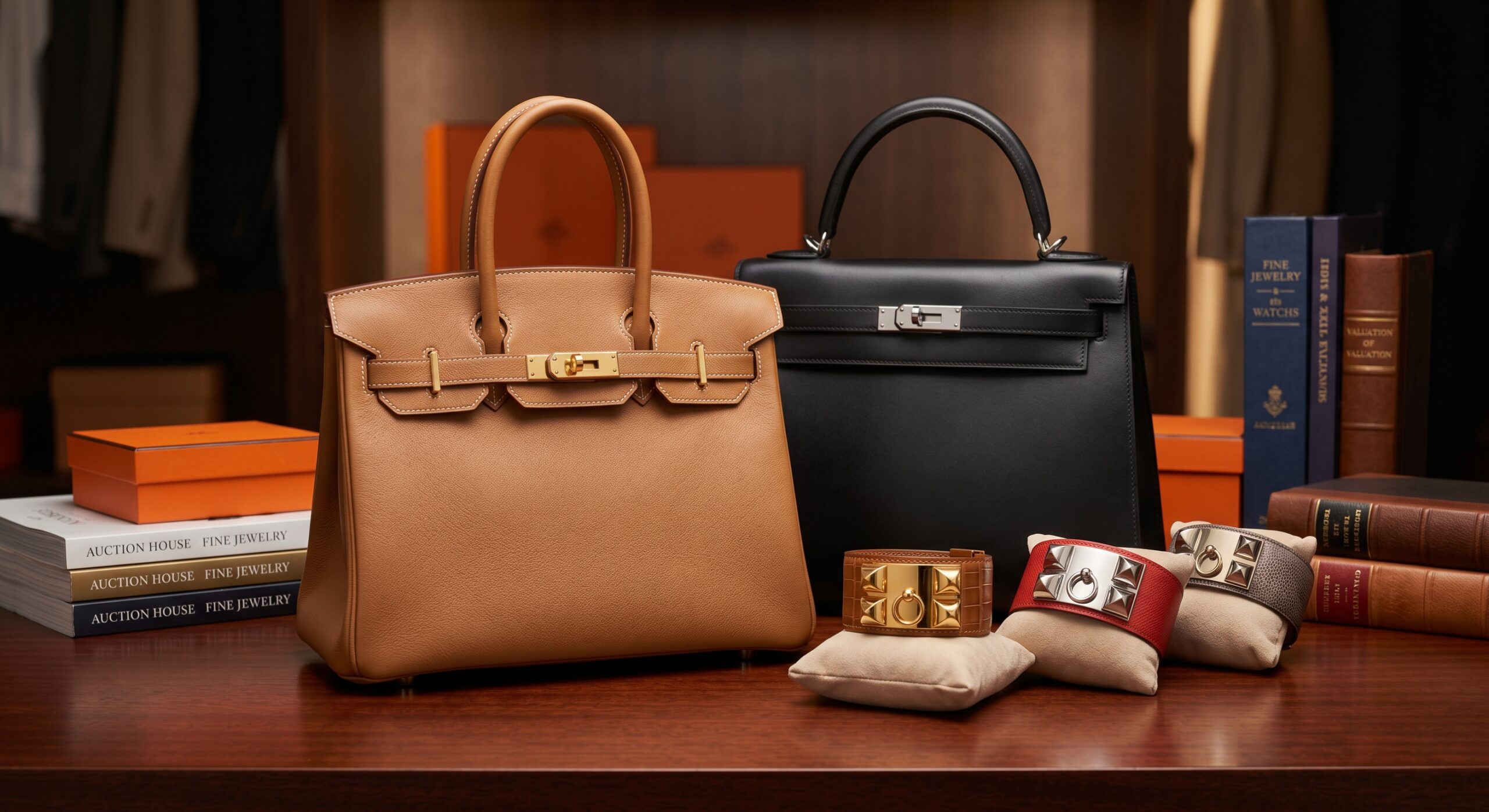
Fine Jewelry: Where the Secondary Market Actually Sits
The Hermès fine jewelry range covers a broad spectrum — from entry-level fashion jewelry and enamel pieces through to precious metal and diamond fine jewelry. The secondary market performance across this range is highly variable, with the best pieces achieving significantly stronger resale positions than the weakest. Understanding this spectrum is essential for buyers who need to make jewelry purchases for spend ratio purposes and want to minimise the investment loss embedded in those purchases.
The Collier de Chien occupies its own tier within the jewelry range — it is the only piece that consistently achieves close to retail on resale platforms, driven by its iconic status, its leather and hardware construction (which aligns it aesthetically with the quota bag world), and a dedicated collector community on Vestiaire Collective and 1stDibs. In excellent condition with original box and hardware, a Collier de Chien in leather and palladium achieves approximately 70–90% of retail — a strong result for jewelry, but still structurally below the above-retail position of any standard quota bag.
For buyers who need to make jewelry purchases for spend ratio purposes and want to minimise the resale loss embedded in those purchases, the hierarchy is clear: Collier de Chien first, Chaîne d'Ancre in yellow gold second, limited edition enamel cuffs third. These three categories deliver the best spend ratio signal per dollar while minimising the resale loss relative to other jewelry categories.
Purchase jewelry with full original packaging — box, dustbag, authenticity card — and maintain it in unworn or lightly worn condition. The condition premium for jewelry at resale, while less dramatic than for quota bags, is still meaningful: a Collier de Chien in pristine unworn condition with full box achieves approximately 10–15% more than the same piece in good worn condition on Vestiaire and 1stDibs. Treat jewelry purchases as spend ratio tools with a known resale value, not as a separate investment category.
The platform dynamic for jewelry resale is narrower than for quota bags. The Real Real handles significant volume of Hermès jewelry but typically achieves the lowest prices — its broad buyer base includes non-specialist buyers who do not place collector premiums on specific Hermès jewelry pieces. Vestiaire Collective performs better for mid-to-upper tier pieces (Collier de Chien, gold Chaîne d'Ancre). 1stDibs is the strongest platform for vintage, limited edition, and collector-tier jewelry pieces. Fashionphile has limited jewelry category depth compared to its quota bag expertise.
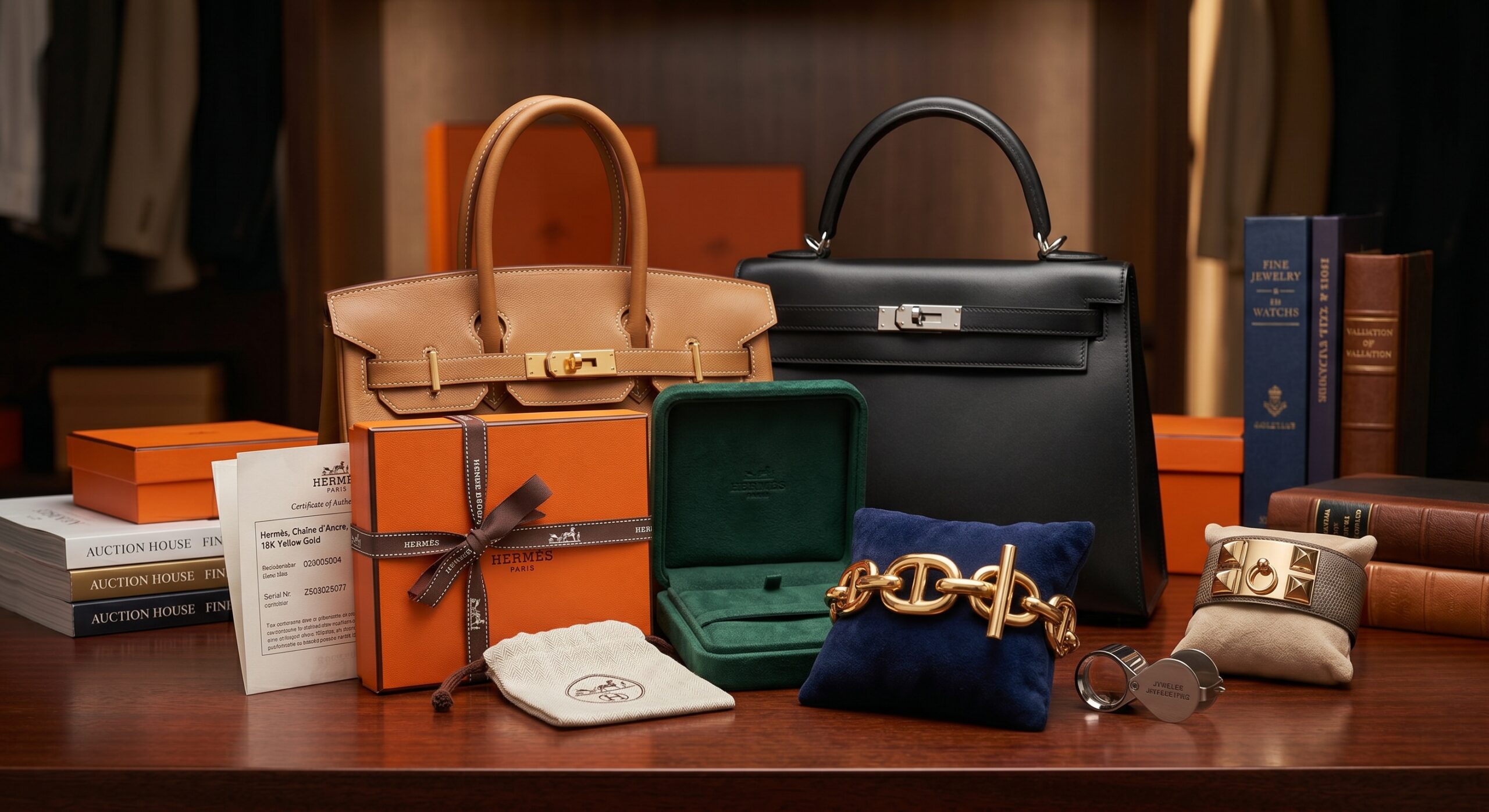
The investment loss embedded in jewelry purchases is best understood as the cost of boutique relationship building. A buyer who spends €8,000 on a Collier de Chien to build spend ratio, and recovers €6,400 (80% of retail) when selling it twelve months later, has effectively paid €1,600 to accelerate their boutique relationship timeline by several months. If that acceleration produces a quota bag offer that would otherwise have taken an additional six months — representing an opportunity cost of holding the Birkin's appreciation through those months — the jewelry purchase may have been economically rational even at a resale loss. The key is making the calculation explicit rather than assuming the jewelry purchase is cost-neutral.
Portfolio Strategy: How to Use Both Asset Classes
The optimal Hermès portfolio strategy in 2026 uses both asset classes for their respective strengths — jewelry as a spend ratio acceleration tool with a known resale loss budget, and quota bags as the primary investment vehicle with above-retail secondary market positioning. Confusing the roles of either asset class produces suboptimal outcomes in both directions.
For buyers in the early and mid-stages of boutique relationship building, the jewelry allocation question is about spend ratio efficiency balanced against resale loss tolerance. The calculation is straightforward: identify the jewelry pieces that offer the best spend ratio signal per dollar of resale loss, purchase accordingly, and maintain full provenance to maximise the resale recovery when the piece is eventually sold. Do not retain jewelry indefinitely in the hope of appreciation — it will not outperform quota bags on a return basis regardless of holding period.
- Allocate jewelry purchases to the Collier de Chien and yellow gold Chaîne d'Ancre tiers for the best combination of spend ratio signal and resale recovery — these two categories minimise the investment loss per dollar of relationship capital gained.
- Maintain full original packaging for all jewelry purchases from day one — box, dustbag, authenticity card — to maximise the eventual resale recovery on 1stDibs or Vestiaire Collective.
- Budget explicitly for the resale loss embedded in jewelry purchases — treat it as the cost of boutique relationship building, not as an investment that will recover at par.
- Once your boutique relationship has produced its first quota bag offer, redirect capital from jewelry to quota bag allocation — the spend ratio function of jewelry diminishes once the SA relationship is established, and the investment case for quota bags is always stronger.
- Consider the vintage quota bag market as an alternative to jewelry for buyers who cannot yet access boutique allocation — a vintage Birkin in excellent condition purchased at post-correction secondary market prices still outperforms any jewelry category on price-to-resale ratio.
For buyers evaluating their Hermès portfolio against alternative asset classes, our analysis of buying vintage Hermès Box Kelly vs new — full investment comparison provides a useful additional data point: the vintage quota bag market's relationship to new retail and secondary market pricing reveals further context on where investment capital within the Hermès ecosystem produces the strongest risk-adjusted returns. The full secondary market framework is available through the Market & Resale category archive.
| Asset / Category | Secondary Market Position | Liquidity | Spend Ratio Value | Investment Role |
|---|---|---|---|---|
| Birkin 25/30 — Grade A — PHW | 120–145% of retail | Very High | Not a ratio tool | Primary investment |
| Kelly 25 Sellier — Grade A | 115–140% of retail | High | Not a ratio tool | Primary investment |
| Collier de Chien — Excellent condition | 70–90% of retail | Moderate | Very High | Ratio tool (best jewelry) |
| Chaîne d'Ancre — Yellow Gold — Excellent | 60–80% of retail | Moderate | High | Ratio tool (strong) |
| Limited Edition Enamel Cuff | 55–75% of retail | Moderate (collector) | Moderate–High | Ratio tool (selective) |
| Fine Diamond Jewelry | 40–65% of retail | Low | Very High (per $) | Ratio tool (high loss) |
| Silver Jewelry | 30–50% of retail | Low | Moderate | Weak ratio / no investment |
| Standard Enamel / Fashion Jewelry | 25–45% of retail | Very Low | Low | Not recommended |
Secondary market position figures are approximate and reflect observed resale ranges for pieces in excellent condition with full provenance. Actual outcomes vary by specific piece, condition, platform, and timing. All figures based on observed market patterns.
Quota Bags Win on Investment Return — Jewelry Wins on Spend Ratio Efficiency
The secondary market data resolves this comparison clearly and without hedging. Hermès quota bags — Birkin and Kelly in investment-grade configurations — trade at 120–145% of retail in excellent condition. Hermès fine jewelry, even the strongest pieces (Collier de Chien, yellow gold Chaîne d'Ancre), trades at 60–90% of retail. The price-to-resale ratio differential is not narrow; it is structural and consistent across all major resale platforms.
Fine jewelry's strength is spend ratio efficiency — not investment return. A well-chosen jewelry purchase builds boutique relationship capital faster and more signally than most other non-quota categories, accelerating the timeline to a first quota bag offer. This role is genuinely valuable, but it is a different role from investment return, and buyers who conflate the two will be disappointed at the point of resale.
The optimal portfolio approach is to budget explicitly for jewelry's resale loss as the cost of relationship building, select the highest-recovery jewelry categories (Collier de Chien first, gold Chaîne d'Ancre second), maintain full provenance, and redirect capital to quota bag acquisition as soon as boutique allocation access is established. The jewelry category serves its purpose in the relationship-building phase; quota bags serve their purpose as the investment vehicle throughout.
Bottom Line: Hermès quota bags decisively outperform fine jewelry on every investment return metric — buy jewelry to build your boutique relationship and spend ratio, buy quota bags to build your investment return, and never confuse the two functions.
Popular Searches
Explore our most searched Hermès investment return and jewelry comparison questions
Frequently Asked Questions
No — Hermès fine jewelry consistently underperforms quota bags on the secondary market in terms of price-to-resale ratio and liquidity. Quota bags (Birkin, Kelly) trade at 20–40% above retail on major resale platforms; Hermès fine jewelry typically trades at 30–60% below retail on The Real Real and Vestiaire Collective, depending on the piece. The exception is a narrow tier of iconic jewelry pieces — Collier de Chien, Chaîne d'Ancre in gold and diamond configurations, and certain enamel cuff bracelets — which can approach or occasionally exceed retail in excellent condition with full provenance on 1stDibs. For full quota bag return context see our Hermès price increase history analysis.
The Hermès jewelry pieces with the strongest secondary market positions are: the Collier de Chien cuff in leather and palladium or gold hardware (achieves 70–90% of retail on Vestiaire and 1stDibs in excellent condition), the Chaîne d'Ancre bracelet in yellow gold (achieves 60–80% of retail in excellent condition), and select limited edition enamel cuffs with original box and documentation. These three categories demonstrate the strongest collector demand within the jewelry range. All other Hermès jewelry categories — fashion jewelry, silver pieces, lower-tier enamel items — typically achieve 30–55% of retail at secondary market, making them poor investment vehicles compared to quota bags.
Yes — Hermès fine jewelry is one of the most spend-ratio-efficient purchases available within the brand's range. A single jewellery purchase at €3,000–€10,000 builds spend ratio faster than multiple scarf or small leather goods purchases, signals genuine high-engagement client status to the SA and boutique manager, and contributes to the breadth-of-category purchasing pattern that strong boutique relationships require. As a spend ratio strategy tool, jewelry is highly effective. As a standalone investment vehicle for resale, it is not. These two roles are complementary: buy jewelry to build your relationship and spend ratio; buy quota bags for investment return. See our Hermès quota bag spending ratio strategy for 2026 for the full spend ratio framework.
The Collier de Chien is the strongest single investment within the Hermès jewelry range — but it still underperforms quota bags on every primary investment metric. In excellent condition with original box and hardware, a Collier de Chien in leather and palladium achieves approximately 70–90% of retail on Vestiaire and 1stDibs, compared to a Birkin 30's 120–140% of retail in the same condition. The Collier de Chien's strong position relative to other jewelry pieces makes it a better-than-average jewelry hold, but its below-retail secondary market position means it cannot match the price-to-resale ratio that defines quota bag investment return.