Hermès Quota Bag Spending Ratio Strategy for 2026
What purchase history actually triggers a Birkin or Kelly offer — the spend ratio mechanics, category weighting, SA relationship dynamics, and boutique strategy that determine allocation in 2026.
The spend ratio for a Hermès quota bag offer in 2026 is not a number — it is a relationship. Buyers who approach the boutique with a spreadsheet of purchases and a calculated ratio will wait longer than buyers who have developed a genuine, consistent boutique relationship with a specific SA. That said, the purchase history that underpins that relationship is real, it is tracked in Hermès's client profile system, and it matters significantly in the allocation decision. Understanding both dimensions — the financial and the relational — is the only way to approach quota bag acquisition intelligently.
Across observed boutique patterns in major markets, the spend ratio that precedes a first quota bag offer typically falls in the range of 0.5× to 1.5× the retail value of the desired bag, accumulated over 12 to 24 months of consistent engagement. For a Birkin 30 retailing at approximately $12,000–$14,000 in standard leather, that means an observed purchase history of roughly $6,000 to $21,000 in non-quota goods before the first offer. In highly competitive boutiques — Paris flagships, key US cities, top Asian locations — the upper end of that range is the baseline, not the ceiling.
This article breaks down the full spend ratio strategy: which purchase categories carry the most weight, how SA relationship dynamics operate alongside the financial history, and how to structure your 2026 boutique approach for maximum allocation efficiency.
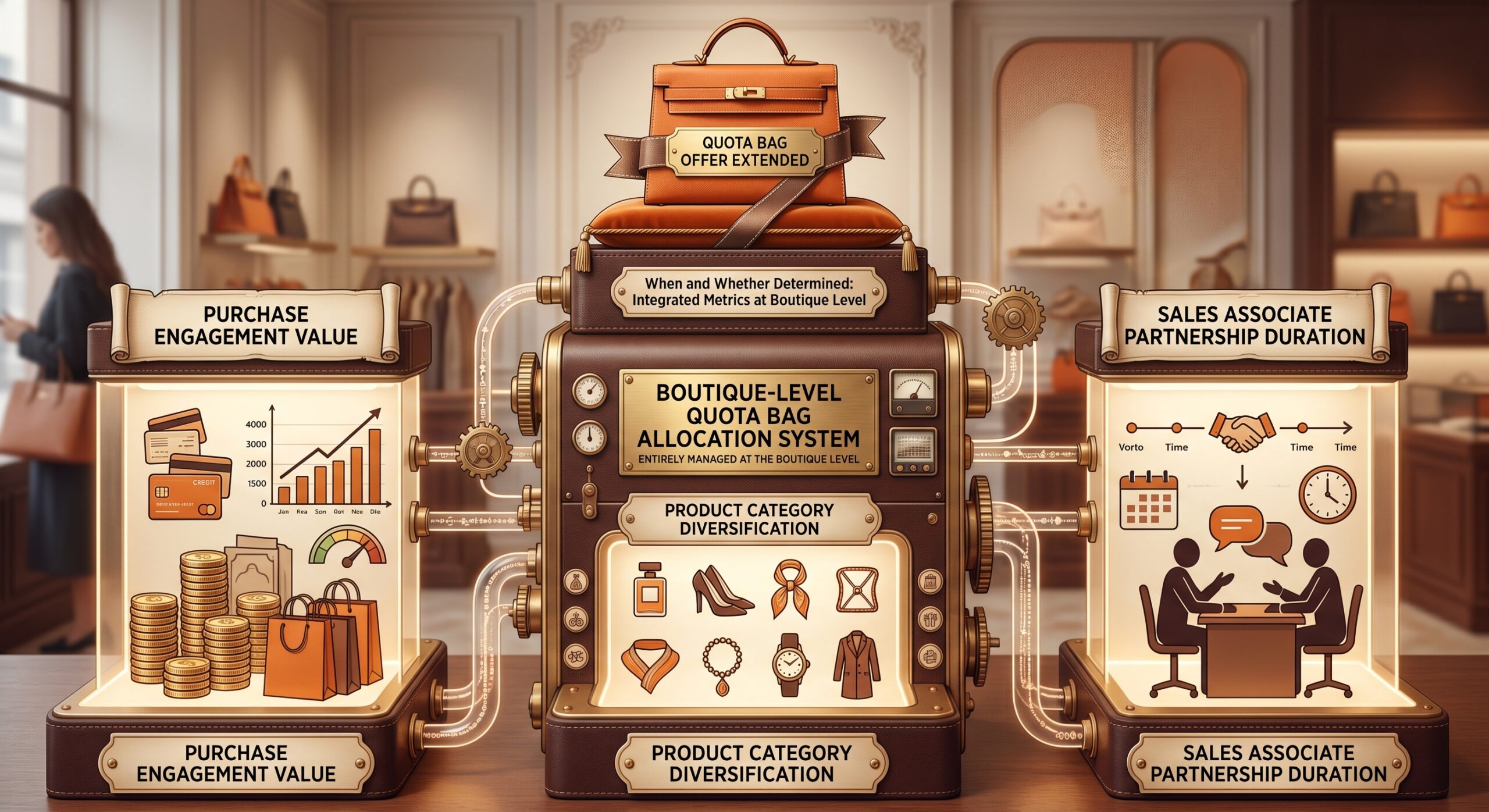
How the Spend Ratio System Actually Works
Hermès does not publish allocation criteria, does not operate an official wait list, and does not guarantee quota bag access to any client regardless of spend history. What the brand does operate is a sophisticated client relationship management system that tracks every purchase by client profile across all global boutiques. Every scarf, belt, piece of homeware, and ready-to-wear item purchased under your name builds a client record that SAs and boutique managers can access when making allocation decisions.
The full mechanics of quota bag access — including the boutique selection strategy that maximises your odds — is covered in the Hermès Iconic Collections hub, but the investment framework for spend ratio requires understanding one critical distinction: purchase history is necessary but not sufficient for an offer. The SA relationship is the activation mechanism. A client with a strong spend history but no consistent SA relationship will be considered; a client with a moderate spend history and a genuine, recognised SA relationship will often be prioritised.
First boutique visits. Introduce yourself to an SA — not aggressively, but memorably. Purchase one or two accessible items: a silk scarf, a small leather good. Register your profile. Express genuine interest in the brand, not specifically in quota bags.
Return to the same boutique, ideally the same SA. Purchase across categories — homeware, ready-to-wear, further leather goods. Visit consistently but not excessively. Begin mentioning quota bag interest naturally in conversation, not as a demand.
Spend history is accumulating. SA recognises you as a consistent, genuine client. Continue purchasing in higher-value categories if budget allows — jewellery, RTW, fine leather goods. Your SA begins to consider you for allocation when inventory becomes available.
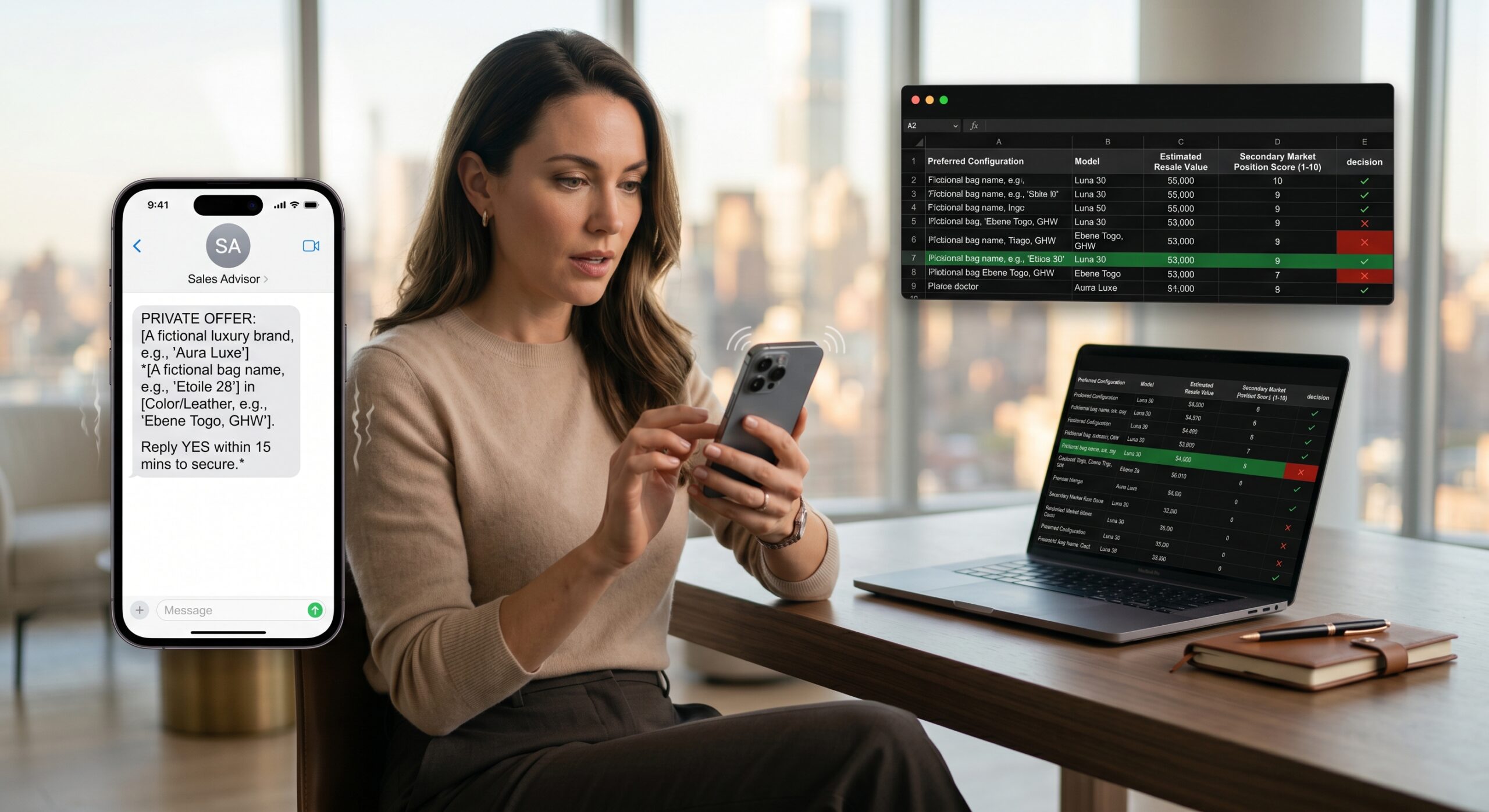
First quota bag offer typically arrives in this window for clients at established boutiques with consistent engagement. Offer may not be in your preferred configuration — evaluate secondary market position before declining. Accept and hold, or accept and plan your resale strategy.
One of the most common strategic errors in spend ratio building is spreading purchases across multiple boutiques. Global spend accumulates to your client profile, but quota bag allocation is managed locally. An SA in New York does not benefit professionally from allocating a quota bag to a client whose spend history is split between Paris, London, and Tokyo — they allocate to clients who have built a relationship with them specifically.
The correct strategy is to identify one primary boutique and one primary SA, direct the majority of your relationship-building spend there, and treat all other boutique visits as supplementary. In cities with multiple Hermès locations, this matters significantly — a client split between two nearby boutiques is building half a relationship at each, not two relationships.
The spend ratio is also not purely backward-looking. An SA who knows a client's preferred quota bag configuration — and who has heard it expressed clearly and once, without repeated pressure — will factor that preference into their allocation decision when the right piece becomes available. Clients who have never expressed a preference get what is available; clients with a known, stated preference get considered when the configuration matches.
Category Weighting: What to Buy and Why
Not all Hermès purchases carry equal weight in the informal spend ratio assessment. While every purchase contributes to your financial history, certain categories signal the kind of genuine, engaged client relationship that SAs are looking for — as opposed to a buyer who is treating the boutique as a quota bag access mechanism.
Small leather goods deserve particular emphasis. Card holders, agenda covers, belt and buckle sets, and keychains all sit within the leather goods category — the same product family as quota bags. An SA who sees consistent leather goods purchases in a client's history is looking at a client who engages with the category genuinely, not one who visits exclusively when they want a Birkin. This category relevance is noted, even if informally, in the allocation consideration.
"The best spend ratio strategy is not a strategy at all — it is genuine engagement with the brand across categories, consistently expressed through a single SA relationship over 18 to 24 months."
Fine jewellery is the highest-efficiency ratio-building category by spend per item. A single jewellery purchase at €3,000–€8,000 builds ratio faster than ten scarf purchases — and signals a level of client investment that SAs and boutique managers register as meaningful. For buyers whose budget allows jewellery engagement, prioritising one or two jewellery pieces within the ratio-building period can significantly compress the timeline to a first quota bag offer.
- Lead with silk and small leather goods in the first three months — these are relationship-building purchases that read as genuine without appearing calculated.
- Add homeware and ready-to-wear in months three to nine — category breadth signals genuine brand engagement to the SA and boutique manager reviewing your client profile.
- Consider one jewellery purchase if your budget supports it — the spend efficiency and signal strength make it the single most ratio-accelerating category available.
- Never purchase non-quota bags (Evelyne, Picotin, Lindy) as ratio-building items — they contribute spend but consume quota bag budget inefficiently and signal price-sensitivity rather than genuine investment intent.
- Keep all receipts and maintain your client profile details — your address, contact information, and purchase history should be accurate and up to date in the Hermès client system at all times.
For buyers considering how the materials used in their non-quota purchases connect to their leather knowledge and SA conversations, the team at Hermès Insights Hub covers the leather tanning and production process in technical depth — understanding this gives you credible talking points with your SA that reinforce genuine brand engagement rather than purchase-driven access seeking.

SA Relationship Mechanics: Beyond the Numbers
The spend ratio is the financial dimension of quota bag acquisition. The SA relationship is the human dimension — and in most boutiques, the human dimension is the deciding factor when two clients with comparable spend histories are both being considered for a limited allocation.
An SA's allocation decision is influenced by factors that no client profile data captures: how reliably a client responds when contacted, whether they have been respectful and patient in previous interactions, whether they have honoured previous commitments (items held, deposits placed, appointments kept), and whether they have recommended the boutique or the SA to other clients. These soft factors are not trivial — they are the relational currency that an SA draws on when advocating internally for a client's allocation.
When a quota bag becomes available for allocation, the SA presents the client to their manager for approval. The SA's internal pitch is essentially: "This client has X purchase history, has been a consistent and respectful presence in the boutique, and is ready to purchase immediately." The manager approves or redirects. An SA who has a strong personal investment in a client relationship — who has enjoyed the interactions and trusts the client to handle the allocation well — will advocate more effectively than one who sees the client as a purchase history on a screen.
This is why the relational dimension matters independently of the financial one. Clients who are difficult, pressuring, or transactional in their boutique interactions may have strong spend histories and still find that offers go elsewhere. The SA's internal advocacy is not guaranteed — it has to be earned.
The practical implications are clear. Visit your primary boutique on a schedule that maintains presence without pressure — roughly once every four to six weeks is a common pattern for relationship-stage buyers. Purchase something at most visits, even if it is a small item. Engage with the SA about products genuinely, ask questions about the range, and express interest in categories beyond quota bags. When you have stated your quota bag preference, state it clearly once and do not repeat it at every visit — an SA who knows what you want does not need to be reminded.
Our dedicated guide on best Hermès boutique locations for walk-in Birkins in 2026 provides location-specific context on which boutiques offer the most accessible allocation environments for newer clients — a factor that should inform which boutique you choose to focus your relationship-building spend. And for the specific mechanics of expressing quota bag interest without triggering the wrong dynamic, our Hermès wish list strategy for new clients covers the insider approach in detail.
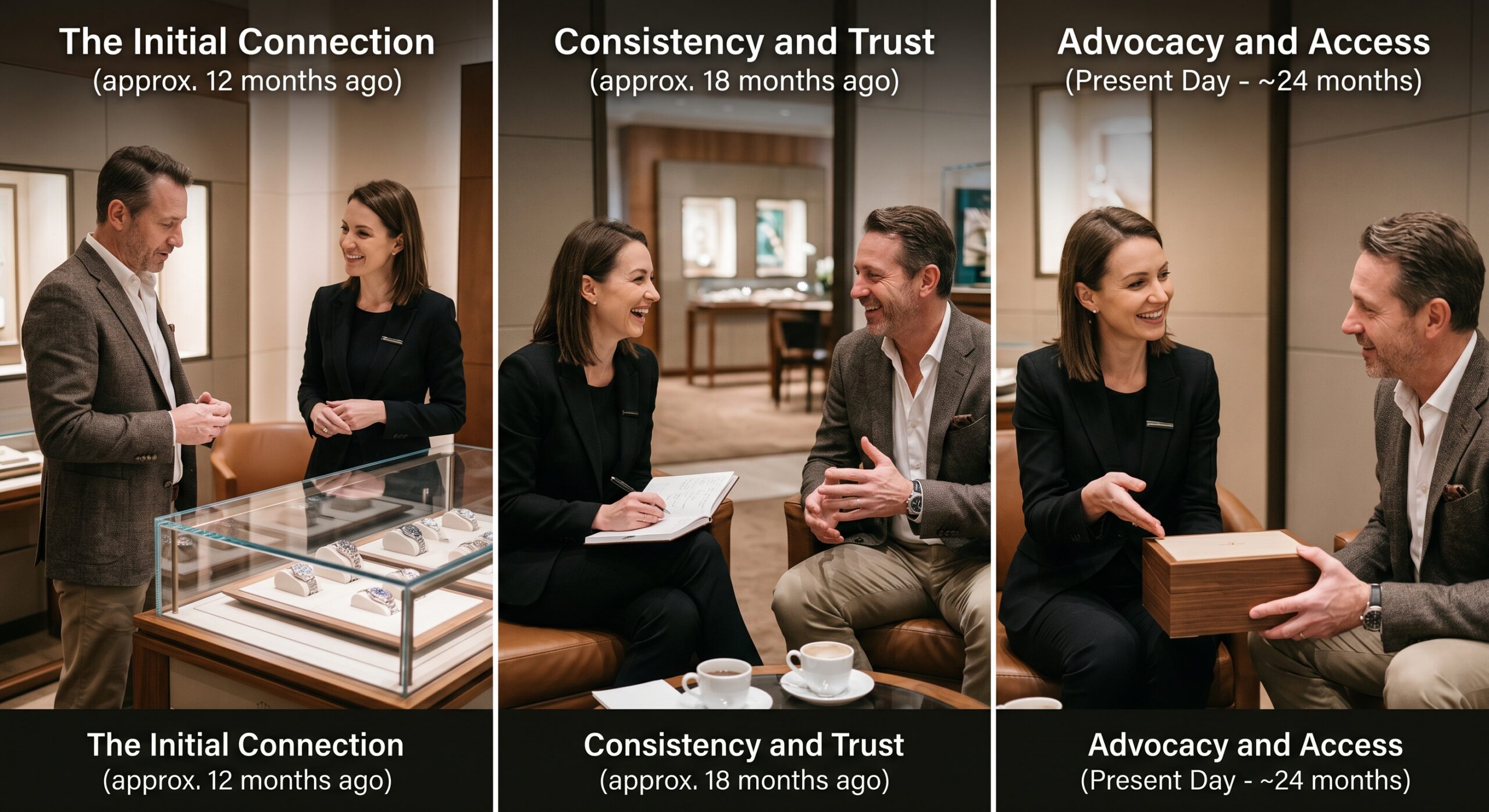
One dynamic that experienced buyers navigate carefully is the boutique transfer. If your primary SA leaves the boutique or is reassigned, your client profile data remains — but the relationship does not. Starting a new SA relationship with an existing spend history is a stronger position than starting from zero, but the relationship-building process must restart. Experienced buyers maintain good relationships with two SAs at their primary boutique where possible, so that a staffing change does not reset their allocation standing entirely.
Building Your 2026 Spend Ratio Strategy
The practical construction of a spend ratio strategy for 2026 requires three decisions: which boutique to focus on, which categories to prioritise within your available budget, and how to structure your visit frequency and SA interaction to build the relational dimension alongside the financial one.
Boutique selection is the most consequential decision. Highly competitive boutiques — Paris flagships, New York Madison Avenue, Beverly Hills, key Asian flagships — have the deepest inventory and the most established client bases. The observed spend ratio threshold at these locations is at the upper end of the range, and the timeline to a first offer for a new client is typically 18–24 months or longer. Less competitive boutiques in secondary markets, smaller US cities, or resort locations may produce first offers in 12–16 months with a comparable spend history, because the client base is smaller and the allocation competition is lower.
- Select your primary boutique based on realistic access — the most prestigious location is not always the most strategically optimal for a new client building their first relationship.
- Establish your SA relationship in the first two visits — introduce yourself, allow the SA to register your profile, and make a genuine initial purchase.
- Visit on a four-to-six week cycle during the relationship-building phase — consistent enough to be remembered, infrequent enough to not create pressure dynamics.
- State your quota bag preference once, clearly and specifically: style, size, leather, hardware, color — then let the SA hold that information without repeated prompting.
- Maintain your client profile accuracy — ensure your contact details, purchase history, and preferences are correctly registered in the Hermès client system.
- Be immediately responsive when your SA contacts you about an available piece — delayed responses to quota bag offers are noted and affect future allocation priority.
- When offered a piece that is not your first preference, evaluate the secondary market position before declining — a quota bag offer in any configuration has financial value that declining unconditionally wastes.
The Paris Lottery — the appointment system at the Paris flagship stores that gives international visitors a chance to purchase a quota bag — operates on different mechanics than the boutique relationship model. Our dedicated guide on Hermès Leather Appointment Paris Lottery tips covers what actually works for international buyers pursuing that specific route. For buyers who want to understand the full secondary market context alongside their boutique strategy, the All Topics archive provides the complete market intelligence framework.
| Strategy Type | Typical Timeline | Spend Efficiency | Offer Probability | Key Risk |
|---|---|---|---|---|
| Focused: 1 boutique, 1 SA, breadth of categories | 12–18 months | High | Strong | SA turnover resets relationship |
| Jewellery-led: high-value purchases at 1 boutique | 10–16 months | Very High | Strong | High upfront capital requirement |
| Scarf-only accumulation at 1 boutique | 24–36+ months | Low | Moderate | Slow ratio build; lower signal strength |
| Multi-boutique spread strategy | 24–36+ months | Very Low | Weak | Builds history but no SA relationship |
| Secondary market only (no boutique) | Immediate access | Very Low (20–40% premium) | Guaranteed (at price) | No retail price-to-resale advantage |
| Paris Lottery (international visitors) | Single trip dependent | High if successful | Low (competitive) | No relationship continuity post-purchase |
| Resort/secondary boutique focus | 12–20 months | Moderate | Higher than flagship | Limited inventory variety |
Timeline and probability estimates reflect observed patterns across major markets. Individual boutique dynamics, inventory availability, and specific SA relationships significantly affect outcomes. All figures approximate.
The Spend Ratio Is Real — But the Relationship Is the Trigger
The observed spend ratio for a first quota bag offer in 2026 is approximately 0.5× to 1.5× the retail value of the desired bag, accumulated over 12 to 24 months at a single boutique with a consistent SA relationship. At competitive flagship boutiques, the upper end of that range is the realistic baseline. At secondary market boutiques with lower client competition, the lower end is achievable in a compressed timeline.
Category selection matters. Small leather goods, ready-to-wear, homeware, and fine jewellery are the highest-signal purchases — they demonstrate genuine brand engagement rather than quota bag access seeking. Silk scarves are the essential entry-point category. Non-quota bags are an inefficient use of ratio-building budget and should not be purchased for this purpose.
The spend ratio is necessary but not sufficient. The SA relationship — built through consistent presence, respectful interaction, clear preference expression, and reliable responsiveness — is the activation mechanism that converts purchase history into an actual offer. Clients who treat the boutique as a transactional access mechanism will find that their spend history is acknowledged but their offers go to clients who have built something more genuine.
Bottom Line: Focus all relationship-building spend at one boutique, one SA, across breadth of categories — the 12–18 month focused strategy with jewellery acceleration is the most spend-efficient path to a first quota bag offer in 2026.
Popular Searches
Explore our most searched Hermès quota bag acquisition and spend ratio questions
Frequently Asked Questions
There is no single published ratio — Hermès does not disclose its internal allocation criteria. Based on observed boutique patterns, buyers at established boutiques in major cities typically require a purchase history of approximately 0.5× to 1.5× the retail value of the quota bag they are seeking, accumulated over 12–24 months of consistent engagement. In highly competitive boutiques (Paris flagship, key US flagships, major Asian locations), observed ratios are at the upper end of this range or higher. The ratio is not purely financial — consistency of visits, breadth of category engagement, and genuine relationship with a specific SA all factor into allocation decisions. For boutique location strategy, see our guide on best Hermès boutique locations for walk-in Birkins in 2026.
All purchases registered under your client profile contribute to your spend history. However, the categories that signal genuine engagement most effectively to an SA are: leather goods (small leather goods, belts, agenda covers), ready-to-wear, fine jewellery, and homeware. Silk scarves are the most accessible entry-point category and are universally understood as relationship-building purchases. Fragrance and beauty products contribute to spend but are seen as lower-engagement signals. The goal is breadth across categories, not concentration in the most affordable items.
No — there is no official Hermès wait list for quota bags. The allocation system is managed entirely at the boutique level by individual SAs and their managers. What buyers experience as a "wait list" is in fact an informal queue maintained within an SA's client relationships — clients who have expressed interest are remembered and considered when allocation becomes available. There is no centralised system, no registration process, and no guaranteed timeline. The relationship with a specific SA at a specific boutique is the entire mechanism. See our Hermès wish list strategy for new clients for the insider approach to expressing quota bag interest effectively.
Spend history is tracked at the client profile level across all Hermès boutiques globally — your purchases at any authorised Hermès location contribute to your overall client record. However, quota bag allocation is managed locally by individual SAs, and the relationship dynamic that determines who receives an offer operates at the boutique and SA level. Spreading spend across many boutiques without building a relationship at any single location is a common strategic error — it builds spend history without building the SA relationship that actually triggers an offer. Focus your relationship-building spend at one or two boutiques maximum.